Jack C. Massey College of Business, Belmont University, 1900 Belmont Boulevard, Nashville, TN, 37212, USA.
Jack C. Massey College of Business, Frist College of Medicine, Belmont University, Nashville, TN, 37212, USA.
Int J Health Econ Manag. 2023 Mar;23(1):1-26. doi: 10.1007/s10754-022-09336-7. Epub 2022 Jul 6.
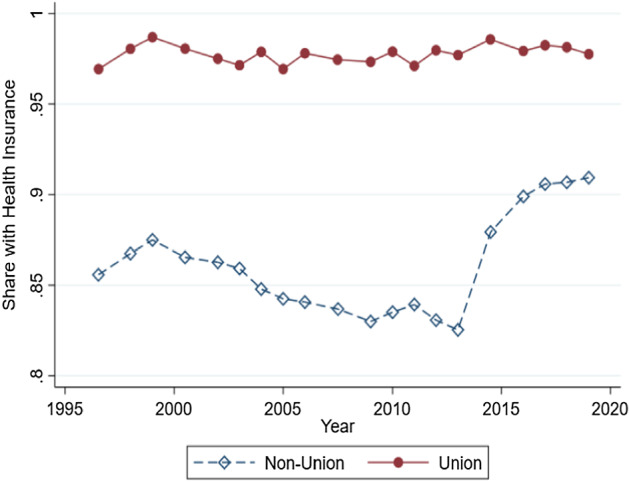
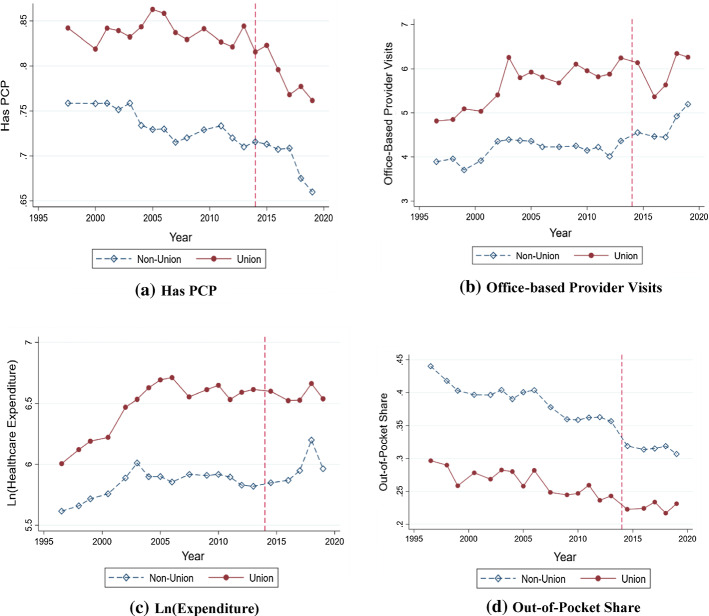
We describe a "union advantage" in health insurance coverage and access to care. Using multiple statistical models and data from the Medical Expenditure Panel Survey for 1996-2019, we show that-compared to non-union workers-union workers are more likely to have health insurance coverage (98% vs. 86%), more likely to have a regular care provider (83% vs. 74%), visited office-based providers 31% more often (5.64 vs. 4.27 visits), spend $832 more on healthcare annually, and pay a lower share of their expenditures out-of-pocket (26% vs. 37%). When we control for demographic characteristics across variety of specifications, these differences almost always remain at a statistically significant level. Further, we show that the union advantage is greater for low-income workers. Next, we demonstrate that-although the Affordable Care Act (ACA) appears to have reduced the union advantage in health insurance coverage by increasing coverage rates among non-union workers-a substantial union advantage in access to care remains after the ACA's main provisions become effective. Finally, we explore how the ACA interacted with the trade union goal of maintaining employer-based health insurance. We show that unionized workers are less likely to contribute to "enrollment shifting," which occurs when individuals shift from existing employer-based insurance to a new government funded program. This suggests that union bargaining over fringe benefits may have positive externalities in the form of cost reductions to the public sector.
我们描述了医疗保险覆盖范围和获得医疗服务方面的“工会优势”。利用来自 1996 年至 2019 年的医疗支出面板调查的多个统计模型和数据,我们表明与非工会工人相比,工会工人更有可能拥有医疗保险覆盖(98%比 86%),更有可能有常规医疗服务提供者(83%比 74%),更频繁地去看诊(31%比 27%),每年在医疗保健上的花费多 832 美元,自付支出占比低 26%(比 37%)。在各种规范中控制人口特征后,这些差异几乎总是保持在统计学显著水平。此外,我们表明,这种工会优势在低收入工人中更大。接下来,我们证明,尽管《平价医疗法案》(ACA)似乎通过提高非工会工人的保险覆盖率而降低了医疗保险覆盖范围的工会优势,但在 ACA 的主要条款生效后,在获得医疗服务方面仍然存在着实质性的工会优势。最后,我们探讨了 ACA 如何与工会维持雇主提供的医疗保险的目标相互作用。我们发现,工会工人不太可能参与“登记转移”,即个人从现有的雇主提供的保险转移到新的政府资助计划。这表明,工会就额外福利进行谈判可能会对公共部门产生降低成本的积极外部性。