Jiang Shanshan, Li Xiaoxiao, Wang Ling, Lin Tingting, Qin Tao
Department of Neonatal, The First People's Hospital of Wenling, Wenling 317500, Zhejiang, China.
Evid Based Complement Alternat Med. 2022 Jun 27;2022:1659860. doi: 10.1155/2022/1659860. eCollection 2022.
To explore the influencing factors of severe hyperbilirubinemia in neonates complicated with acute bilirubin encephalopathy (ABE) and then build relevant prediction models and evaluate the prediction performance of the models.
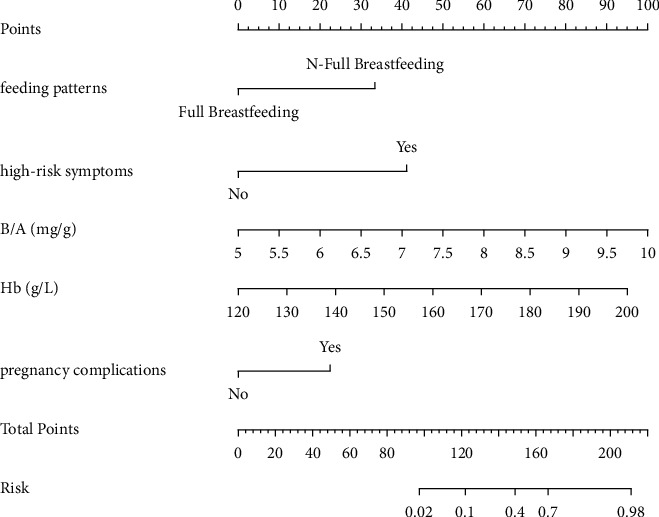
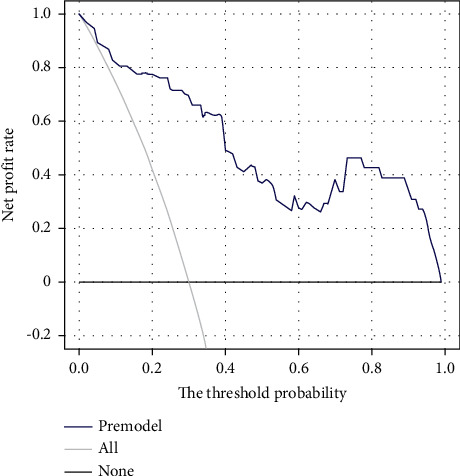
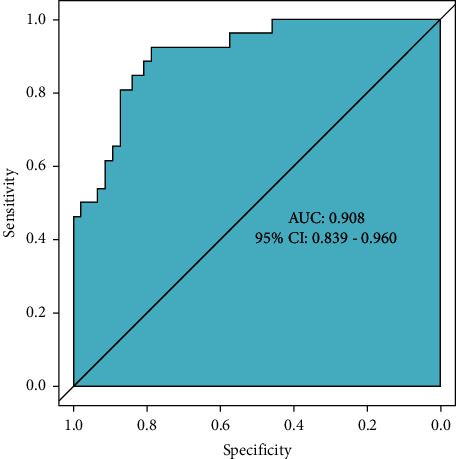
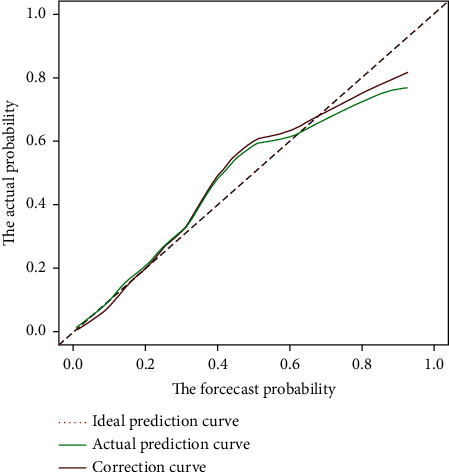
The data of 120 neonates with severe hyperbilirubinemia were collected by retrospective analysis. Univariate and multivariate analysis methods were used to analyze the data of 120 children. R software was used to visualize the results of multivariate analysis, and a nomogram model was obtained. The receiver operating characteristic curve (ROC), calibration curve, and decision-making curve (DC) were used to evaluate the discrimination, accuracy, and clinical net profit rate of the model.
Multivariate analysis showed that nonfull breastfeeding, high-risk symptoms, and pregnancy complications were independent risk factors for ABE in neonates with severe hyperbilirubinemia. At the same time, the risk of ABE in neonates with severe hyperbilirubinemia increased with the increase of B/A and Hb levels. The ROC curve showed that the area under the curve for the model was 0.908 (95% CI: 0.839-0.960). The calibration curve shows that the actual prediction curve of the model is in good agreement with the corrected prediction curve. Using the cutoff value of the ROC curve as the diagnostic criterion, the threshold probability of the model was calculated to be 38%. The decision curve shows that when 38% is used as the basis for judging whether to take measures to intervene, the profit rate is 61%.
The occurrence of ABE in neonates with severe hyperbilirubinemia is affected by many factors, and there is a certain degree of interaction between these factors. Combining multiple factors to construct a risk nomogram model can provide a reference for early clinical detection of high-risk neonates.
探讨新生儿重度高胆红素血症合并急性胆红素脑病(ABE)的影响因素,构建相关预测模型并评估模型的预测性能。
采用回顾性分析方法收集120例重度高胆红素血症新生儿的数据。运用单因素和多因素分析方法对120例患儿的数据进行分析。使用R软件对多因素分析结果进行可视化处理,得到列线图模型。采用受试者工作特征曲线(ROC)、校准曲线和决策曲线(DC)评估模型的区分度、准确性和临床净收益率。
多因素分析显示,非纯母乳喂养、高危症状和妊娠并发症是重度高胆红素血症新生儿发生ABE的独立危险因素。同时,重度高胆红素血症新生儿发生ABE的风险随B/A和Hb水平的升高而增加。ROC曲线显示,模型的曲线下面积为0.908(95%CI:0.839 - 0.960)。校准曲线显示,模型的实际预测曲线与校正后的预测曲线吻合良好。以ROC曲线的截断值作为诊断标准,计算出模型的阈值概率为38%。决策曲线显示,以38%作为判断是否采取措施进行干预的依据时,收益率为61%。
重度高胆红素血症新生儿发生ABE受多种因素影响,且这些因素之间存在一定程度的相互作用。综合多个因素构建风险列线图模型可为临床早期筛查高危新生儿提供参考。