Chang Hesheng, Zheng Jing, Ju Jun, Huang Shuxia, Yang Xue, Tian Runyu, Liu Zunjie, Liu Gaifen, Qin Xuanguang
Department of Pediatrics, Beijing Chaoyang Hospital, Capital Medical University, Beijing, China.
Department of Neonatology, Beijing Obstetrics and Gynecology Hospital, Capital Medical University, Beijing, China.
Transl Pediatr. 2021 Mar;10(3):647-656. doi: 10.21037/tp-21-35.
To establish a clinical prediction model of acute bilirubin encephalopathy (ABE) using amplitude-integrated electroencephalography (aEEG).
A total of 114 neonatal hyperbilirubinemia patients in the Beijing Chaoyang Hospital from August 2015 to October 2018 were enrolled in this study. There were 62 (54.38%) males, and the age of patients undergoing aEEG examination was 2-23 days, with an average of 7.61±4.08 days. Participant clinical information, peak bilirubin value, albumin value, hyperbilirubinemia, and the graphic indicators of aEEG were extracted from medical records, and ABE was diagnosed according to a bilirubin-induced neurological dysfunction (BIND) score >0. Multivariable logistic regression was used to establish a clinical prediction model of ABE. Furthermore, decision curve analysis (DCA) was performed to evaluate the model's predictive value.
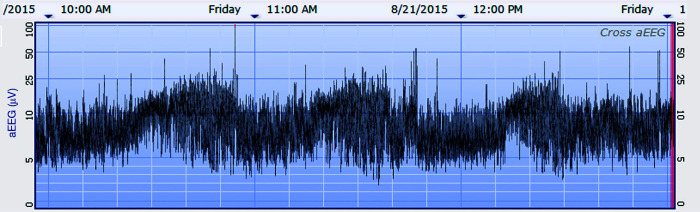
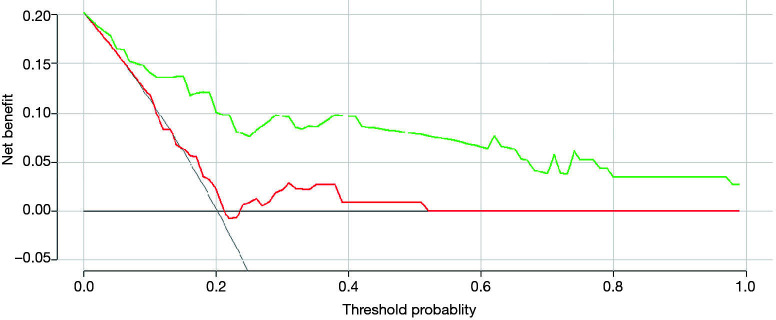
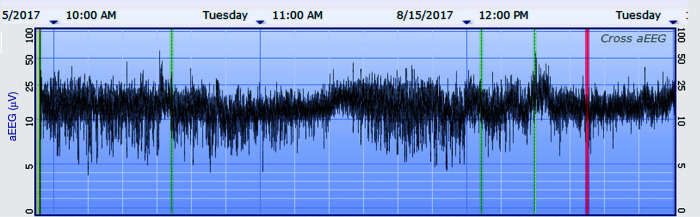
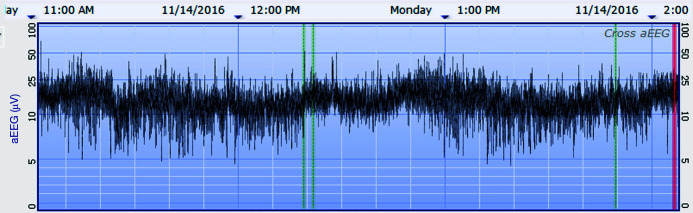
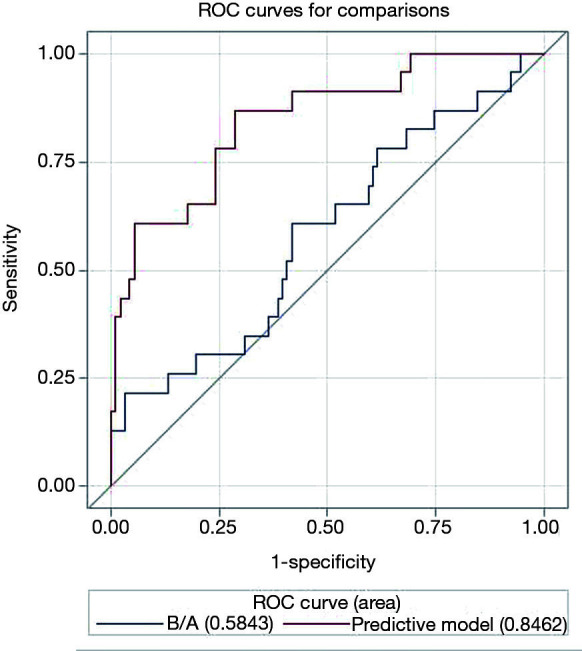
According to the BIND score, there were a total of 23 (20.18%) ABE cases. The multivariable logistic regression analysis showed that the value of bilirubin/albumin (B/A), presence of hyperbilirubinemia risk factors, number of sleep-wake cycling (SWC) within 3 hours, widest bandwidth, duration of SWC, and type of SWC were significantly associated with ABE. A clinical prediction model was developed as: p=ex/ (1+ex), X=0.278+0.713B/A+2.602with risk factors (with risk factors equals 1) - 1.500SWC number within 3 hours + 0.219the widest bandwidth-0.065the duration of one SWC + 1.491 SWC (mature SWC equals 0, immature SWC equals 1). The area under the curve (AUC) was 0.85 [95% confidence interval (CI): 0.75-0.94], which was significantly higher than the AUC only based on conventional clinical information of B/A (AUC: 0.58, 95% CI: 0.45-0.72). The DCA also showed good predictive ability compared to B/A.
A clinical prediction model can be established based on the patients' B/A, presence of risk factors for hyperbilirubinemia, number of SWC within 3 hours, widest bandwidth, duration of 1 SWC, and the type of SWC. It has good predictive ability and may improve the diagnostic accuracy of ABE.
使用振幅整合脑电图(aEEG)建立急性胆红素脑病(ABE)的临床预测模型。
选取2015年8月至2018年10月在北京朝阳医院就诊的114例新生儿高胆红素血症患者纳入本研究。其中男性62例(54.38%),接受aEEG检查患者的年龄为2 - 23天,平均为7.61±4.08天。从病历中提取参与者的临床信息、胆红素峰值、白蛋白值、高胆红素血症情况以及aEEG的图形指标,并根据胆红素诱导的神经功能障碍(BIND)评分>0诊断ABE。采用多变量逻辑回归建立ABE的临床预测模型。此外,进行决策曲线分析(DCA)以评估该模型的预测价值。
根据BIND评分,共有23例(20.18%)ABE病例。多变量逻辑回归分析显示,胆红素/白蛋白(B/A)值、高胆红素血症危险因素的存在、3小时内睡眠 - 觉醒周期(SWC)数量、最宽带宽、SWC持续时间以及SWC类型与ABE显著相关。建立的临床预测模型为:p = ex / (1 + ex),X = 0.278 + 0.713 * B/A + 2.602 * 有危险因素(有危险因素等于1) -1.500 * 3小时内SWC数量 + 0.219 * 最宽带宽 - 0.065 * 一个SWC的持续时间 + 1.491 * SWC(成熟SWC等于0,未成熟SWC等于1)。曲线下面积(AUC)为0.85 [95%置信区间(CI):0.75 - 0.94],显著高于仅基于B/A常规临床信息的AUC(AUC:0.58,95% CI:0.45 - 0.72)。DCA也显示出与B/A相比具有良好的预测能力。
可基于患者的B/A、高胆红素血症危险因素的存在、3小时内SWC数量、最宽带宽、1个SWC的持续时间以及SWC类型建立临床预测模型。它具有良好的预测能力,可能提高ABE的诊断准确性。