Hussain Naushair, Das Deea, Pramanik Atreyi, Pandey Manoj K, Joshi Vivek, Pramanik Kartick C
Department of Biomedical Sciences, Kentucky College of Osteopathic Medicine, University of Pikeville, Pikeville, KY 41501, USA.
Department of Education, South College, Knoxville, TN 37902, USA.
Cancer Drug Resist. 2022 Apr 3;5(2):317-327. doi: 10.20517/cdr.2021.150. eCollection 2022.
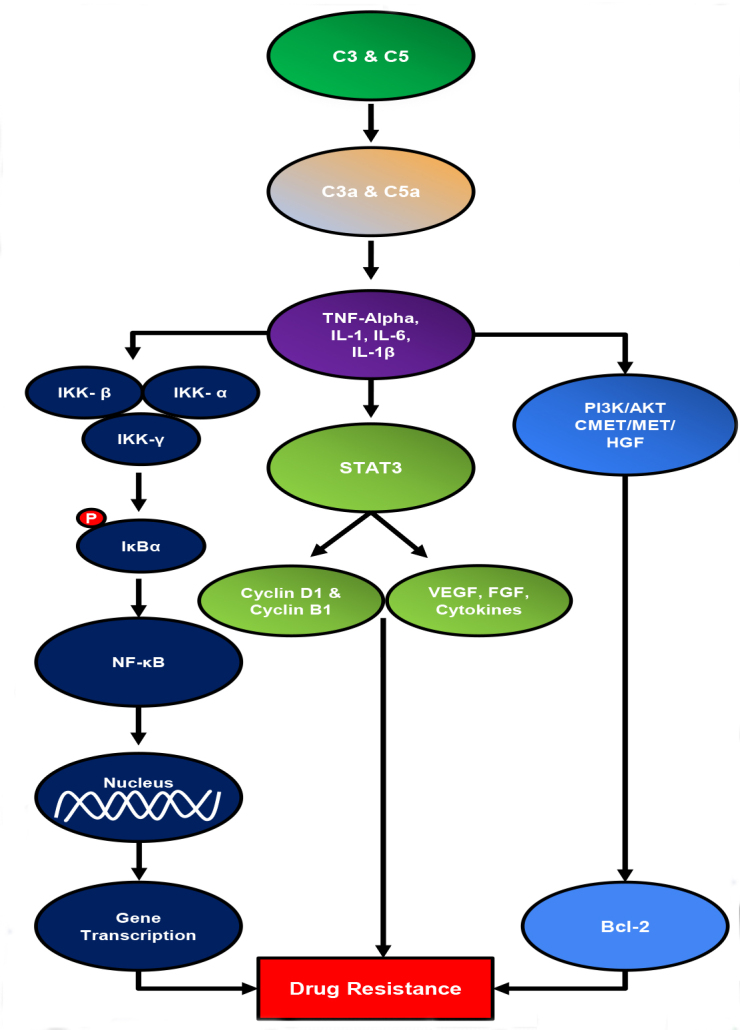
Pancreatic cancer is ranked as the fourth leading cause of cancer-related mortality and is predicted to become the second leading cause of cancer-related death by 2030. The cause of this high mortality rate is due to pancreatic ductal adenocarcinoma's rapid progression and metastasis, and development of drug resistance. Today, cancer immunotherapy is becoming a strong candidate to not only treat various cancers but also to combat against chemoresistance. Studies have suggested that complement system pathways play an important role in cancer progression and chemoresistance, especially in pancreatic cancer. A recent report also suggested that several signaling pathways play an important role in causing chemoresistance in pancreatic cancer, major ones including nuclear factor kappa B, signal transducer and activator of transcription 3, c-mesenchymal-epithelial transition factor, and phosphoinositide-3-kinase/protein kinase B. In addition, it has also been proven that the complement system has a very active role in establishing the tumor microenvironment, which would aid in promoting tumorigenesis, progression, metastasis, and recurrence. Interestingly, it has been shown that the downstream products of the complement system directly upregulate inflammatory mediators, which in turn activate these chemo-resistant pathways. Therefore, targeting complement pathways could be an innovative approach to combat against pancreatic cancer drugs resistance. In this review, we have discussed the role of complement system pathways in pancreatic cancer drug resistance and a special focus on the complement as a therapeutic target in pancreatic cancer.
胰腺癌是癌症相关死亡的第四大主要原因,预计到2030年将成为癌症相关死亡的第二大主要原因。这种高死亡率的原因是胰腺导管腺癌的快速进展和转移以及耐药性的产生。如今,癌症免疫疗法不仅正成为治疗各种癌症的有力候选方法,而且还能对抗化疗耐药性。研究表明,补体系统通路在癌症进展和化疗耐药性中起重要作用,尤其是在胰腺癌中。最近的一份报告还表明,几种信号通路在胰腺癌化疗耐药性的产生中起重要作用,主要包括核因子κB、信号转导和转录激活因子3、c-间充质-上皮转化因子以及磷脂酰肌醇-3-激酶/蛋白激酶B。此外,还已证明补体系统在建立肿瘤微环境中具有非常活跃的作用,这将有助于促进肿瘤发生、进展、转移和复发。有趣的是,已表明补体系统的下游产物直接上调炎症介质,进而激活这些化疗耐药通路。因此,靶向补体通路可能是对抗胰腺癌耐药性的一种创新方法。在本综述中,我们讨论了补体系统通路在胰腺癌耐药性中的作用,并特别关注补体作为胰腺癌治疗靶点的情况。