Laureate Institute for Brain Research, Tulsa, OK 74136, USA.
Oxley School of Community Medicine, University of Tulsa, Tulsa, OK 74119, USA.
Soc Cogn Affect Neurosci. 2023 Feb 23;18(1). doi: 10.1093/scan/nsac045.
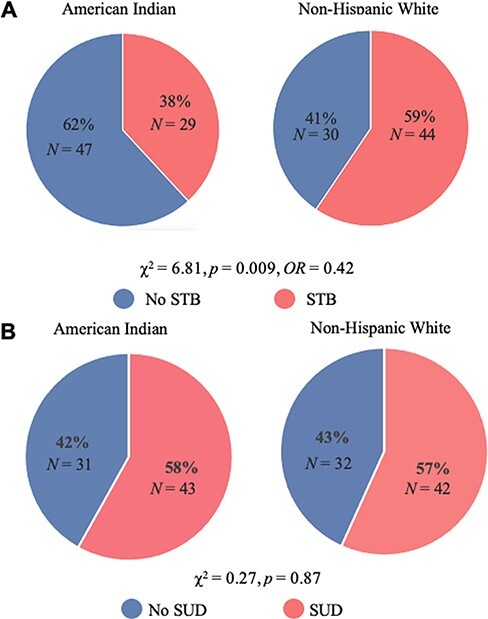
American Indians (AI) experience disproportionately high prevalence of suicide and substance use disorders (SUD). However, accounting for risk burden (e.g. historical trauma and discrimination), the likelihood of mental health disorders or SUD is similar or decreased compared with the broader population. Such findings have spurred psychological research examining the protective factors, but no studies have investigated its potential neural mechanisms. Inhibitory control is one of the potential neurobehavioral construct with demonstrated protective effects, but has not been examined in neuroimaging studies with AI populations specifically. We examined the incidence of suicidal thoughts and behaviors (STB) and SUD among AI (n = 76) and propensity matched (sex, age, income, IQ proxy and trauma exposure) non-Hispanic White (NHW) participants (n = 76). Among the AI sample, functional magnetic resonance imaging (fMRI) data recorded during the stop-signal task (SST) was examined in relation to STB and SUDs. AIs relative to NHW subjects displayed lower incidence of STB. AIs with no reported STBs showed greater activity in executive control regions during the SST compared with AI who endorsed STB. AI without SUD demonstrated lower activity relative to those individual reporting SUD. Results are consistent with a growing body of literature demonstrating the high level of risk burden driving disparate prevalence of mental health concerns in AI. Furthermore, differential activation during inhibitory control processing in AI individuals without STB may represent a neural mechanism of protective effects against mental health problems in AI. Future research is needed to elucidate sociocultural factors contributing protection against mental health outcomes in AIs and further delineate neural mechanisms with respect to specific concerns (e.g. SUD vs STB).
美国印第安人(AI)的自杀和物质使用障碍(SUD)患病率过高。然而,考虑到风险负担(例如历史创伤和歧视),与更广泛的人群相比,精神健康障碍或 SUD 的可能性相似或降低。这些发现促使人们进行心理研究,以探讨保护因素,但尚无研究调查其潜在的神经机制。抑制控制是具有保护作用的潜在神经行为结构之一,但尚未在针对 AI 人群的神经影像学研究中进行检查。我们检查了 AI(n=76)和倾向匹配(性别、年龄、收入、智商代理和创伤暴露)的非西班牙裔白人(NHW)参与者(n=76)中的自杀念头和行为(STB)和 SUD 的发生率。在 AI 样本中,检查了在停止信号任务(SST)期间记录的功能磁共振成像(fMRI)数据与 STB 和 SUD 的关系。与 NHW 受试者相比,AI 显示出较低的 STB 发生率。与报告 STB 的 AI 相比,没有报告 STB 的 AI 在 SST 期间执行控制区域的活动更高。与报告 SUD 的个体相比,没有 SUD 的 AI 的活动较低。结果与越来越多的文献一致,这些文献表明,高风险负担导致 AI 中精神健康问题的患病率存在差异。此外,在没有 STB 的 AI 个体中,抑制控制处理过程中的差异激活可能代表 AI 中针对精神健康问题的保护作用的神经机制。需要进一步的研究来阐明导致 AI 中精神健康结果保护的社会文化因素,并进一步阐明与特定问题(例如 SUD 与 STB)相关的神经机制。