Liu Yan-Wen, Kuo Chuan-Wei, Chang Ting-Chang, Hung Yu-Chiang, Tan Yung-Fang, Wu Chia-Chuan, Lin Chien-Hung, Chen Wen-Chung, Hu Wen-Long, Tsai Tsung-Ming
Department of Chinese Medicine, Kaohsiung Chang Gung Memorial Hospital, 123 Dapi Road, Kaohsiung, 83301, Taiwan.
Department of Materials and Optoelectronic Science, National Sun Yat-Sen University, 70 Lienhai Rd., Kaohsiung, 80424, Taiwan.
Nanoscale Res Lett. 2022 Jul 8;17(1):64. doi: 10.1186/s11671-022-03694-4.
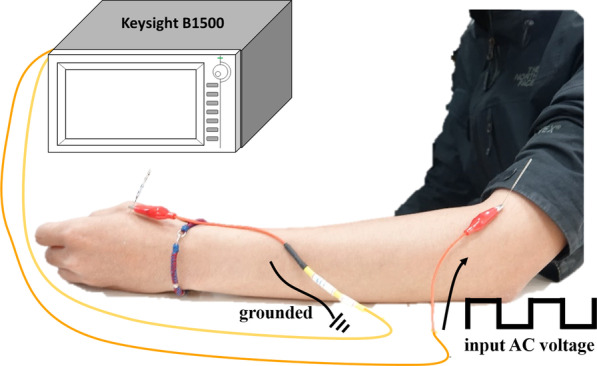
Meridians constitute the theoretical foundation of acupuncture in traditional Chinese medicine (TCM), and they have been described for 2000 years. Classical TCM advocates for the directionality of meridians. Finding an accurate method to verify this directionality is an important goal of TCM doctors and researchers. In this study, we objectively explored the physical properties of meridians, such as response current from electrical stimulation, to explore their directionality. The Agilent B1500A semiconductor measurement analyzer was utilized to input the alternating current waveforms and detect the response current on the meridians. The results showed that the direction of the meridians influences the intensity of the response current. Therefore, the mechanisms behind the directions of ion transportation and the meridians were investigated using the response time and the intensity of the response current. Thereafter, we propose a model to explain this mechanism. Afterward, a comparison between the direction of the meridian in this experiment and ancient Chinese medicine classics was performed.
经络构成了中医针灸的理论基础,且已有2000年的描述历史。古典中医主张经络具有方向性。找到一种准确的方法来验证这种方向性是中医医生和研究人员的一个重要目标。在本研究中,我们客观地探究了经络的物理特性,如电刺激产生的响应电流,以探索其方向性。利用安捷伦B1500A半导体测量分析仪输入交流波形并检测经络上的响应电流。结果表明,经络的方向会影响响应电流的强度。因此,利用响应时间和响应电流强度研究了离子运输方向和经络背后的机制。此后,我们提出了一个模型来解释这一机制。随后,将本实验中经络的方向与中国古代医学经典进行了比较。