The University of Texas MD Anderson Cancer Center, Houston, TX, USA.
Yonsei Cancer Center, Yonsei University College of Medicine, Yonsei University Health System, Seoul, South Korea.
Invest New Drugs. 2022 Oct;40(5):1001-1010. doi: 10.1007/s10637-022-01277-9. Epub 2022 Jul 8.
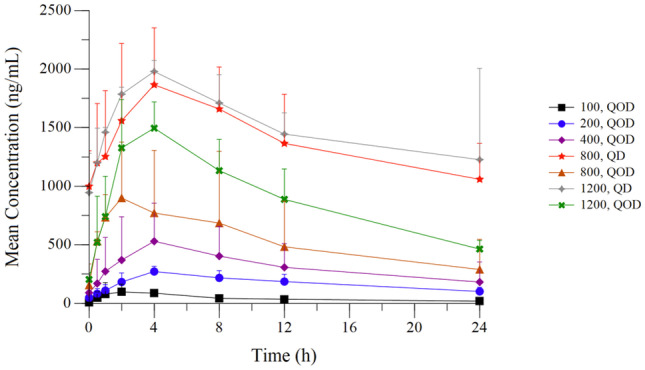
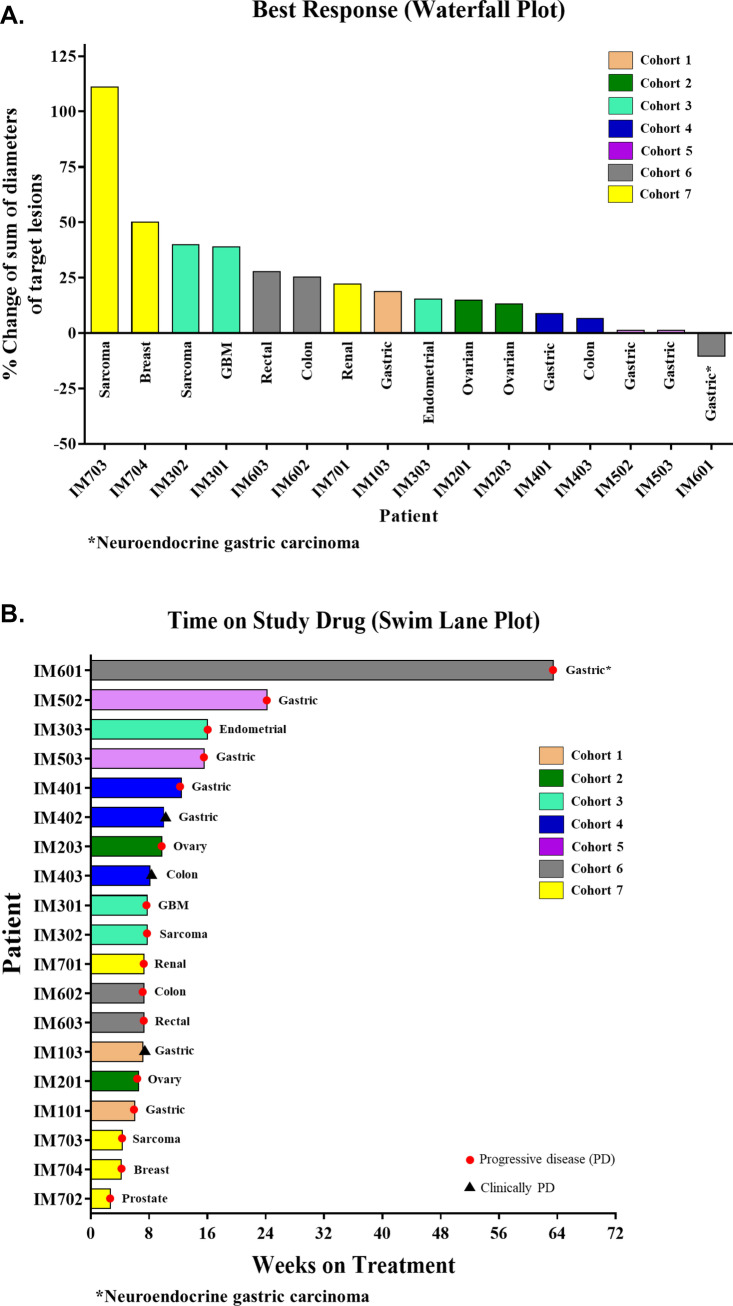
Preclinical models suggest anticancer activity of IM156, a novel biguanide mitochondrial protein complex 1 inhibitor of oxidative phosphorylation (OXPHOS). This first-in-human dose-escalation study enrolled patients with refractory advanced solid tumors to determine the maximum tolerated dose (MTD) or recommended phase 2 dose (RP2D). Eligible patients received oral IM156 every other day (QOD) or daily (QD) and were assessed for safety, dose-limiting toxicities (DLTs), pharmacokinetics, and preliminary signals of efficacy. 22 patients with advanced cancers (gastric, n = 8; colorectal, n = 3; ovarian, n = 3; other, n = 8) received IM156 100 to 1,200 mg either QOD or QD. There were no DLTs. However, 1,200 mg QD was not well tolerated due to nausea; 800 mg QD was determined as the RP2D. The most frequent treatment-related AEs (TRAEs) were nausea (n = 15; 68%), diarrhea (n = 10; 46%), emesis (n = 9; 41%), fatigue (n = 4; 18%) and abdominal pain, constipation, and blood lactate increased (n = 2 each; 9%). Grade 3 nausea (n = 3; 14%) was the only grade ≥ 3 TRAE. Plasma exposures increased dose proportionally; mean Day 27 area under the curve (AUC) values were higher following QD administration compared to the respective QOD regimen. Stable disease (SD), observed in 7 (32%) patients (confirmed in 2 [9%]), was the best response. To our knowledge, this is the first phase 1 study of an OXPHOS inhibitor that established a RP2D for further clinical development in cancer. Observed AEs of IM156 were manageable and SD was the best response.
临床前模型表明,IM156 具有抗癌活性,这是一种新型的双胍类线粒体蛋白复合物 1 抑制剂,可抑制氧化磷酸化 (OXPHOS)。这项首次人体剂量递增研究招募了难治性晚期实体瘤患者,以确定最大耐受剂量 (MTD) 或推荐的 2 期剂量 (RP2D)。符合条件的患者每天或隔天接受口服 IM156 治疗,并评估安全性、剂量限制毒性 (DLT)、药代动力学和初步疗效信号。22 名晚期癌症患者(胃癌,n=8;结直肠癌,n=3;卵巢癌,n=3;其他,n=8)接受 IM156 100 至 1200mg,每天或隔天一次。无 DLT。然而,由于恶心,1200mg 每天一次的剂量不耐受;800mg 每天一次的剂量确定为 RP2D。最常见的治疗相关不良事件 (TRAEs) 是恶心 (n=15;68%)、腹泻 (n=10;46%)、呕吐 (n=9;41%)、疲劳 (n=4;18%) 和腹痛、便秘和血乳酸升高 (n=2;9%)。只有 3 名 (14%) 患者出现 3 级恶心,为唯一的 3 级 TRAE。血浆暴露量与剂量成比例增加;与各自的 QOD 方案相比,QD 给药后第 27 天的平均 AUC 值更高。稳定的疾病 (SD),在 7 名 (32%) 患者中观察到(2 名患者[9%]确认),是最佳反应。据我们所知,这是第一项 OXPHOS 抑制剂的 1 期研究,为癌症的进一步临床开发确定了 RP2D。观察到的 IM156 的不良反应是可管理的,SD 是最佳反应。