Centro de Investigação em Saúde de Manhiça (CISM), Bairro Cambeve, Rua 12, Distrito da Manhiça, CP 1929, Maputo, Mozambique.
ISGlobal, Hospital Clínic, Universitat de Barcelona, Barcelona, Spain.
BMC Public Health. 2022 Jul 8;22(1):1312. doi: 10.1186/s12889-022-13543-9.
The World Health Organization (WHO) risk assessment algorithm for vertical transmission of HIV (VT) assumes the availability of maternal viral load (VL) result at delivery and early viral control 4 weeks after initiating antiretroviral treatment (ART). However, in many low-and-middle-income countries, VL is often unavailable and mothers' ART adherence may be suboptimal. We evaluate the inclusion of the mothers' self-reported adherence into the established WHO-algorithm to identify infants eligible for enhanced post-natal prophylaxis when mothers' VL result is not available at delivery.
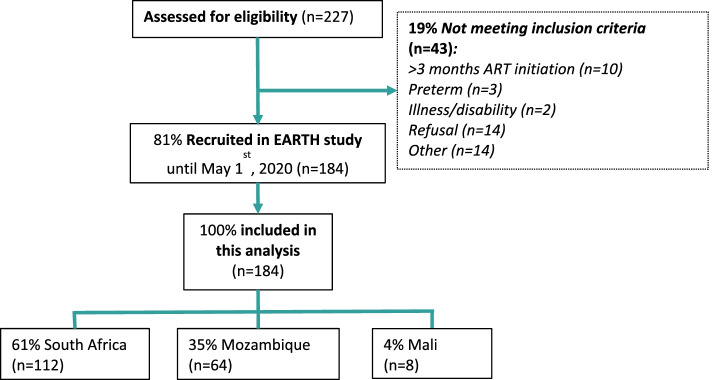
We used data from infants with perinatal HIV infection and their mothers enrolled from May-2018 to May-2020 in Mozambique, South Africa, and Mali. We retrospectively compared the performance of the WHO-algorithm with a modified algorithm which included mothers' adherence as an additional factor. Infants were considered at high risk if born from mothers without a VL result in the 4 weeks before delivery and with adherence <90%.
At delivery, 143/184(78%) women with HIV knew their status and were on ART. Only 17(12%) obtained a VL result within 4 weeks before delivery, and 13/17(76%) of them had VL ≥1000 copies/ml. From 126 women on ART without a recent VL result, 99(79%) had been on ART for over 4 weeks. 45/99(45%) women reported suboptimal (< 90%) adherence. A total of 81/184(44%) infants were classified as high risk of VT as per the WHO-algorithm. The modified algorithm including self-adherence disclosure identified 126/184(68%) high risk infants.
In the absence of a VL result, mothers' self-reported adherence at delivery increases the number of identified infants eligible to receive enhanced post-natal prophylaxis.
世界卫生组织(WHO)的艾滋病毒垂直传播(VT)风险评估算法假设在分娩时可获得母体病毒载量(VL)结果,并在开始抗逆转录病毒治疗(ART)后 4 周内实现早期病毒控制。然而,在许多中低收入国家,VL 通常无法获得,并且母亲的 ART 依从性可能不理想。我们评估将母亲自我报告的依从性纳入既定的 WHO 算法中,以在分娩时无法获得母亲 VL 结果的情况下确定有资格接受强化产后预防的婴儿。
我们使用了 2018 年 5 月至 2020 年 5 月期间在莫桑比克、南非和马里入组的患有围产期 HIV 感染的婴儿及其母亲的数据。我们回顾性地比较了 WHO 算法与包含母亲依从性作为附加因素的改良算法的性能。如果婴儿的母亲在分娩前 4 周内没有 VL 结果且依从性<90%,则认为婴儿具有高 VT 风险。
在分娩时,184 名 HIV 阳性母亲中有 143 名(78%)知晓其状况并正在接受 ART。只有 17 名(12%)在分娩前 4 周内获得了 VL 结果,其中 13 名(76%)的 VL≥1000 拷贝/ml。在 126 名未进行近期 VL 检测的接受 ART 的母亲中,99 名(79%)已接受 ART 超过 4 周。99 名妇女中有 45 名(79%)报告依从性不理想(<90%)。根据 WHO 算法,共有 81 名(44%)婴儿被归类为 VT 高风险。包括自我报告的依从性披露在内的改良算法确定了 184 名婴儿中有 126 名(68%)为高风险婴儿。
在缺乏 VL 结果的情况下,母亲在分娩时自我报告的依从性增加了可接受强化产后预防的婴儿数量。