Lindgaard Sidsel C, Maag Emil, Sztupinszki Zsófia, Chen Inna M, Johansen Astrid Z, Jensen Benny V, Bojesen Stig E, Nielsen Dorte L, Szallasi Zoltan, Johansen Julia S
Department of Oncology, Copenhagen University Hospital-Herlev and Gentofte, DK-2730 Herlev, Denmark.
BioXpedia, DK-8200 Aarhus N, Denmark.
Cancers (Basel). 2022 Jul 1;14(13):3250. doi: 10.3390/cancers14133250.
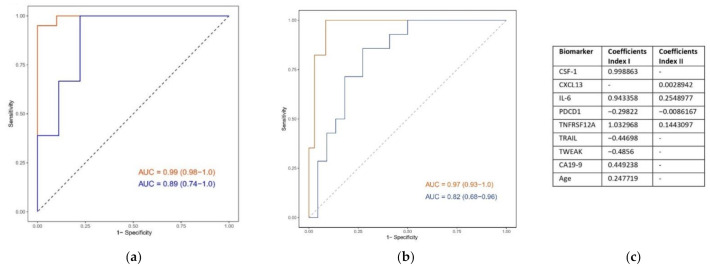
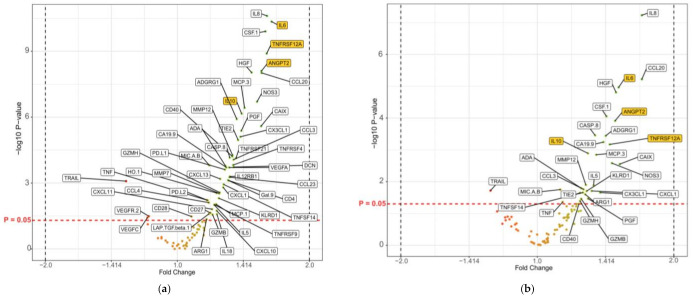
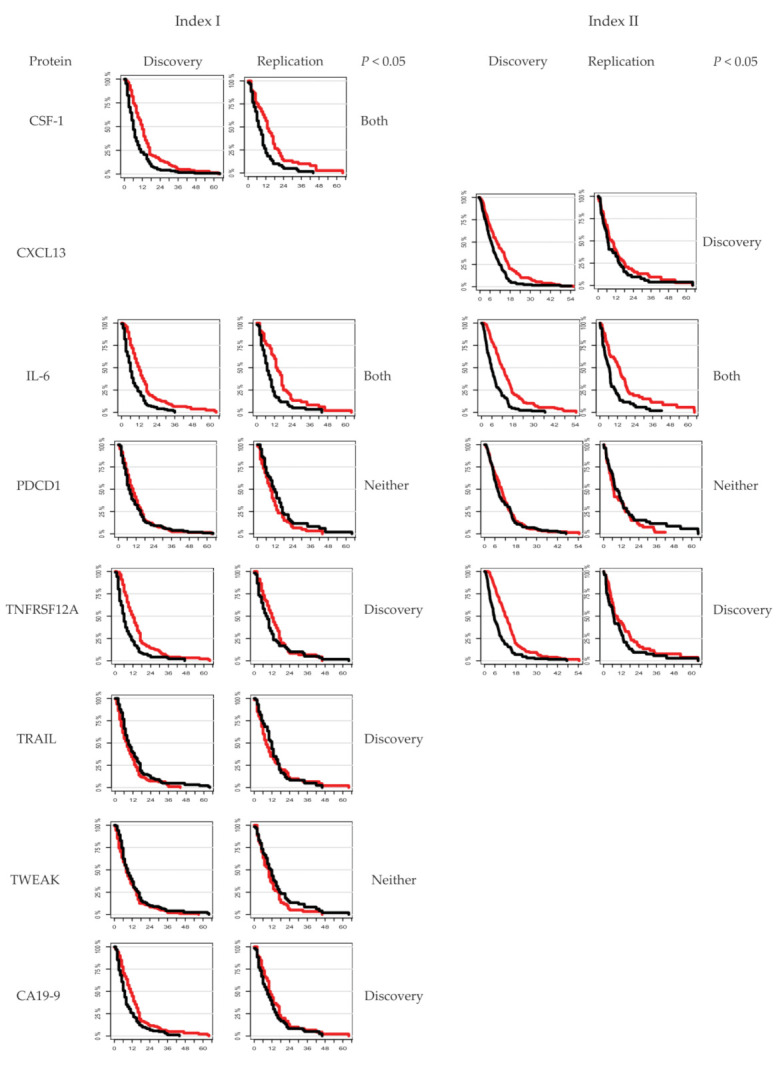
Patients with advanced pancreatic ductal adenocarcinoma (PDAC) have a dismal prognosis. We aimed to find a prognostic protein signature for overall survival (OS) in patients with advanced PDAC, and to explore whether early changes in circulating-protein levels could predict survival. We investigated 92 proteins using the Olink Immuno-Oncology panel in serum samples from 363 patients with advanced PDAC. Protein panels for several survival cut-offs were developed independently by two bioinformaticians using LASSO and Ridge regression models. Two panels of proteins discriminated patients with OS < 90 days from those with OS > 2 years. Index I (CSF-1, IL-6, PDCD1, TNFRSF12A, TRAIL, TWEAK, and CA19-9) had AUCs of 0.99 (95% CI: 0.98−1) (discovery cohort) and 0.89 (0.74−1) (replication cohort). For Index II (CXCL13, IL-6, PDCD1, and TNFRSF12A), the corresponding AUCs were 0.97 (0.93−1) and 0.82 (0.68−0.96). Four proteins (ANGPT2, IL-6, IL-10, and TNFRSF12A) were associated with survival across all treatment groups. Longitudinal samples revealed several changes, including four proteins that were also part of the prognostic signatures (CSF-1, CXCL13, IL-6, TNFRSF12A). This study identified two circulating-protein indices with the potential to identify patients with advanced PDAC with very short OS and with long OS.
晚期胰腺导管腺癌(PDAC)患者的预后很差。我们旨在寻找晚期PDAC患者总生存期(OS)的预后蛋白特征,并探讨循环蛋白水平的早期变化是否可以预测生存期。我们使用Olink免疫肿瘤学检测板对363例晚期PDAC患者的血清样本中的92种蛋白质进行了研究。两位生物信息学家分别使用LASSO和岭回归模型独立开发了针对几个生存临界值的蛋白组。两组蛋白区分了OS<90天的患者和OS>2年的患者。指标I(CSF-1、IL-6、PDCD1、TNFRSF12A、TRAIL、TWEAK和CA19-9)在发现队列中的曲线下面积(AUC)为0.99(95%CI:0.98−1),在验证队列中的AUC为0.89(0.74−1)。对于指标II(CXCL13、IL-6、PDCD1和TNFRSF12A),相应的AUC分别为0.97(0.93−1)和0.82(0.68−0.96)。四种蛋白质(ANGPT2、IL-6、IL-10和TNFRSF12A)与所有治疗组的生存期相关。纵向样本显示了一些变化,包括四种也是预后特征一部分的蛋白质(CSF-1、CXCL13、IL-6、TNFRSF12A)。本研究确定了两个循环蛋白指标,它们有可能识别出OS极短和OS长的晚期PDAC患者。