Brekken Kristoffer A, Vestrum Ole, Dey Sumita, Reyes Aase, Børvik Tore
Structural Impact Laboratory (SIMLab), Department of Structural Engineering, NTNU-Norwegian University of Science and Technology, 7491 Trondheim, Norway.
Centre for Advanced Structural Analysis (CASA), NTNU-Norwegian University of Science and Technology, 7491 Trondheim, Norway.
Materials (Basel). 2022 Jul 1;15(13):4651. doi: 10.3390/ma15134651.
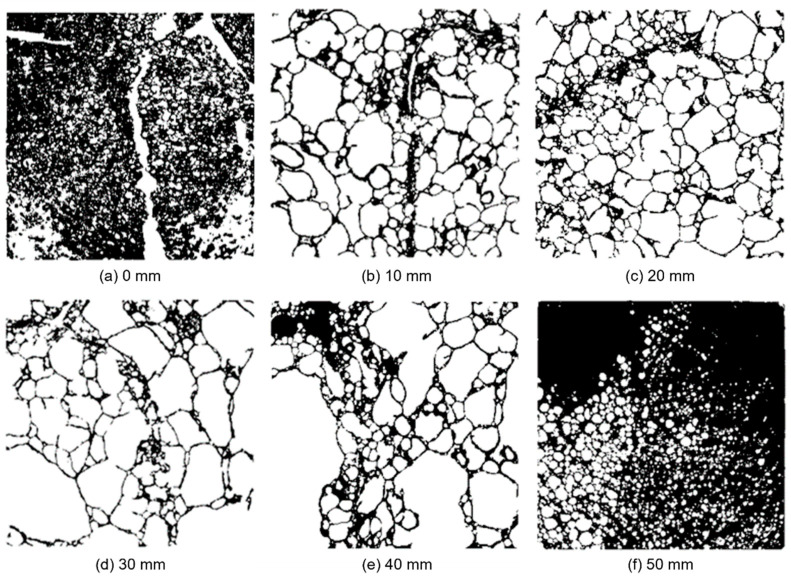
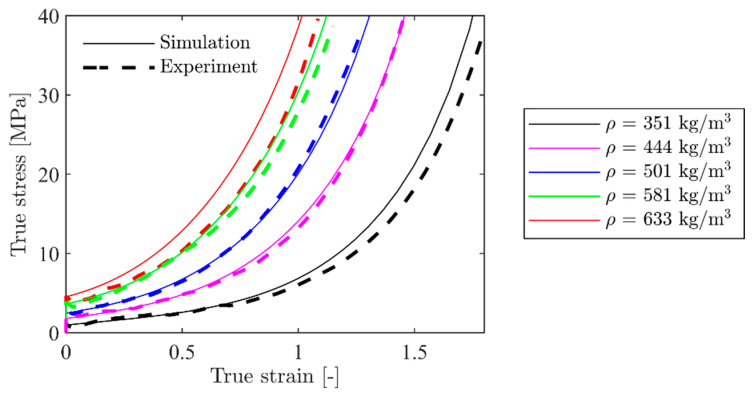
A sandwich structure is a composite material consisting of thin skins encapsulating a cellular core. Such structures have proven to be excellent energy absorbents and are frequently found in various types of protection. Even so, few studies exist in the open literature on the response of the core material itself under extreme loadings such as blast and impact. Since a blast load is usually accompanied by numerous fragments, it is important to understand and be able to predict the ballistic impact resistance of the often highly inhomogeneous cellular core materials in design. In this study, the ballistic impact response of an aluminium foam with a complex cell structure has been investigated both experimentally and numerically. First, an extensive material test program involving compression tests on cubic specimens loaded in the thickness direction of the foam was carried out to reveal the mechanical properties of the material. In addition, several of the specimens were scanned before testing using X-ray Micro Computed Tomography (XRMCT) to map the multi-scale topology and morphology of the material. These data were later analysed to extract density-variation plots in many different material orientations. Second, ballistic impact tests were conducted using a gas gun where rigid spheres were launched towards aluminium foam plates, and the ballistic limit velocity and curve of the foam material were established. Finally, numerical simulations of both the material tests and the ballistic impact tests were carried out using LS-DYNA and different modelling approaches based on the XRMCT data. It will be shown that, independent of the modelling strategy applied, good agreement between the experimental impact tests and the numerical predictions can be obtained. However, XRMCT data are important if the final goal is to numerically optimise and improve the behaviour of inhomogeneous foams with respect to energy absorption, thermal isolation, or similar properties.
夹层结构是一种复合材料,由包裹着多孔芯材的薄蒙皮组成。这种结构已被证明是优异的能量吸收体,并且常用于各种防护类型中。即便如此,公开文献中关于芯材本身在爆炸和冲击等极端载荷作用下的响应研究却很少。由于爆炸载荷通常伴随着大量碎片,因此在设计中了解并能够预测通常高度不均匀的多孔芯材的抗弹道冲击性能非常重要。在本研究中,对具有复杂胞体结构的泡沫铝的弹道冲击响应进行了实验和数值研究。首先,开展了一项广泛的材料测试计划,对沿泡沫厚度方向加载的立方试件进行压缩试验,以揭示材料的力学性能。此外,在测试前使用X射线显微计算机断层扫描(XRMCT)对部分试件进行扫描,以绘制材料的多尺度拓扑结构和形态。随后对这些数据进行分析,以提取许多不同材料取向的密度变化图。其次,使用气枪进行弹道冲击试验,将刚性球体射向泡沫铝板,并确定泡沫材料的弹道极限速度和曲线。最后,使用LS-DYNA并基于XRMCT数据采用不同的建模方法,对材料试验和弹道冲击试验进行了数值模拟。结果表明,无论采用何种建模策略,实验冲击试验和数值预测之间都能取得良好的一致性。然而,如果最终目标是在能量吸收、热绝缘或类似性能方面对不均匀泡沫的行为进行数值优化和改进,XRMCT数据就很重要。