College of Chemical and Pharmaceutical Engineering, Jilin Institute of Chemical Technology, Jilin 132022, China.
Molecules. 2022 Jul 4;27(13):4291. doi: 10.3390/molecules27134291.
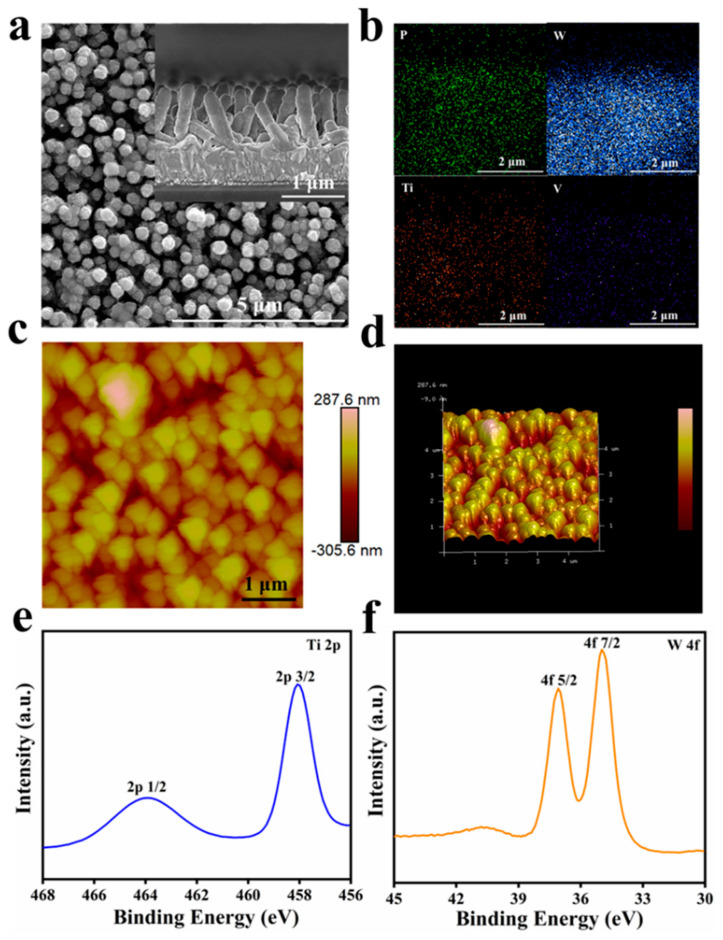
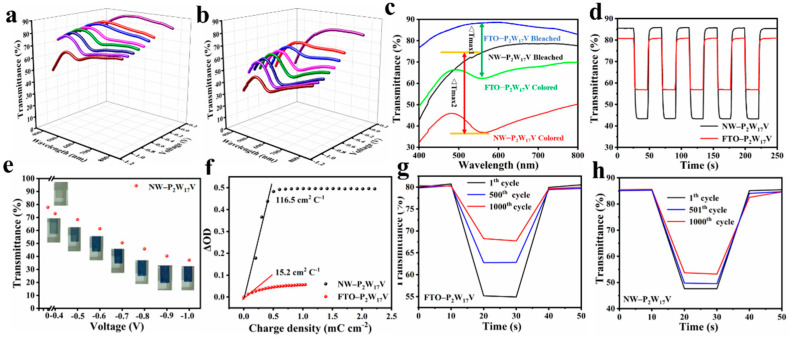
Polyoxometalates (POMs) demonstrate potential for application in the development of integrated smart energy devices based on bifunctional electrochromic (EC) optical modulation and electrochemical energy storage. Herein, a nanocomposite thin film composed of a vanadium-substituted Dawson-type POM, i.e., K[PWVO]·18HO, and TiO nanowires were constructed via the combination of hydrothermal and layer-by-layer self-assembly methods. Through scanning electron microscopy and energy-dispersive spectroscopy characterisations, it was found that the TiO nanowire substrate acts as a skeleton to adsorb POM nanoparticles, thereby avoiding the aggregation or stacking of POM particles. The unique three-dimensional core-shell structures of these nanocomposites with high specific surface areas increases the number of active sites during the reaction process and shortens the ion diffusion pathway, thereby improving the electrochemical activities and electrical conductivities. Compared with pure POM thin films, the composite films showed improved EC properties with a significant optical contrast (38.32% at 580 nm), a short response time (1.65 and 1.64 s for colouring and bleaching, respectively), an excellent colouration efficiency (116.5 cm C), and satisfactory energy-storage properties (volumetric capacitance = 297.1 F cm at 0.2 mA cm). Finally, a solid-state electrochromic energy-storage (EES) device was fabricated using the composite film as the cathode. After charging, the constructed device was able to light up a single light-emitting diode for 20 s. These results highlight the promising features of POM-based EES devices and demonstrate their potential for use in a wide range of applications, such as smart windows, military camouflage, sensors, and intelligent systems.
多金属氧酸盐(POMs)在开发基于双功能电致变色(EC)光学调制和电化学储能的集成智能能源设备方面具有应用潜力。本文通过水热法和层层自组装方法相结合,构建了一种由钒取代的 Dawson 型 POM,即 K[PWVO]·18H2O 和 TiO 纳米线组成的纳米复合薄膜。通过扫描电子显微镜和能谱分析表明,TiO 纳米线基底作为吸附 POM 纳米颗粒的骨架,从而避免了 POM 颗粒的聚集或堆叠。这些纳米复合材料具有独特的三维核壳结构,比表面积高,增加了反应过程中的活性位点数量,并缩短了离子扩散途径,从而提高了电化学活性和电导率。与纯 POM 薄膜相比,复合薄膜表现出更好的 EC 性能,具有显著的光学对比度(580nm 时为 38.32%)、较短的响应时间(着色和褪色分别为 1.65 和 1.64s)、较高的着色效率(116.5cm2C-1)和令人满意的储能性能(体积电容=297.1Fcm-3,在 0.2mAcm-3时)。最后,使用复合薄膜作为阴极制备了固态电致变色储能(EES)器件。充电后,构建的器件能够点亮单个发光二极管 20s。这些结果突出了基于 POM 的 EES 器件的有前景的特性,并展示了它们在智能窗户、军事伪装、传感器和智能系统等广泛应用中的潜力。