Section of Neurosurgery, Department of Neurosciences, Christian Medical College, Vellore, Tamil Nadu, India.
Department of Infectious Diseases, Christian Medical College, Vellore, Tamil Nadu, India.
J Clin Neurosci. 2022 Sep;103:26-33. doi: 10.1016/j.jocn.2022.06.024. Epub 2022 Jul 4.
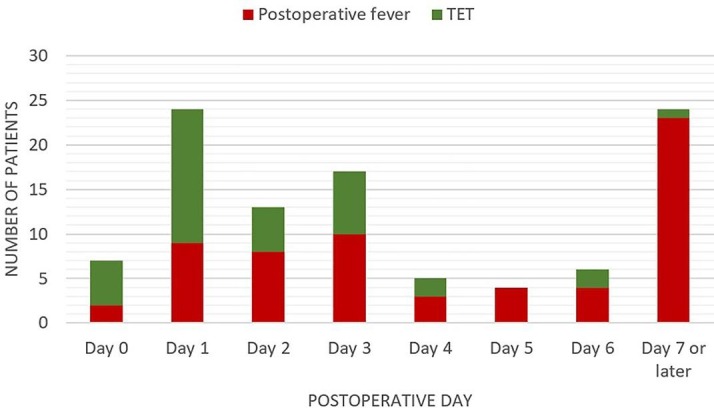
Postoperative fever is mostly transient and inconsequential but may portend a serious postoperative infection requiring a thorough evaluation, especially during the recent COVID-19 pandemic. We aimed to determine the incidence, causes and outcomes of postoperative fever in neurosurgical patients, as well as to evaluate a protocol for management of postoperative fever. We conducted a prospective study over 12 months, recruiting 425 adult patients operated for non-traumatic neurosurgical indications. We followed a standard protocol for the evaluation and management of postoperative fever collecting data regarding operative details, daily maximal temperature, clinical features, as well as use of surgical drains, urinary catheters, and other invasive adjuncts. Elevated body temperature of > 99.9°F or 37.7 °C for over 48 h or associated with clinical deterioration or localising features was considered as "fever" and was evaluated according to our protocol. We classified elevated temperature not meeting this criterion as a transient elevation in temperature (TET). Sixty-five patients (13.5%) had postoperative fever. Transient elevation of temperature, occurring in 40 patients (8.8%) was most common in the first 48 h after surgery. The most common causes of fever were urinary tract infections (13.7%), followed by aseptic meningitis (10.8%), wound infections and pneumonia. Various aetiologies of fever followed distinct patterns, with COVID-19 and meningitis causing high-grade, prolonged fever. Multivariate analysis revealed cranial surgery, prolonged duration of surgery, urinary catheters and wound drains retained beyond POD 3 to predict fever. Postoperative fever was associated with significantly longer duration of hospital admission. COVID-19 had a high mortality rate in the early postoperative period.
术后发热大多是短暂和无足轻重的,但可能预示着严重的术后感染,需要进行彻底评估,尤其是在最近的 COVID-19 大流行期间。我们旨在确定神经外科患者术后发热的发生率、原因和结果,并评估术后发热管理的方案。我们进行了为期 12 个月的前瞻性研究,招募了 425 名因非创伤性神经外科指征接受手术的成年患者。我们遵循了术后发热评估和管理的标准方案,收集了手术细节、每日最高体温、临床特征以及手术引流管、导尿管和其他侵入性辅助设备的使用情况。体温升高超过 99.9°F 或 37.7°C 超过 48 小时或与临床恶化或局部特征相关被认为是“发热”,并根据我们的方案进行评估。我们将不符合此标准的体温升高归类为体温短暂升高(TET)。65 名患者(13.5%)出现术后发热。40 名患者(8.8%)出现体温短暂升高,这种情况最常见于手术后的前 48 小时。发热的最常见原因是尿路感染(13.7%),其次是无菌性脑膜炎(10.8%)、伤口感染和肺炎。发热的各种病因遵循不同的模式,COVID-19 和脑膜炎导致高热、持续时间长的发热。多变量分析显示,颅部手术、手术时间延长、导尿管和伤口引流管保留时间超过术后第 3 天是发热的预测因素。术后发热与住院时间明显延长相关。COVID-19 在术后早期的死亡率较高。