Dzidzishvili Lika, López-Torres Irene Isabel, Guerrero Carlos Carnero, Calvo Emilio
Department of Orthopaedic Surgery and Traumatology, Hospital Universitario Fundación Jiménez Díaz, IIS-Fundación Jiménez Díaz, Universidad Autónoma de Madrid, Av. De los Reyes Católicos, 2, 28040, Madrid, Spain.
Animal Core Facility Manager, Experimental Surgery Department and Animal Core Facility, IIS- Fundación Jiménez Díaz, Universidad Autónoma de Madrid, Av. De los Reyes Católicos, 2, 28040, Madrid, Spain.
J Exp Orthop. 2022 Jul 9;9(1):66. doi: 10.1186/s40634-022-00501-y.
To develop a predictable and reproducible model of knee osteoarthritis after medial meniscus posterior root release.
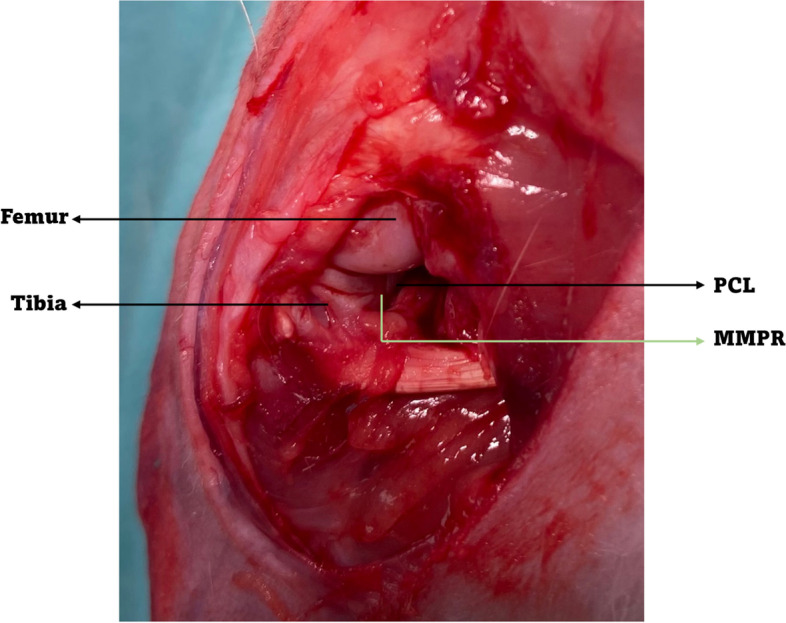
Posteromedial meniscal root tears were created in 12 White New Zealand rabbit knees. The contralateral limbs were used as healthy controls. The animals were euthanized at 16 weeks postoperatively; tissue samples of femoral and tibial articular cartilage were collected and processed for macro and microscopic analyses to detect signs of early degeneration. Clinical evaluation of the weight-bearing status on the affected knee was conducted at 0-, 4-, 8-, and 16-weeks postoperatively.
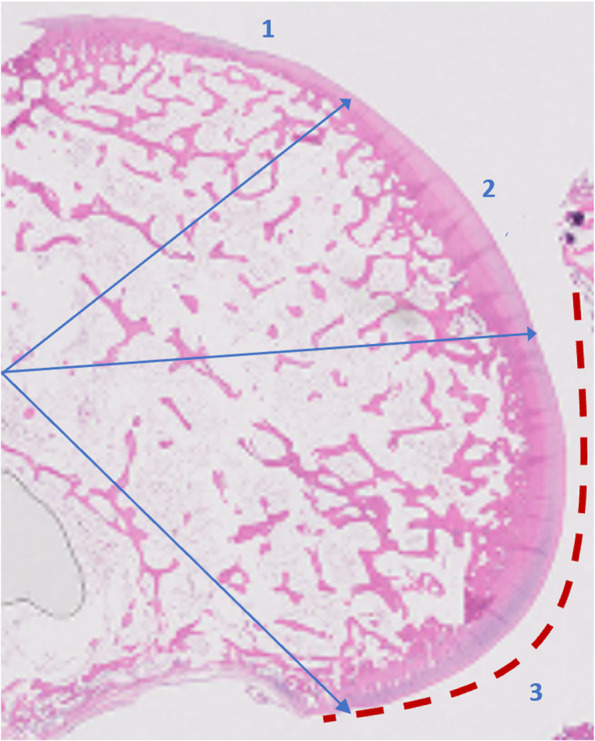
Early and severe osteoarthritic changes were the hallmark and the main findings after 16-weeks post-surgery. Macroscopically, extensive osteoarthritic changes were observed across the femoral condyle and tibial plateau. Microscopic finding included ulcerations, fissures, fibrillations, pitting, and loss of the superficial layer. Cellularity was diminished, the normal pattern of distribution in columns was lost, and subchondral bone exposure was also evident.
This study describes a novel model of knee osteoarthritis that may guide the development of tailored interventions to delay or prevent knee osteoarthritis. This knowledge could shift the current treatment paradigm toward more conservative and knee salvageable treatment options and increase surgeons' awareness of this injury pattern. Such considerations may have a positive impact on clinical decision-making and subsequent patient-reported clinical outcomes.
Controlled laboratory study.
II.
建立一种可预测且可重复的内侧半月板后根松解术后膝骨关节炎模型。
在12只新西兰白兔的膝关节上制造后内侧半月板根部撕裂。对侧肢体用作健康对照。术后16周对动物实施安乐死;收集股骨和胫骨关节软骨的组织样本并进行处理,以进行宏观和微观分析,检测早期退变迹象。在术后0、4、8和16周对患侧膝关节的负重状态进行临床评估。
术后16周,早期和严重的骨关节炎改变是其标志和主要发现。宏观上,在股骨髁和胫骨平台观察到广泛的骨关节炎改变。微观发现包括溃疡、裂隙、纤维化、点蚀和表层缺失。细胞数量减少,柱状分布的正常模式丧失,软骨下骨暴露也很明显。
本研究描述了一种新型的膝骨关节炎模型,该模型可能指导制定针对性的干预措施以延缓或预防膝骨关节炎。这些知识可能会使当前的治疗模式转向更保守且可挽救膝关节的治疗选择,并提高外科医生对这种损伤模式的认识。这些考虑因素可能会对临床决策以及随后患者报告的临床结果产生积极影响。
对照实验室研究。
II级。