McConnell Brice V, Kronberg Eugene, Medenblik Lindsey M, Kheyfets Vitaly O, Ramos Alberto R, Sillau Stefan H, Pulver Rachelle L, Bettcher Brianne M
Department of Neurology, University of Colorado, Denver, Denver, CO, United States.
Pediatric Critical Care Medicine, University of Colorado, Denver, Denver, CO, United States.
Front Neurosci. 2022 Jun 23;16:915934. doi: 10.3389/fnins.2022.915934. eCollection 2022.
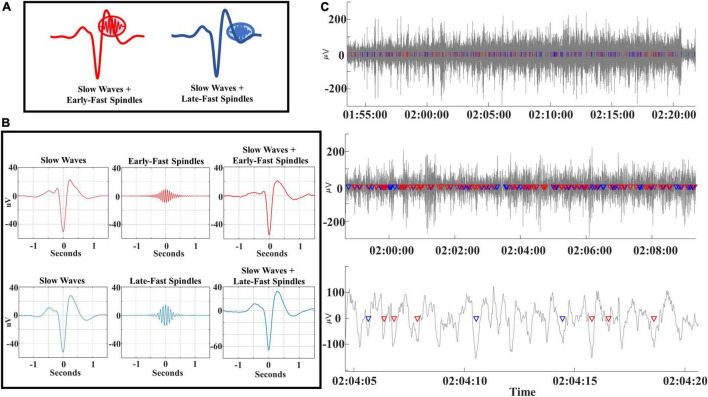
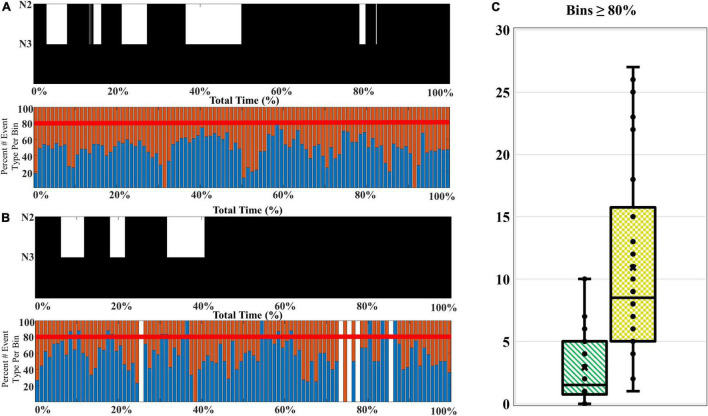
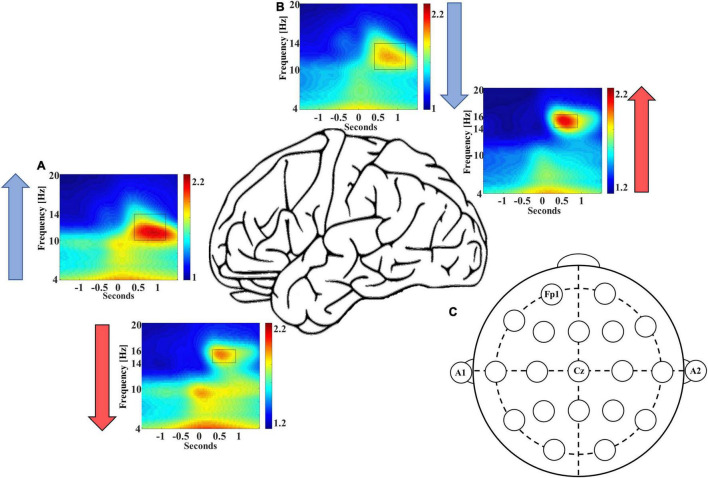
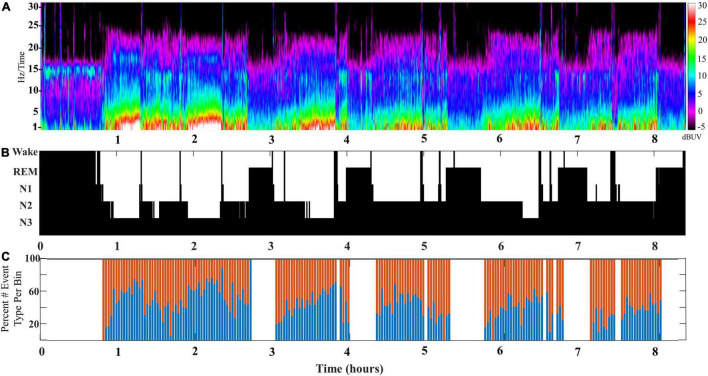
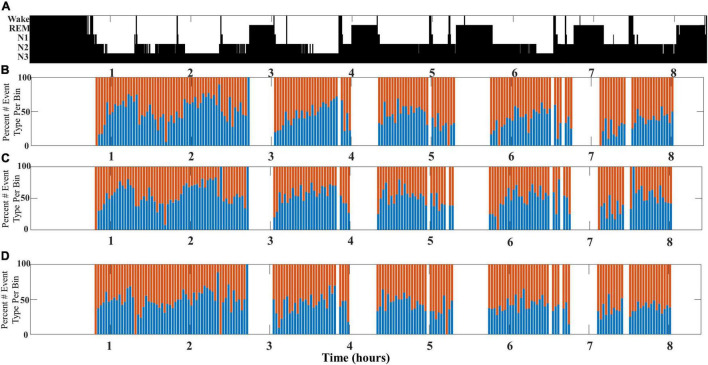
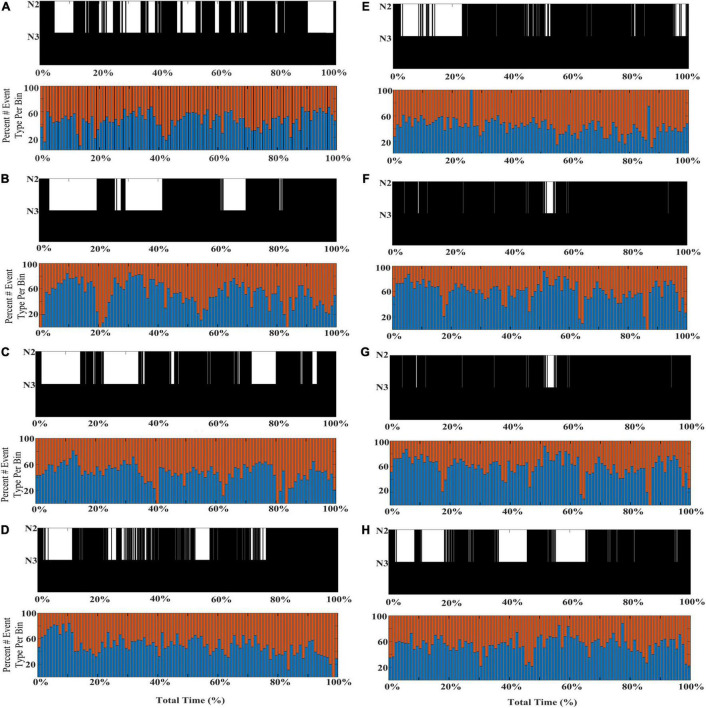
Slow wave activity (SWA) during sleep is associated with synaptic regulation and memory processing functions. Each cycle of non-rapid-eye-movement (NREM) sleep demonstrates a waxing and waning amount of SWA during the transitions between stages N2 and N3 sleep, and the deeper N3 sleep is associated with an increased density of SWA. Further, SWA is an amalgam of different types of slow waves, each identifiable by their temporal coupling to spindle subtypes with distinct physiological features. The objectives of this study were to better understand the neurobiological properties that distinguish different slow wave and spindle subtypes, and to examine the composition of SWA across cycles of NREM sleep. We further sought to explore changes in the composition of NREM cycles that occur among aging adults. To address these goals, we analyzed subsets of data from two well-characterized cohorts of healthy adults: (1) The DREAMS Subjects Database ( = 20), and (2) The Cleveland Family Study ( = 60). Our analyses indicate that slow wave/spindle coupled events can be characterized as frontal vs. central in their relative distribution between electroencephalography (EEG) channels. The frontal predominant slow waves are identifiable by their coupling to late-fast spindles and occur more frequently during stage N3 sleep. Conversely, the central-associated slow waves are identified by coupling to early-fast spindles and favor occurrence during stage N2 sleep. Together, both types of slow wave/spindle coupled events form the composite of SWA, and their relative contribution to the SWA rises and falls across cycles of NREM sleep in accordance with depth of sleep. Exploratory analyses indicated that older adults produce a different composition of SWA, with a shift toward the N3, frontal subtype, which becomes increasingly predominant during cycles of NREM sleep. Overall, these data demonstrate that subtypes of slow wave/spindle events have distinct cortical propagation patterns and differ in their distribution across lighter vs. deeper NREM sleep. Future efforts to understand how slow wave sleep and slow wave/spindle coupling impact memory performance and neurological disease may benefit from examining the composition of SWA to avoid potential confounds that may occur when comparing dissimilar neurophysiological events.
睡眠期间的慢波活动(SWA)与突触调节和记忆处理功能相关。非快速眼动(NREM)睡眠的每个周期在N2和N3睡眠阶段转换期间都表现出SWA量的增减,且更深的N3睡眠与SWA密度增加相关。此外,SWA是不同类型慢波的混合体,每种慢波可通过其与具有不同生理特征的纺锤波亚型的时间耦合来识别。本研究的目的是更好地理解区分不同慢波和纺锤波亚型的神经生物学特性,并检查NREM睡眠各周期中SWA的组成。我们进一步试图探索老年人中NREM周期组成的变化。为实现这些目标,我们分析了来自两个特征明确的健康成年人队列的数据集:(1)DREAMS受试者数据库(n = 20),以及(2)克利夫兰家庭研究(n = 60)。我们的分析表明,慢波/纺锤波耦合事件在脑电图(EEG)通道之间的相对分布可分为额叶型和中央型。额叶占主导的慢波可通过其与晚期快速纺锤波的耦合来识别,且在N3睡眠阶段更频繁出现。相反,与中央相关的慢波通过与早期快速纺锤波的耦合来识别,且更倾向于在N2睡眠阶段出现。这两种类型的慢波/纺锤波耦合事件共同构成了SWA的复合体,它们对SWA的相对贡献在NREM睡眠各周期中随着睡眠深度的变化而增减。探索性分析表明,老年人产生的SWA组成不同,向N3、额叶亚型转变,在NREM睡眠周期中这种亚型变得越来越占主导。总体而言,这些数据表明慢波/纺锤波事件的亚型具有不同的皮层传播模式,且在浅度与深度NREM睡眠中的分布不同。未来在理解慢波睡眠和慢波/纺锤波耦合如何影响记忆表现和神经系统疾病方面的努力,可能会受益于检查SWA的组成,以避免在比较不同神经生理事件时可能出现的潜在混淆。