Verhaegen Jeroen C F, Innmann Moritz, Alves Batista Nuno, Dion Charles-Antoine, Horton Isabel, Pierrepont Jim, Merle Christian, Grammatopoulos George
Division of Orthopaedic Surgery, Critical Care Wing, The Ottawa Hospital, Ottawa, Ontario, Canada.
University Hospital Antwerp, Edegem, Belgium.
JB JS Open Access. 2022 Jul 5;7(3). doi: 10.2106/JBJS.OA.22.00007. eCollection 2022 Jul-Sep.
Spinopelvic characteristics influence the hip's biomechanical behavior. However, there is currently little knowledge regarding what "normal" characteristics are. This study aimed to determine how static and dynamic spinopelvic characteristics change with age, sex, and body mass index (BMI) among well-functioning volunteers.
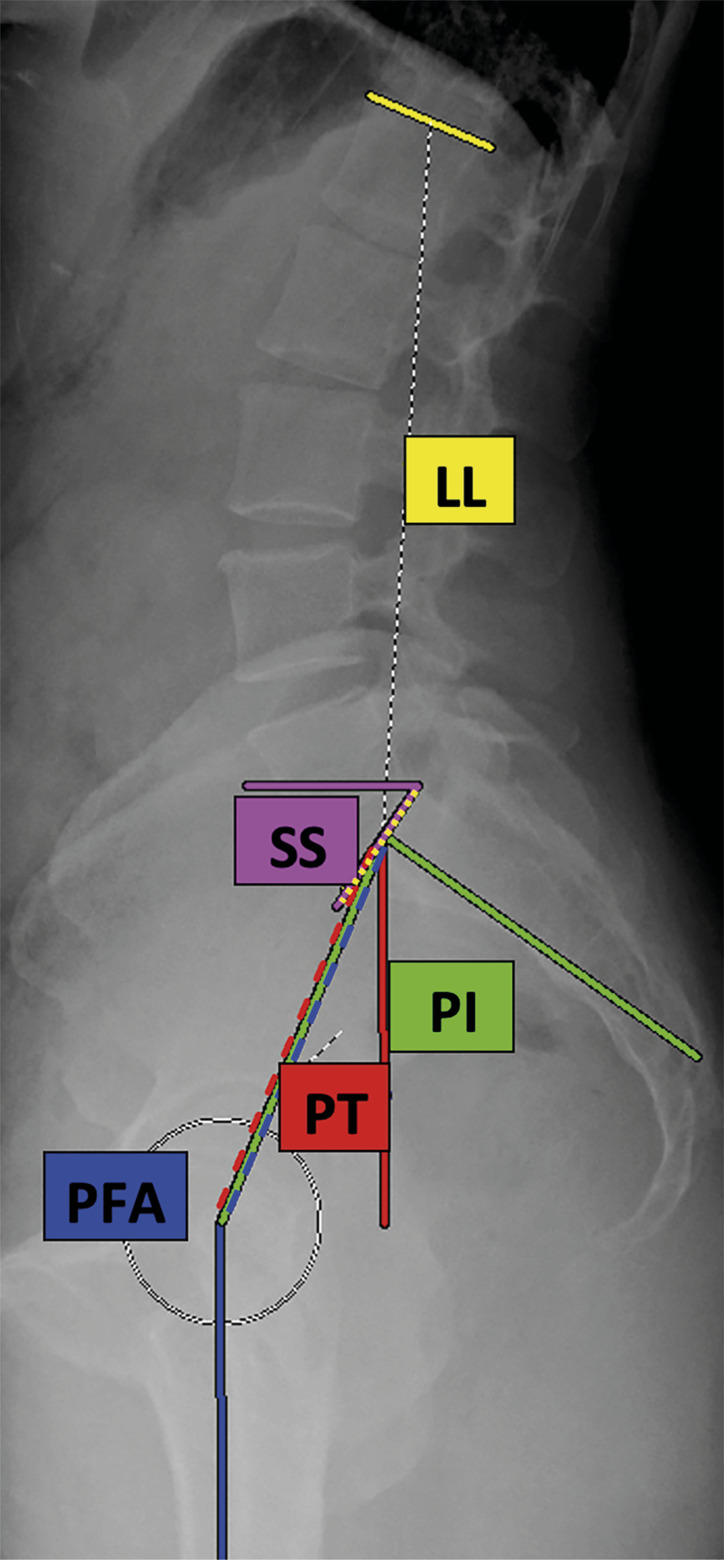
This was a cross-sectional cohort study of 112 asymptomatic volunteers (age, 47.4 ± 17.7 years; 50.0% female; BMI, 27.3 ± 4.9 kg/m). All participants underwent lateral spinopelvic radiography in the standing and deep-seated positions to determine maximum hip and lumbar flexion. Lumbar flexion (change in lumbar lordosis, ∆LL), hip flexion (change in pelvic-femoral angle, ∆PFA), and pelvic movement (change in pelvic tilt, ΔPT) were determined. The hip user index, which quantifies the relative contribution of the hip to overall sagittal movement, was calculated as (∆PFA/[∆PFA + ∆LL]) × 100%.
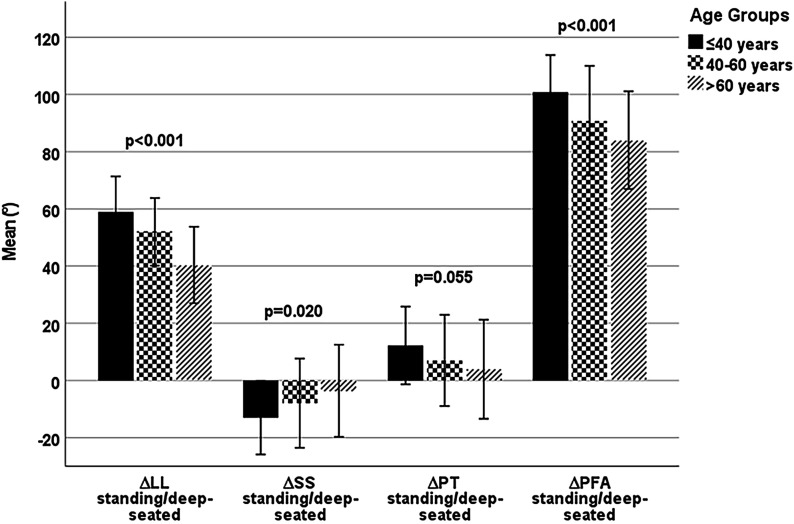
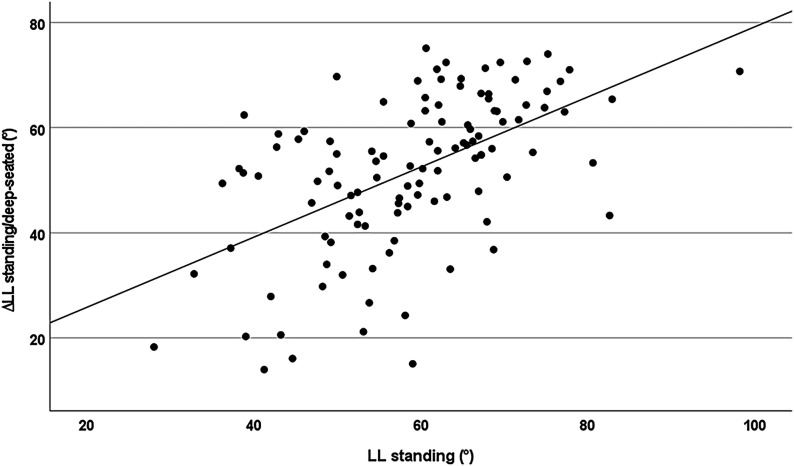
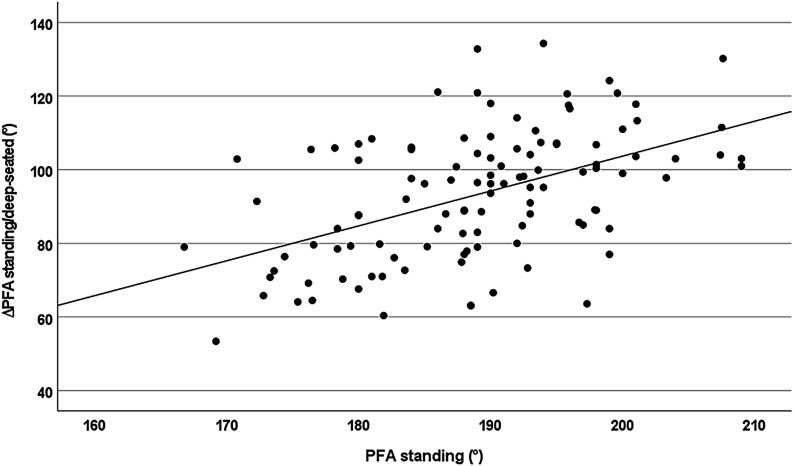
There were decreases of 4.5° (9%) per decade of age in lumbar flexion (rho, -0.576; p < 0.001) and 3.6° (4%) per decade in hip flexion (rho, -0.365; p < 0.001). ∆LL could be predicted by younger age, low standing PFA, and high standing LL. Standing spinopelvic characteristics were similar between sexes. There was a trend toward men having less hip flexion (90.3° ± 16.4° versus 96.4° ± 18.1°; p = 0.065) and a lower hip user index (62.9% ± 8.2% versus 66.7% ± 8.3%; p = 0.015). BMI weakly correlated with ∆LL (rho, -0.307; p = 0.011) and ∆PFA (rho, -0.253; p = 0.039).
Spinopelvic characteristics were found to be age, sex, and BMI-dependent. The changes in the lumbar spine during aging (loss of lumbar lordosis and flexion) were greater than the changes in the hip, and as a result, the hip's relative contribution to overall sagittal movement increased. Men had a greater change in posterior pelvic tilt when moving from a standing to a deep-seated position in comparison with women, secondary to less hip flexion. The influence of BMI on spinopelvic parameters was low.
脊柱骨盆特征会影响髋关节的生物力学行为。然而,目前对于什么是“正常”特征知之甚少。本研究旨在确定在功能良好的志愿者中,静态和动态脊柱骨盆特征如何随年龄、性别和体重指数(BMI)而变化。
这是一项对112名无症状志愿者(年龄47.4±17.7岁;50.0%为女性;BMI 27.3±4.9kg/m²)进行的横断面队列研究。所有参与者在站立位和深坐位时进行脊柱骨盆侧位X线摄影,以确定最大髋关节和腰椎前屈角度。测定腰椎前屈(腰椎前凸变化,∆LL)、髋关节前屈(骨盆股骨角变化,∆PFA)和骨盆运动(骨盆倾斜变化,∆PT)。计算髋关节使用指数,该指数量化髋关节对整体矢状面运动的相对贡献,计算方法为(∆PFA/[∆PFA + ∆LL])×100%。
腰椎前屈每十年下降4.5°(9%)(rho,-0.576;p<0.001),髋关节前屈每十年下降3.6°(4%)(rho,-0.365;p<0.001)。∆LL可通过年龄较小、站立位PFA较低和站立位LL较高来预测。站立位脊柱骨盆特征在性别之间相似。男性的髋关节前屈略少(90.3°±16.4°对96.4°±18.1°;p = 0.065)且髋关节使用指数较低(62.9%±8.2%对66.7%±8.3%;p = 0.015),存在这种趋势。BMI与∆LL(rho,-0.307;p = 0.011)和∆PFA(rho,-0.253;p = 0.039)弱相关。
发现脊柱骨盆特征与年龄、性别和BMI有关。衰老过程中腰椎的变化(腰椎前凸和前屈丧失)大于髋关节的变化,因此,髋关节对整体矢状面运动的相对贡献增加。与女性相比,男性从站立位到深坐位时骨盆后倾变化更大,这是由于髋关节前屈较少。BMI对脊柱骨盆参数的影响较小。