Luo Ying, Chen Jiaxian, Chen Yuewu, Su Yangshen, Wu Xiaoyan, Zheng Wanling, Liu Xianxia, Chen Lei
Department of Cardiology, the Second Affiliated Hospital of Hainan Medical College, Haikou, China.
J Thorac Dis. 2022 Jun;14(6):2213-2223. doi: 10.21037/jtd-22-606.
This study aimed to explore the potential mechanism of Qishen Yiqi dropping pills (QYDPs) in the treatment of chronic heart failure (CHF) by regulating the expression of lncRNAs during CHF.
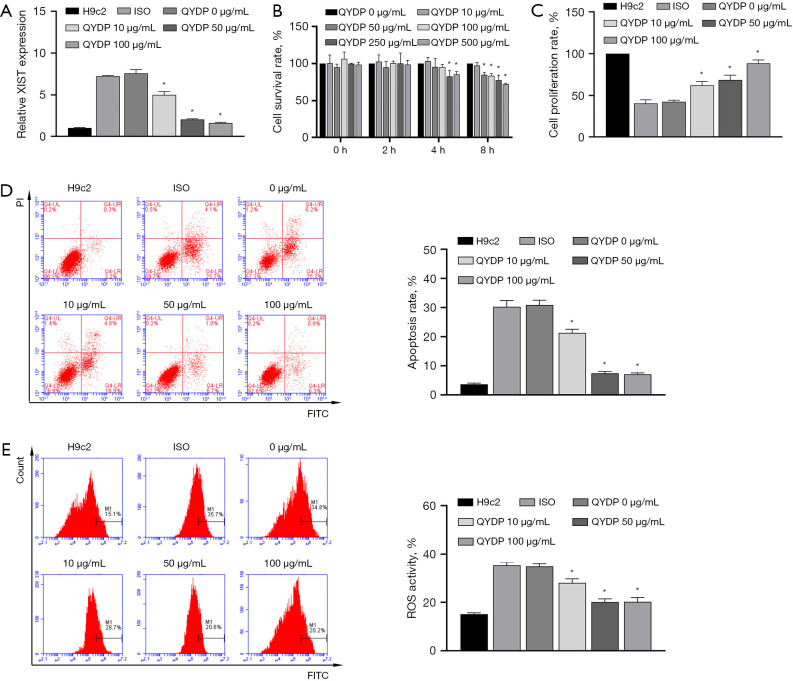
Differences in the expression of the long non-coding RNA (lncRNA), X-inactive specific transcript (XIST), in an isoproterenol (ISO)-induced cardiomyocyte hypertrophy model treated with QYDPs was analyzed by reverse transcription quantitative polymerase chain reaction (RT-qPCR). A cell counting kit-8 (CCK8) assay, flow cytometry (FCM), and enzyme linked immunosorbent assay (ELISA) were used to analyze the protective effects of QYDPs on the proliferation rate, apoptosis, myocardial enzyme, oxidative stress, and inflammation of cardiomyocytes, as well as the molecular mechanism of XIST.
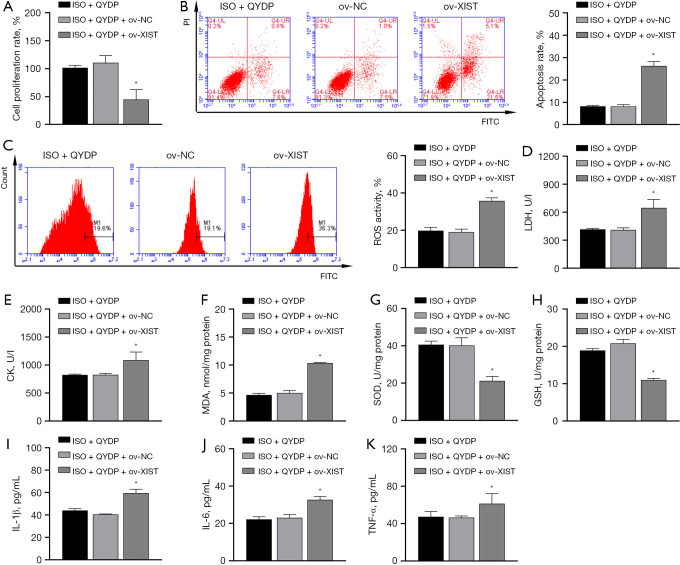
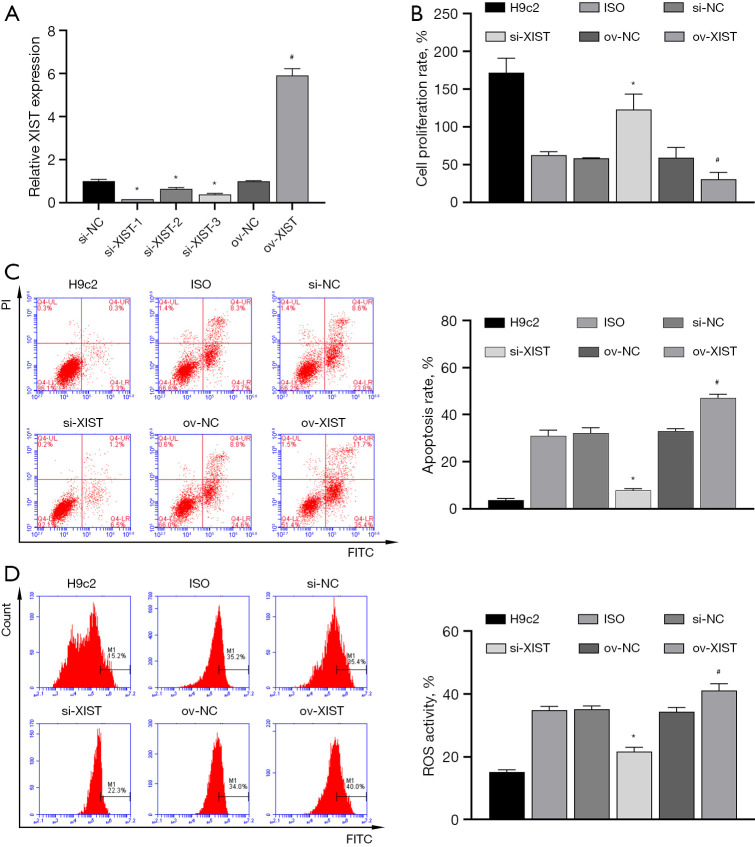
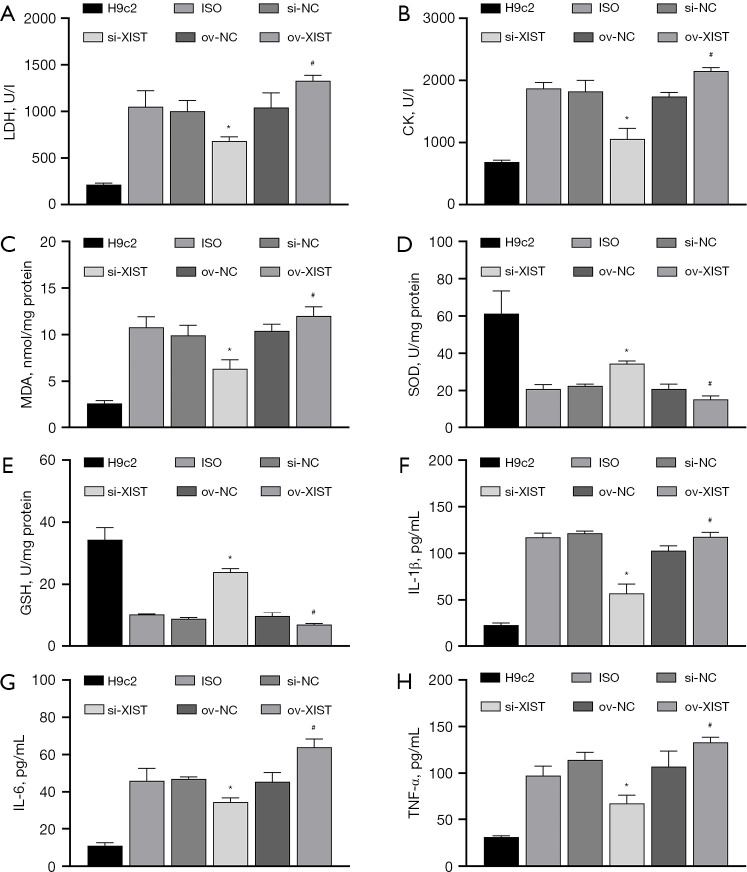
Our results showed that in the ISO-induced cardiomyocyte hypertrophy model, XIST expression and apoptosis were increased, the cell proliferation rate was decreased, and myocardial enzyme levels increased [i.e., increased lactate dehydrogenase (LDH) and creatine kinase (CK) levels]. Furthermore, cellular oxidative stress [i.e., increased malondialdehyde (MDA) levels and decreased superoxide dismutase (SOD) levels] and inflammatory response [i.e., increased interleukin (IL)-1β, IL-6, and tumor necrosis factor (TNF)-α protein secretion] were also promoted. QYDP treatment effectively mitigated the effects of ISO induction. Subsequently, we found that suppressing XIST expression reversed the effect of ISO induction, whereas overexpression (ov) of XIST enhanced the effect of ISO induction. Finally, this study confirmed that QYDP treatment improved the ISO-induced decrease in proliferation, apoptosis, and promotion of oxidative stress and inflammatory response in cardiomyocytes, whereas ov of XIST partially negated the effect of QYDPs.
QYDPs protected H9c2 cells from ISO-induced damage by downregulating XIST expression.
本研究旨在探讨芪参益气滴丸(QYDPs)在慢性心力衰竭(CHF)治疗中通过调节CHF期间lncRNAs表达的潜在机制。
采用逆转录定量聚合酶链反应(RT-qPCR)分析芪参益气滴丸处理的异丙肾上腺素(ISO)诱导的心肌细胞肥大模型中长链非编码RNA(lncRNA)X染色体失活特异性转录本(XIST)的表达差异。使用细胞计数试剂盒8(CCK8)检测、流式细胞术(FCM)和酶联免疫吸附测定(ELISA)分析芪参益气滴丸对心肌细胞增殖率、凋亡、心肌酶、氧化应激和炎症的保护作用,以及XIST的分子机制。
我们的结果表明,在ISO诱导的心肌细胞肥大模型中,XIST表达和凋亡增加,细胞增殖率降低,心肌酶水平升高[即乳酸脱氢酶(LDH)和肌酸激酶(CK)水平升高]。此外,细胞氧化应激[即丙二醛(MDA)水平升高和超氧化物歧化酶(SOD)水平降低]和炎症反应[即白细胞介素(IL)-1β、IL-6和肿瘤坏死因子(TNF)-α蛋白分泌增加]也得到促进。芪参益气滴丸治疗有效减轻了ISO诱导的影响。随后,我们发现抑制XIST表达可逆转ISO诱导的作用,而XIST过表达(ov)增强了ISO诱导的作用。最后,本研究证实芪参益气滴丸治疗改善了ISO诱导的心肌细胞增殖减少、凋亡以及氧化应激和炎症反应的促进作用,而XIST的ov部分抵消了芪参益气滴丸的作用。
芪参益气滴丸通过下调XIST表达保护H9c2细胞免受ISO诱导的损伤。