Zhao Jingtao, Li Maowei, Tan Chen
Hebei Yanda Hospital, Langfang, China.
No. 988th Hospital of Joint Logistic Support Force of PLA, Zhengzhou, China.
Front Med (Lausanne). 2022 Jun 22;9:795839. doi: 10.3389/fmed.2022.795839. eCollection 2022.
The effect of N-acetylcysteine (NAC), an antioxidant, on preventing acute kidney injury (AKI) and major adverse cardiac events (MACE) remains controversial. Therefore, we conducted this meta-analysis and trial sequential analysis to evaluate its efficacy on cardiac surgery-related adverse events.
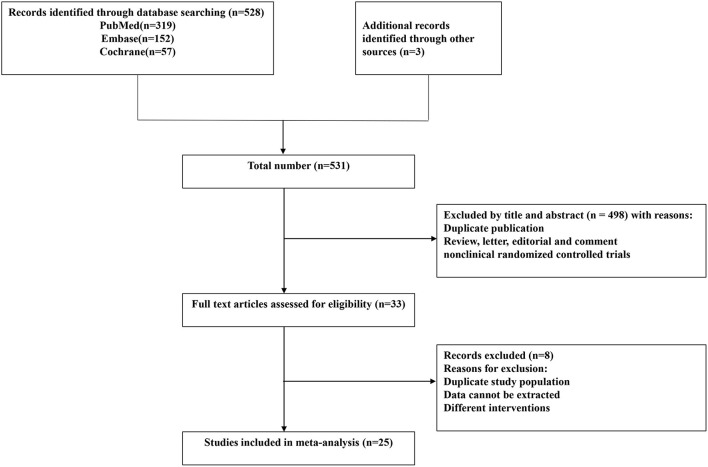
PubMed, Embase, and Cochrane Library were searched for relevant studies from inception to June 2021. We selected randomized controlled trials comparing NAC with controls in patients undergoing cardiac surgery.
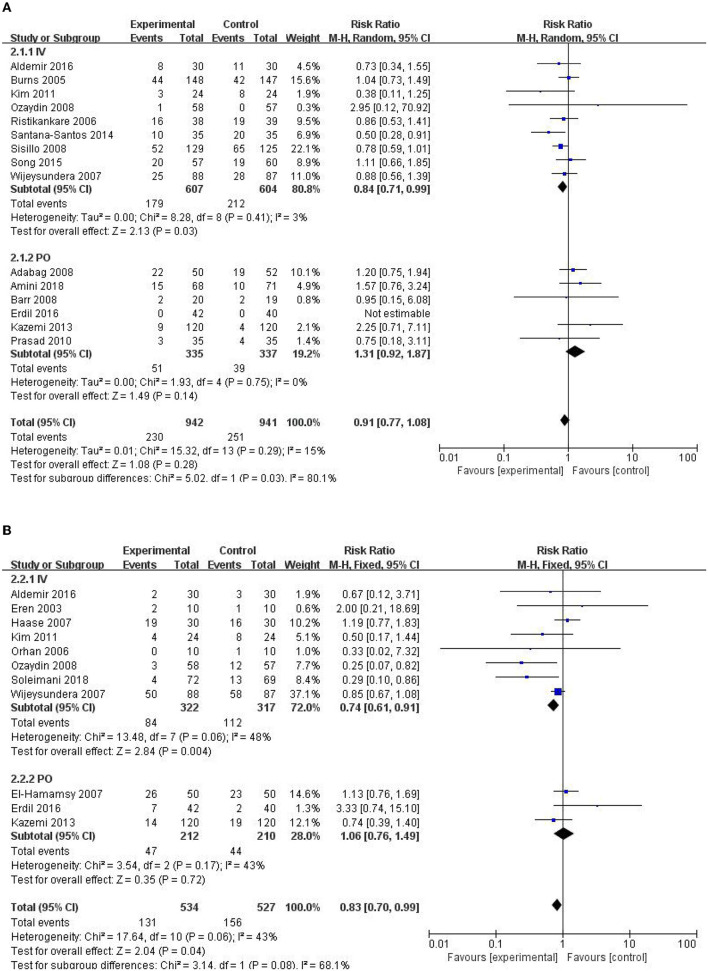
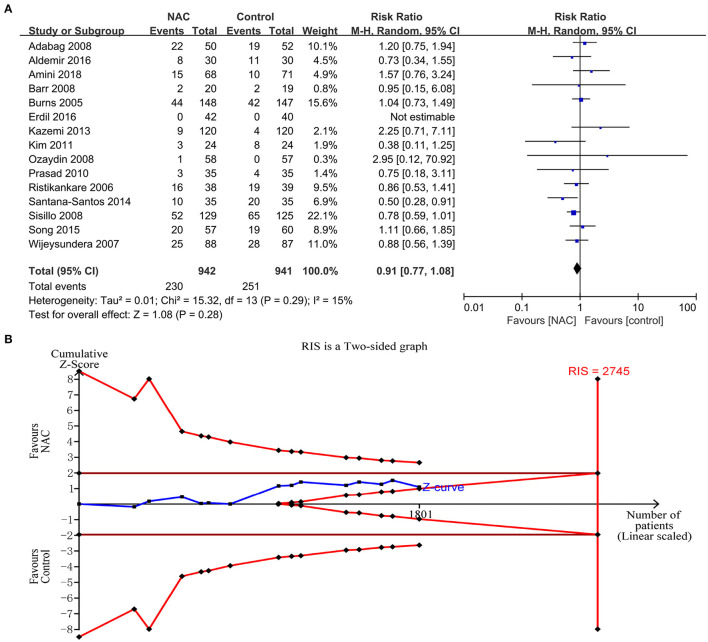
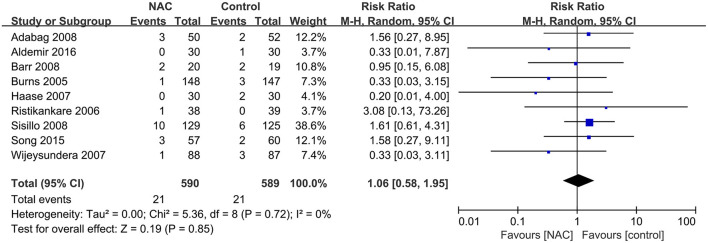
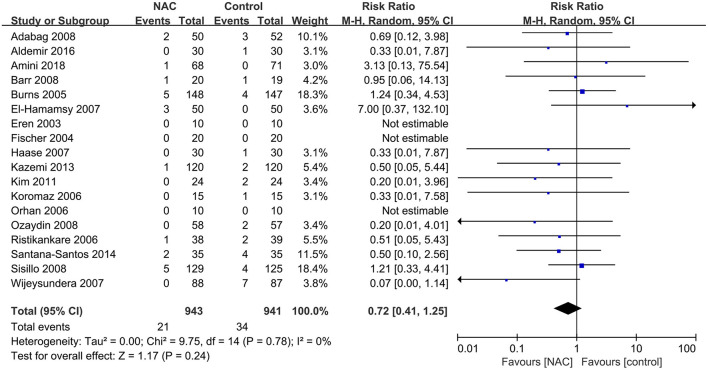
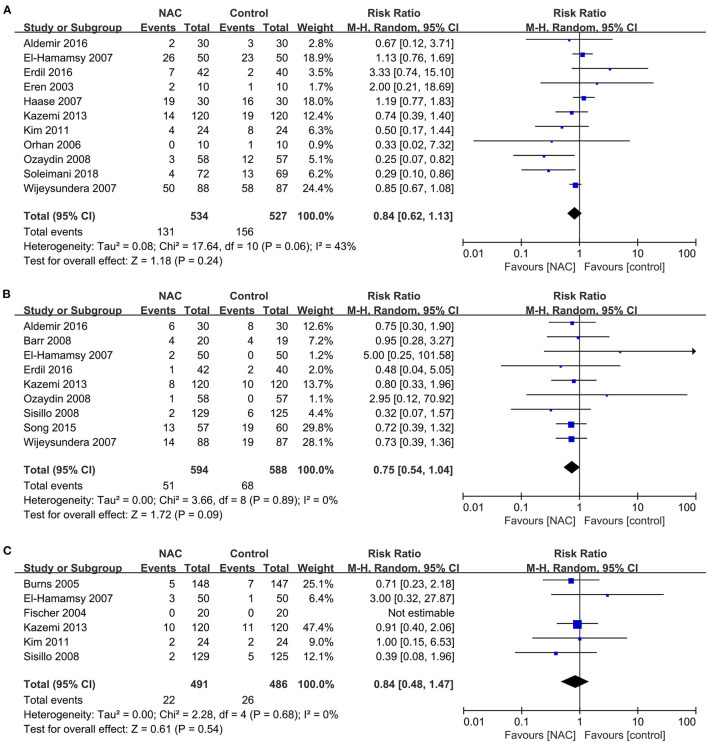
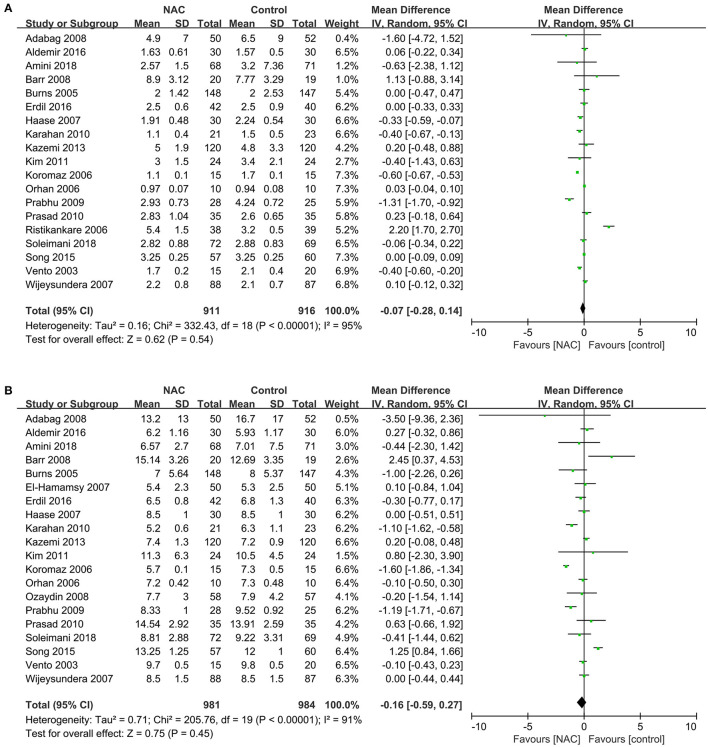
Twenty-five studies including 2,444 patients met the inclusion criteria. The pooled results showed that there was no significant difference in the incidence of AKI between the NAC and control groups [relative risk (RR) = 0.91, 95% confidence interval (CI) = 0.77, 1.08, P = 0.28], but the trial sequential analysis (TSA) could not confirm this result. No difference was observed in the need for renal replacement therapy (RRT), all-cause mortality, MACE, length of stay in the intensive care unit (ICU), and length of stay in the hospital. Results of subgroup analysis results showed that intravenous infusion instead of oral NAC could significantly reduce the incidence of AKI and arrhythmia (RR = 0.84, 95% CI = 0.71, 0.99, = 0.03, = 3% and RR = 0.74, 95% CI = 0.61, 0.91, = 0.004, = 48%, respectively).
Intravenous administration of NAC can reduce the incidence of AKI and arrhythmia in patients after cardiac surgery, but cannot reduce all-cause mortality, AMI, cardiac insufficiency, and the number of patients using RRT. Oral NAC has no significant effect on the outcomes of patients after cardiac surgery.
抗氧化剂N - 乙酰半胱氨酸(NAC)对预防急性肾损伤(AKI)和主要不良心脏事件(MACE)的作用仍存在争议。因此,我们进行了这项荟萃分析和试验序贯分析,以评估其对心脏手术相关不良事件的疗效。
检索了PubMed、Embase和Cochrane图书馆从创刊至2021年6月的相关研究。我们选择了比较心脏手术患者中NAC与对照组的随机对照试验。
25项研究共2444例患者符合纳入标准。汇总结果显示,NAC组和对照组之间AKI的发生率无显著差异[相对风险(RR)= 0.91,95%置信区间(CI)= 0.77,1.08,P = 0.28],但试验序贯分析(TSA)无法证实这一结果。在肾脏替代治疗(RRT)需求、全因死亡率、MACE、重症监护病房(ICU)住院时间和住院时间方面未观察到差异。亚组分析结果显示,静脉输注而非口服NAC可显著降低AKI和心律失常的发生率(RR分别为0.84,95%CI = 0.71,0.99,P = 0.03,I² = 3%;RR为0.74,95%CI = 0.61,0.91,P = 0.004,I² = 48%)。
静脉注射NAC可降低心脏手术后患者AKI和心律失常的发生率,但不能降低全因死亡率、急性心肌梗死、心脏功能不全以及使用RRT的患者数量。口服NAC对心脏手术后患者的结局无显著影响。