Arai Taeang, Atsukawa Masanori, Tsubota Akihito, Ono Hirotaka, Kawano Tadamichi, Yoshida Yuji, Okubo Tomomi, Hayama Korenobu, Nakagawa-Iwashita Ai, Itokawa Norio, Kondo Chisa, Nagao Mototsugu, Iwakiri Katsuhiko
Division of Gastroenterology and Hepatology Nippon Medical School Tokyo Japan.
Core Research Facilities for Basic Science, Research Center for Medical Sciences The Jikei University School of Medicine Tokyo Japan.
JGH Open. 2022 Jun 16;6(7):503-511. doi: 10.1002/jgh3.12780. eCollection 2022 Jul.
This study aimed to clarify the efficacy and safety of oral semaglutide treatment in patients with non-alcoholic fatty liver disease (NAFLD) complicated by type 2 diabetes mellitus (T2DM).
This was a single-arm, open-label pilot study. Sixteen patients with NAFLD who received oral semaglutide for T2DM were included in the analysis. Oral semaglutide was initiated at a dose of 3 mg once daily, and the dose was sequentially increased to 7 mg at 4 weeks and 14 mg at 8 weeks (maintenance dose) until the end of the 24-week trial.
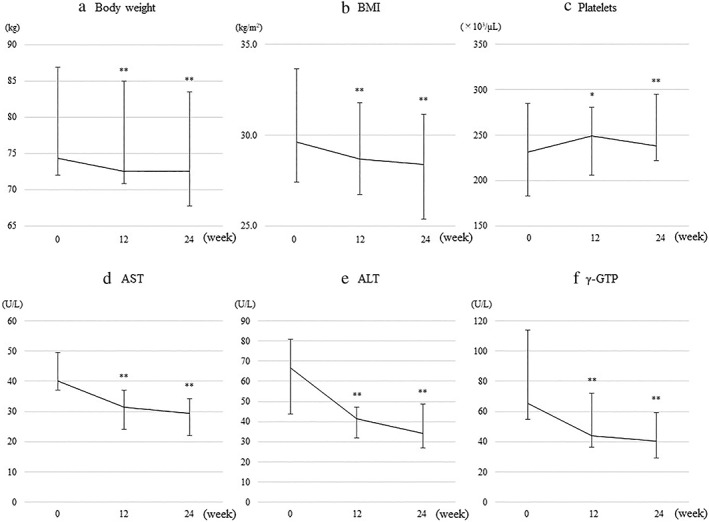
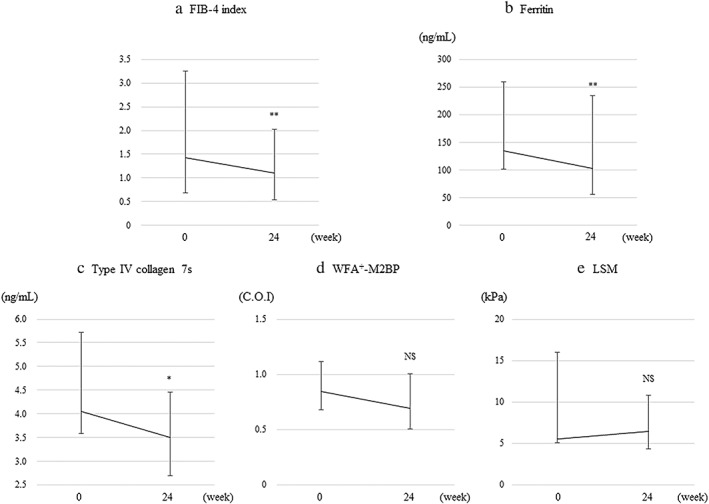
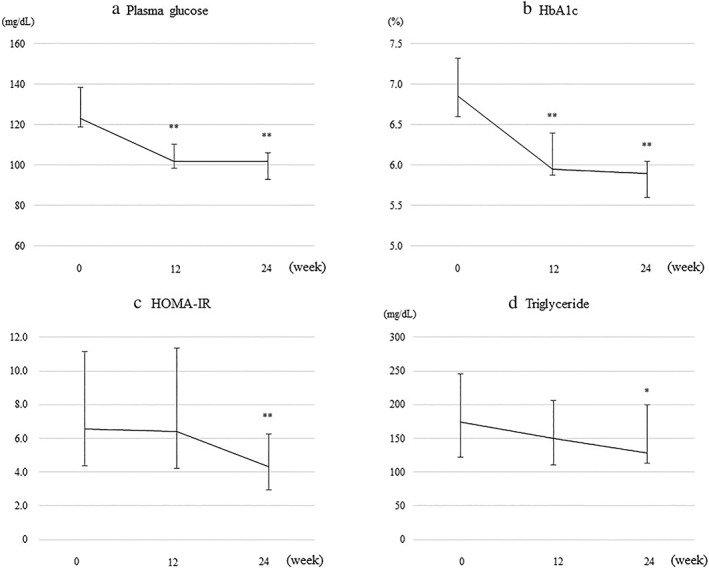
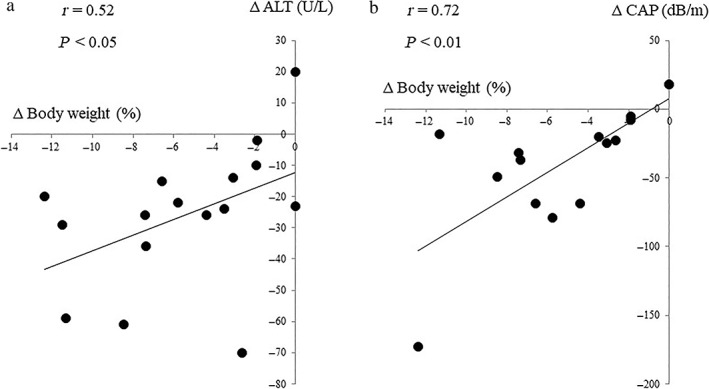
Body weight and levels of liver-related biochemistry, plasma glucose, and hemoglobin A1c decreased significantly from baseline to 12 weeks. These significant decreases were maintained until the end of the trial. Additionally, levels of the homeostasis model assessment-insulin resistance and triglyceride significantly decreased at 24 weeks. Controlled attenuation parameter (CAP) values significantly decreased from baseline to 24 weeks. Changes in body weight were correlated with those in levels of alanine aminotransferase ( = 0.52) and CAP ( = 0.72). As for liver fibrosis markers, significant decreases from baseline to 24 weeks in levels of the fibrosis-4 index, ferritin, and type IV collagen 7 s were found; however, the liver stiffness measurement did not significantly decrease. Most adverse events were grade 1-2 transient gastrointestinal disorders.
Oral semaglutide treatment in patients with NAFLD complicated by T2DM improved impaired liver function, hypertriglyceridemia, insulin resistance, and hepatic steatosis, as well as improving diabetic status and reducing body weight.
本研究旨在阐明口服司美格鲁肽治疗非酒精性脂肪性肝病(NAFLD)合并2型糖尿病(T2DM)患者的疗效和安全性。
这是一项单臂、开放标签的试点研究。纳入分析的16例接受口服司美格鲁肽治疗T2DM的NAFLD患者。口服司美格鲁肽起始剂量为每日3毫克,4周时剂量依次增加至7毫克,8周时增加至14毫克(维持剂量),直至24周试验结束。
从基线到12周,体重、肝脏相关生化指标、血糖和糖化血红蛋白水平显著下降。这些显著下降一直维持到试验结束。此外,24周时稳态模型评估-胰岛素抵抗和甘油三酯水平显著下降。受控衰减参数(CAP)值从基线到24周显著下降。体重变化与丙氨酸氨基转移酶水平(r = 0.52)和CAP(r = 0.72)变化相关。至于肝纤维化标志物,从基线到24周,纤维化-4指数、铁蛋白和IV型胶原7s水平显著下降;然而,肝脏硬度测量值没有显著下降。大多数不良事件为1-2级短暂性胃肠道疾病。
口服司美格鲁肽治疗NAFLD合并T2DM患者可改善肝功能受损、高甘油三酯血症、胰岛素抵抗和肝脂肪变性,同时改善糖尿病状态并减轻体重。