
左右胫骨平台的对称性:200 个胫骨平台的比较。
The symmetry of the left and right tibial plateau: a comparison of 200 tibial plateaus.
机构信息
Department of Trauma Surgery, Radboud University Medical Center, Geert Groteplein Zuid, 6525 GA, Nijmegen, the Netherlands.
Orthopaedic Research Laboratory, Radboud Institute for Health Sciences, Radboud University Medical Center, Nijmegen, The Netherlands.
出版信息
Eur J Trauma Emerg Surg. 2023 Feb;49(1):69-74. doi: 10.1007/s00068-022-02043-5. Epub 2022 Jul 13.
PURPOSE
This study aims to investigate the symmetry of the left and right tibial plateau in young healthy individuals to determine whether left-right mirroring can be reliably used to optimize preoperative 3D virtual planning for patients with tibial plateau fractures.
METHODS
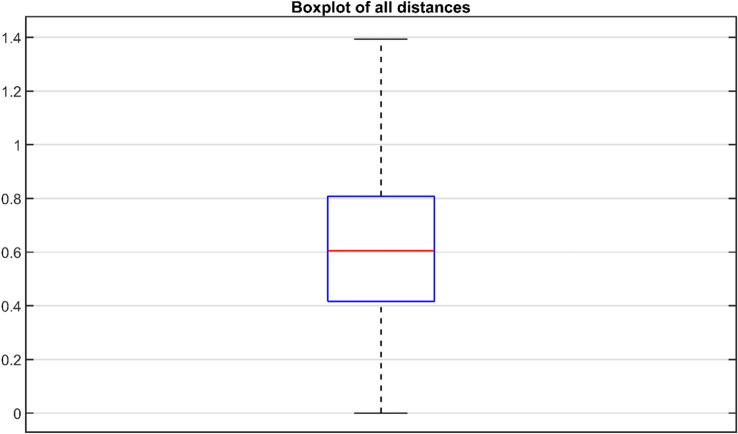
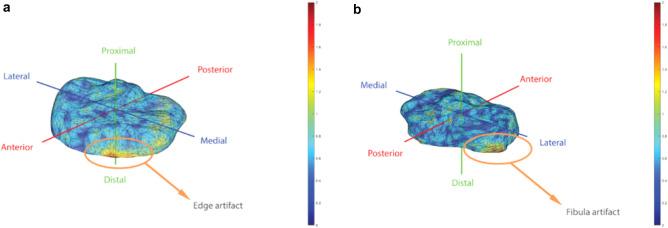
One hundred healthy subjects, without previous knee surgery, severe knee trauma, or signs of osteoarthritis were included for a previous dynamic imaging study of the knee. The subjects underwent a CT scan, scanning the left and right knee with a slice thickness of 0.8 mm. 3D surface models of the femur, patella, and tibia were created using a convolutional neural network. The 3D models of the left and right tibias were exported to MATLAB © and the tibias were mirrored. The mirrored tibias were superimposed on the contralateral tibia using a coherent point drift surface matching algorithm. Correspondence points on both surfaces were established, the mean root squared distance was calculated and visualized in a boxplot and heatmaps.
RESULTS
The overall mean difference between correspondence points on the left and right tibial plateau is 0.6276 ± 0.0343 mm. The greatest differences between correspondence points were seen around two specific surfaces on the outside of the tibial plateau; where the distal tibia was cut 15 mm below the tibial plateau and around the tibiofibular joint.
CONCLUSIONS
The differences between the left and right tibial plateau are small and therefore, we can be confident that the mirrored contralateral, unfractured, tibial plateau can be used as a template for 3D virtual preoperative planning for young patients without previous damage to the knee.
目的
本研究旨在探讨年轻健康个体左右胫骨平台的对称性,以确定左右镜像是否可用于优化胫骨平台骨折患者的术前 3D 虚拟规划。
方法
本研究共纳入 100 名健康受试者,无膝关节手术史、严重膝关节创伤或骨关节炎迹象。这些受试者接受了膝关节动态影像学研究的 CT 扫描,扫描左膝和右膝的层厚为 0.8mm。使用卷积神经网络创建股骨、髌骨和胫骨的 3D 表面模型。将左、右胫骨的 3D 模型导出到 MATLAB©并镜像胫骨。使用相干点漂移表面匹配算法将镜像胫骨与对侧胫骨叠加。在两个表面上建立对应点,计算并可视化均方根距离的均值在箱线图和热图中。
结果
左右胫骨平台对应点的总体平均差异为 0.6276±0.0343mm。在胫骨平台外侧的两个特定表面周围,以及在胫骨远端 15mm 以下和胫腓关节周围,对应点之间的差异最大。
结论
左右胫骨平台之间的差异很小,因此,我们可以有信心认为,镜像的对侧、未骨折的胫骨平台可以作为年轻患者无膝关节既往损伤的 3D 虚拟术前规划模板。


 Zotero 插件