Department of Molecular and Clinical Medicine, Institute of Medicine, Sahlgrenska Academy, University of Gothenburg, Gothenburg, Sweden.
INSERM UMR 1073, Institute for Research and Innovation in Biomedicine, Normandy University, Rouen, France.
United European Gastroenterol J. 2022 Sep;10(7):754-764. doi: 10.1002/ueg2.12277. Epub 2022 Jul 13.
Irritable bowel syndrome patients report reduced disease-specific quality of life (IBSQOL). Factors of potential relevance for QOL include gastrointestinal (GI), psychological, and somatic symptoms, demographics, and GI motor and sensory abnormalities.
The aim of our study was to evaluate the relative importance of these factors on the different IBSQOL dimensions.
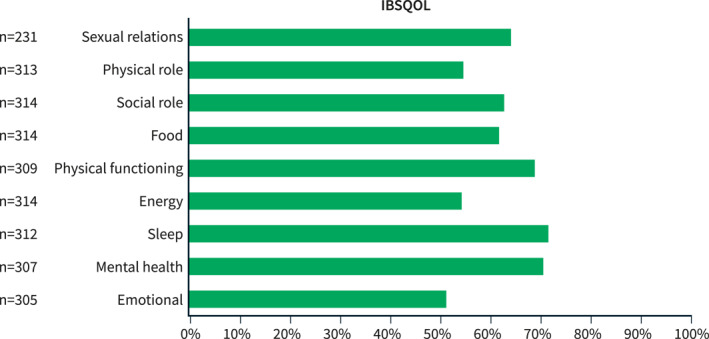
We included irritable bowel syndrome (IBS) patients who completed validated questionnaires to assess QOL, stool form and frequency, GI symptom severity, psychological distress, GI-specific anxiety, sense of coherence, and overall somatic symptom severity. Patients also underwent tests for oroanal transit time and rectal sensitivity. The nine dimensions of IBSQOL and their average (overall IBSQOL) were used as outcome variables, and factors associated with these were assessed using general linear models.
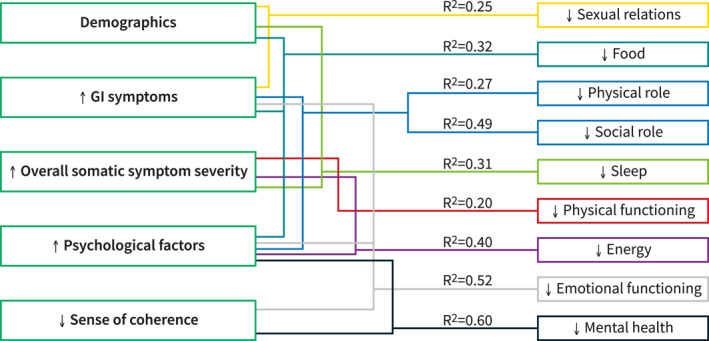
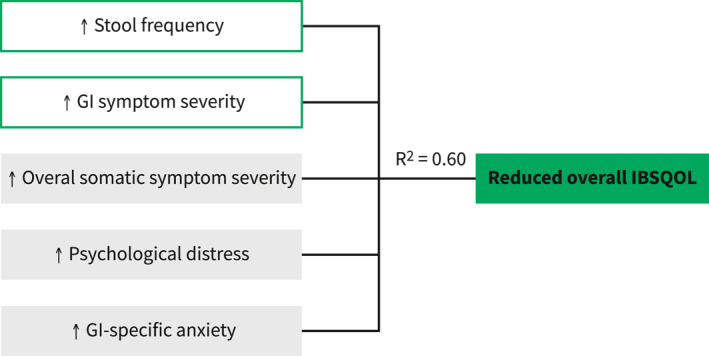
We included 314 IBS patients (74% female, mean age 36.3 ± 12.2 years). Higher stool frequency, GI and overall somatic symptom severity, psychological distress, and GI-specific anxiety were independently associated with reduced overall IBSQOL, with the model explaining 60% of the variance (p < 0.001). In models using each of the nine dimensions as outcomes, different association of demographic factors, GI symptoms, overall somatic symptom severity, psychological factors and sense of coherence were associated with reduced IBSQOL, explaining 20%-60% of the variance, with GI-specific anxiety being the factor that contributed most frequently. Rectal sensitivity or oroanal transit time were not independently associated with any of the dimensions.
Different combinations of demographic factors, GI and somatic symptoms, and psychological factors are of importance for the nine IBSQOL dimensions. Gastrointestinal-specific anxiety was the most important factor contributing to the majority of those dimensions in patients with IBS.
肠易激综合征患者报告疾病特异性生活质量(IBSQOL)降低。可能与 QOL 相关的因素包括胃肠道(GI)、心理和躯体症状、人口统计学以及 GI 运动和感觉异常。
我们研究的目的是评估这些因素对不同 IBSQOL 维度的相对重要性。
我们纳入了完成了评估生活质量、粪便形态和频率、GI 症状严重程度、心理困扰、GI 特异性焦虑、应对感和整体躯体症状严重程度的验证性问卷的肠易激综合征(IBS)患者。患者还接受了口肛传输时间和直肠敏感性测试。IBSQOL 的九个维度及其平均值(总体 IBSQOL)被用作结局变量,使用一般线性模型评估与这些结局变量相关的因素。
我们纳入了 314 名 IBS 患者(74%为女性,平均年龄 36.3±12.2 岁)。更高的粪便频率、GI 和整体躯体症状严重程度、心理困扰和 GI 特异性焦虑与整体 IBSQOL 降低独立相关,该模型解释了 60%的方差(p<0.001)。在使用每个九个维度作为结局的模型中,不同的人口统计学因素、GI 症状、整体躯体症状严重程度、心理因素和应对感与 IBSQOL 降低相关,解释了 20%-60%的方差,其中 GI 特异性焦虑是最常起作用的因素。直肠敏感性或口肛传输时间与任何维度均无独立关联。
不同的人口统计学因素、GI 和躯体症状以及心理因素的组合对 IBSQOL 的九个维度很重要。在 IBS 患者中,GI 特异性焦虑是导致大多数维度的最重要因素。