Department of Neurology, The Affiliated Lianyungang Hospital of Xuzhou Medical University, Jiangsu, China.
State Key Laboratory of Cardiovascular Disease, Fuwai Hospital, National Center for Cardiovascular Diseases, Chinese Academy of Medical Sciences and Peking Union Medical College, Beijing, China.
Aging (Albany NY). 2022 Jul 13;14(14):5749-5767. doi: 10.18632/aging.204174.
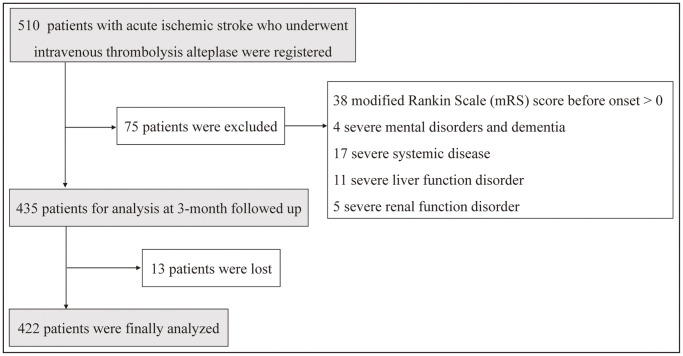
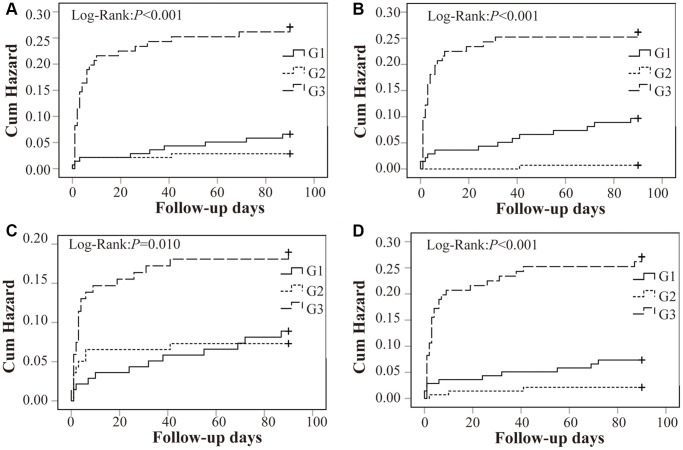
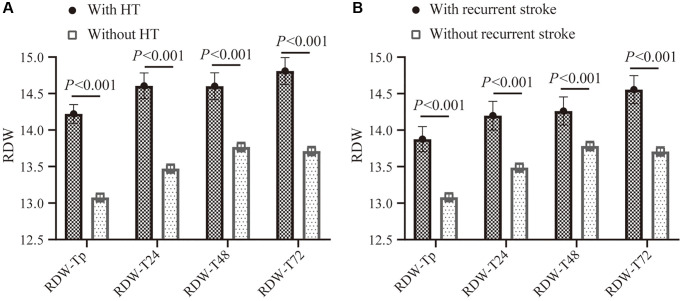
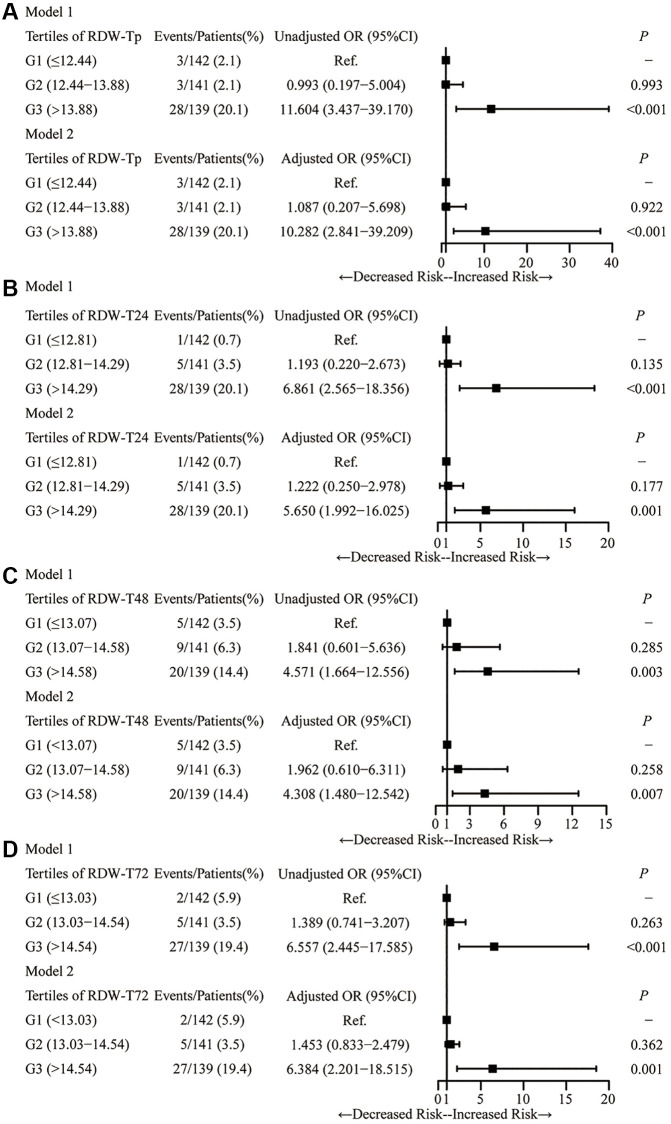
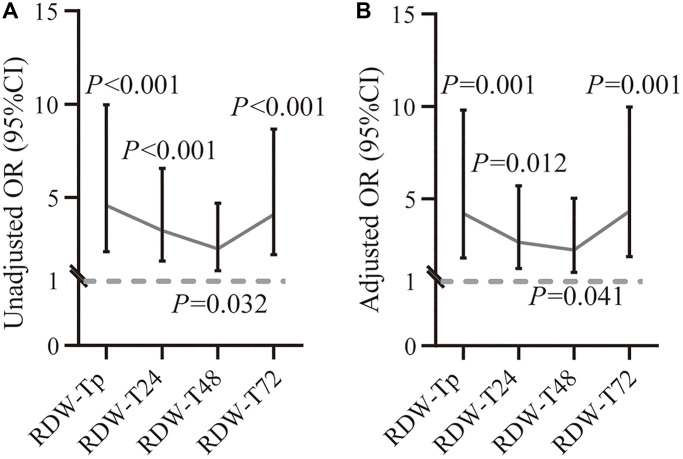
The relationship between red blood cell distribution width (RDW) in peripheral thrombolysis period and prognosis is not fully clarified in those who underwent intravenous thrombolysis (IVT) for acute ischemic stroke (AIS). Our study aimed to clarify this issue. A retrospective analysis of about 510 consecutive thrombolysis cases for AIS from January 2015 to March 2019 in a single-center database was done and followed-up for 3 months. We used univariate and multivariable models to evaluate the relationship between RDW levels at various time-points after IVT and the occurrence risk of hemorrhagic transformation (HT) and recurrent stroke, and used COX regression to assess the hazard ratios of outcomes with RDW levels. Elevated risk of HT was found in higher tertiles of RDW (OR = 10.282, 95% confidence interval (CI) 2.841-39.209, < 0.001 in Tp tertile G3; OR = 5.650, 95% CI 1.992-16.025, = 0.001 in T24 tertile G3; OR = 4.308, 95% CI 1.480-12.542, = 0.007 in T48 tertile G3 and OR = 6.384, 95% CI 2.201-18.515, = 0.001 in T72 tertile G3, respectively). Occurrence of recurrent stroke was highest in the RDW tertile G3 (HR = 4.580, 95% CI 2.123-9.883, < 0.001 in Tp tertile G3; HR = 5.731, 95% CI 2.498-13.151, = 0.001 in T24 tertile G3; HR = 3.019, 95% CI 1.969-4.059, = 0.031 in T48 tertile G3; HR = 3.318, 95% CI 1.598-6.890, = 0.001 in T72 tertile G3, respectively). Mean RDW levels ≥13.60 among AIS patients undergoing thrombolysis was associated with higher risk of HT and recurrent stroke.
RDW 在周围溶栓期与预后的关系在接受急性缺血性脑卒中(AIS)静脉溶栓(IVT)的患者中尚未完全阐明。我们的研究旨在阐明这个问题。对 2015 年 1 月至 2019 年 3 月在一个单中心数据库中接受溶栓治疗的约 510 例 AIS 患者进行回顾性分析,并进行了 3 个月的随访。我们使用单变量和多变量模型评估了 IVT 后不同时间点 RDW 水平与出血性转化(HT)和复发性卒中发生风险之间的关系,并使用 COX 回归评估了 RDW 水平与结局的危险比。RDW 较高的三分位(OR=10.282,95%置信区间(CI)2.841-39.209,Tp 三分位 G3 <0.001;OR=5.650,95%CI 1.992-16.025,T24 三分位 G3 = 0.001;OR=4.308,95%CI 1.480-12.542,T48 三分位 G3 = 0.007;OR=6.384,95%CI 2.201-18.515,T72 三分位 G3 = 0.001)与 HT 的发生风险增加相关。RDW 三分位 G3 组复发性卒中的发生率最高(HR=4.580,95%CI 2.123-9.883,Tp 三分位 G3 <0.001;HR=5.731,95%CI 2.498-13.151,T24 三分位 G3 = 0.001;HR=3.019,95%CI 1.969-4.059,T48 三分位 G3 = 0.031;HR=3.318,95%CI 1.598-6.890,T72 三分位 G3 = 0.001)。接受溶栓治疗的 AIS 患者平均 RDW 水平≥13.60 与 HT 和复发性卒中风险增加相关。