Department of Rheumatology and Clinical Immunology, Peking Union Medical College Hospital, Chinese Academy of Medical Sciences and Peking Union Medical College, The Ministry of Education Key Laboratory, National Clinical Research Center for Dermatologic and Immunologic Diseases, Beijing, China.
Department of Rheumatology and Clinical Immunology, the Third Affiliated Hospital of Chongqing Medical University, Chongqing, China.
Front Immunol. 2022 Jun 27;13:885198. doi: 10.3389/fimmu.2022.885198. eCollection 2022.
The aim of this study is to investigate the clinical significance of myeloperoxidase (MPO)-antineutrophil cytoplasmic antibody (ANCA) on eosinophilic granulomatosis with polyangiitis (EGPA) from a longitudinal Chinese cohort.
A total of 120 patients with EGPA were consecutively enrolled and followed up. Two patients with PR3 ANCA was excluded and our analysis focused on the 118 patients with EGPA. On the basis of MPO-ANCA status, baseline clinical manifestations, treatment, and outcomes were analyzed. Logistic regression analysis was performed to analyze the independently associated factors for renal involvement.
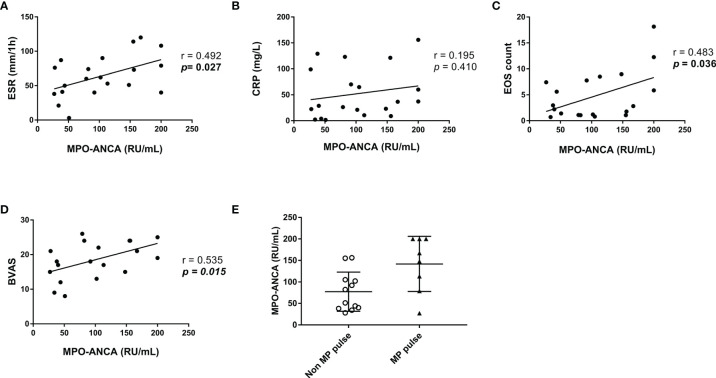
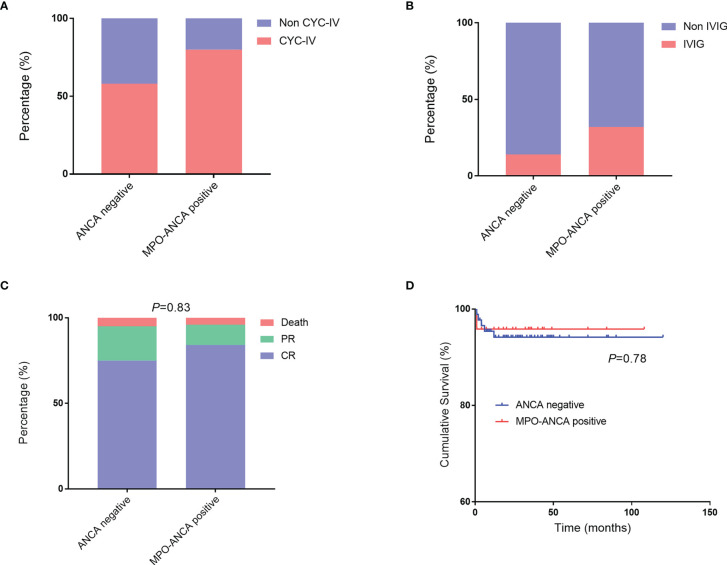
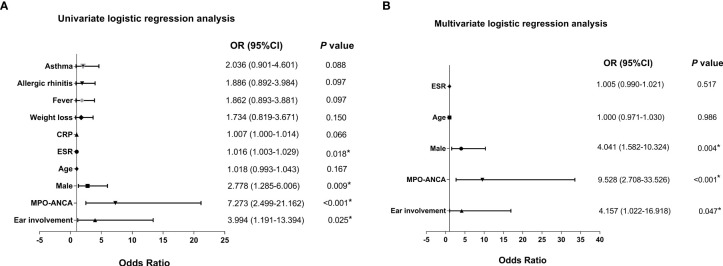
ANCA positivity was observed in 24.2% of patients with EGPA. Patients with MPO-ANCA accounted for 20.8%. Patients with positive MPO-ANCA had higher levels of erythrocyte sedimentation rate (ESR), C-reactive protein, Birmingham Vasculitis Activity Score (BVAS), higher ratios of fever, myalgia, renal involvement, and biopsy-proven vasculitis. Heart manifestations and asthma were more common in patients with negative ANCA. Baseline MPO-ANCA titers positively correlated with ESR, eosinophil count, and BVAS and were higher in patients with methylprednisolone pulse. Among patients with renal involvement, patients with positive MPO-ANCA had higher proportions of female, fever, biopsy-proven vasculitis, and faster ESR; patients with negative ANCA developed more skin and cardiac involvement. MPO-ANCA positivity, male, and ear involvement were the independent factors associated with renal involvement. Intravenous cyclophosphamide and immunoglobulins were prescribed more frequently in patients with positive MPO-ANCA.
In this cohort, patients with positive MPO-ANCA and negative ANCA displayed distinct clinical features, suggesting that MPO-ANCA might be a valuable biomarker for EGPA stratification. Baseline MPO-ANCA level correlated positively with disease activity of EGPA. MPO-ANCA was a significant independent factor associated with renal involvement.
本研究旨在从中国纵向队列中探讨髓过氧化物酶(MPO)-抗中性粒细胞胞质抗体(ANCA)对嗜酸性肉芽肿性多血管炎(EGPA)的临床意义。
连续纳入 120 例 EGPA 患者并进行随访。排除 2 例 PR3-ANCA 阳性患者,我们的分析集中在 118 例 EGPA 患者。根据 MPO-ANCA 状态,分析基线临床特征、治疗和结局。采用 Logistic 回归分析分析肾受累的独立相关因素。
EGPA 患者中 ANCA 阳性率为 24.2%,MPO-ANCA 阳性率为 20.8%。MPO-ANCA 阳性患者的红细胞沉降率(ESR)、C 反应蛋白、伯明翰血管炎活动评分(BVAS)水平较高,发热、肌痛、肾受累和活检证实的血管炎的比例较高。阴性 ANCA 患者更常见心脏表现和哮喘。基线 MPO-ANCA 滴度与 ESR、嗜酸性粒细胞计数和 BVAS 呈正相关,且在接受甲泼尼龙脉冲治疗的患者中更高。在肾受累患者中,MPO-ANCA 阳性患者中女性、发热、活检证实的血管炎和 ESR 更快的比例较高,阴性 ANCA 患者更易出现皮肤和心脏受累。MPO-ANCA 阳性、男性和耳部受累是肾受累的独立相关因素。MPO-ANCA 阳性患者更常接受静脉环磷酰胺和免疫球蛋白治疗。
在本队列中,MPO-ANCA 阳性和阴性 ANCA 的患者表现出不同的临床特征,提示 MPO-ANCA 可能是 EGPA 分层的有价值的生物标志物。基线 MPO-ANCA 水平与 EGPA 的疾病活动呈正相关。MPO-ANCA 是肾受累的显著独立相关因素。