Univ Paris Est Créteil, INSERM, IMRB, AP-HP, Hôpitaux Universitaires H. Mondor, DMU IMPACT, Fondation FondaMental, 94010, Créteil, France.
Service d'information Médical, Hôpitaux Universitaire Henri-Mondor, 94000, Créteil, France.
Environ Sci Pollut Res Int. 2022 Dec;29(59):88577-88586. doi: 10.1007/s11356-022-21964-7. Epub 2022 Jul 14.
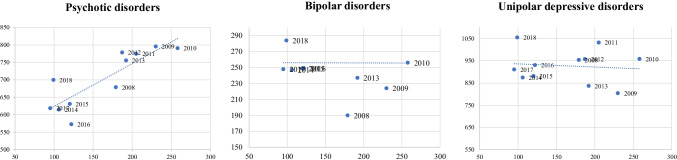
Particulate matters with a diameter of less than 10 µm (PM) or less than 2.5 µm (PM) are major air pollutants. Their relationship to psychiatric disorders has not yet been extensively studied. We aimed to explore the relationship between PM and PM air pollution peaks and the daily number of emergency visits for psychotic and mood disorders. Clinical data were collected from the Emergency Department of a Paris suburb (Créteil, France) from 2008 to 2018. Air pollution data were measured by the Paris region air quality network (Airparif) and collected from public databases. Pollution peak periods were defined as days for which the daily mean level of PM was above nationally predefined warning thresholds (20 µg/m for PM, and 50 µg/m for PM), and the 6 following days. Multivariable analyses compared the number of daily visits for psychotic and mood (unipolar and bipolar) disorders according to pollution peak, using negative binomial regression. After adjustment on meteorological variables (temperature, humidity, amount of sunshine in minutes), the daily number of emergency visits for psychotic disorders was significantly higher during PM and PM air pollution peak periods; while the number of visits for unipolar depressive disorders was higher only during PM peak periods (β = 0.059, p-value = 0.034). There were no significant differences between peak and non-peak periods for bipolar disorders. Differences in the effects of PM air pollution on psychotic and mood disorders should be analyzed in further studies.
直径小于 10μm(PM)或小于 2.5μm(PM)的颗粒物是主要的空气污染物。它们与精神障碍之间的关系尚未得到广泛研究。我们旨在探讨 PM 和 PM 空气污染峰值与精神和心境障碍急诊就诊人数之间的关系。临床数据来自 2008 年至 2018 年法国巴黎郊区克里特尔(Créteil)的急诊部。空气污染数据由巴黎地区空气质量网络(Airparif)测量,并从公共数据库中收集。污染高峰期定义为每日 PM 平均水平高于国家预先设定的警告阈值(PM 为 20μg/m,PM 为 50μg/m)的天数和随后的 6 天。多变量分析使用负二项回归,根据污染高峰期比较精神和心境(单相和双相)障碍的每日就诊次数。在调整气象变量(温度、湿度、阳光分钟数)后,精神障碍的急诊就诊人数在 PM 和 PM 空气污染高峰期显著增加;而单相抑郁障碍的就诊次数仅在 PM 高峰期增加(β=0.059,p 值=0.034)。双相障碍在高峰期和非高峰期之间没有显著差异。在进一步的研究中,应分析 PM 空气污染对精神和心境障碍的影响差异。