Laboratoire d'Aérologie, University of Toulouse III - Paul Sabatier, Toulouse, France.
Sci Rep. 2022 Jul 14;12(1):11985. doi: 10.1038/s41598-022-16240-0.
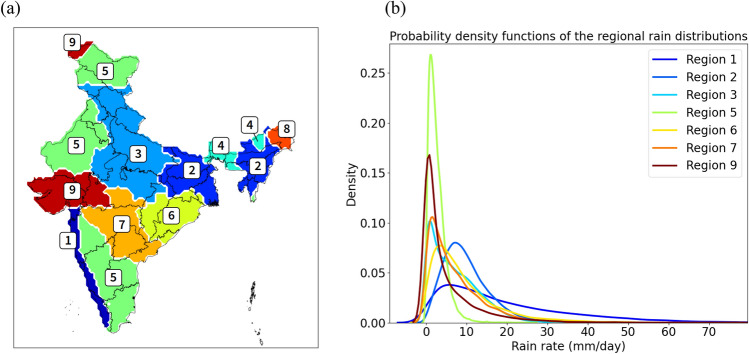
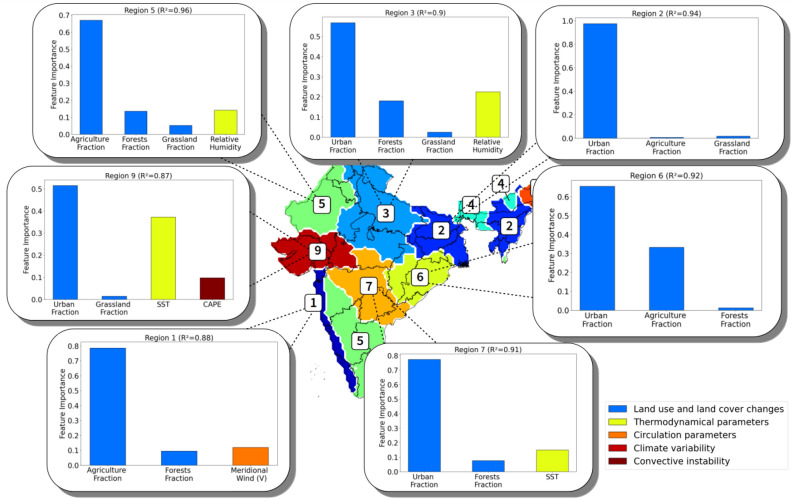
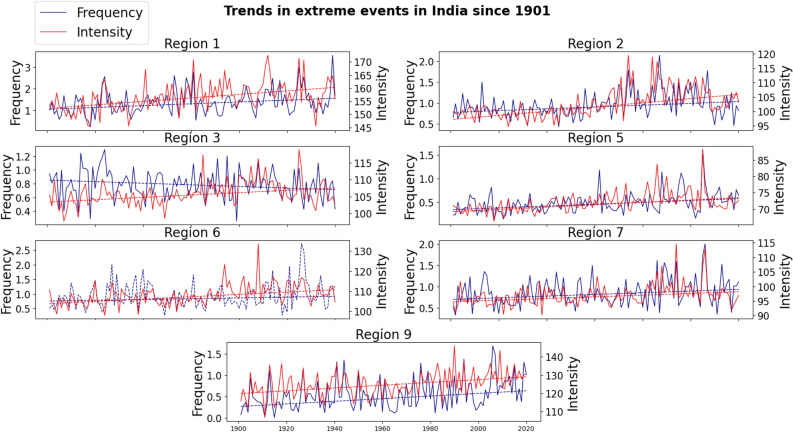
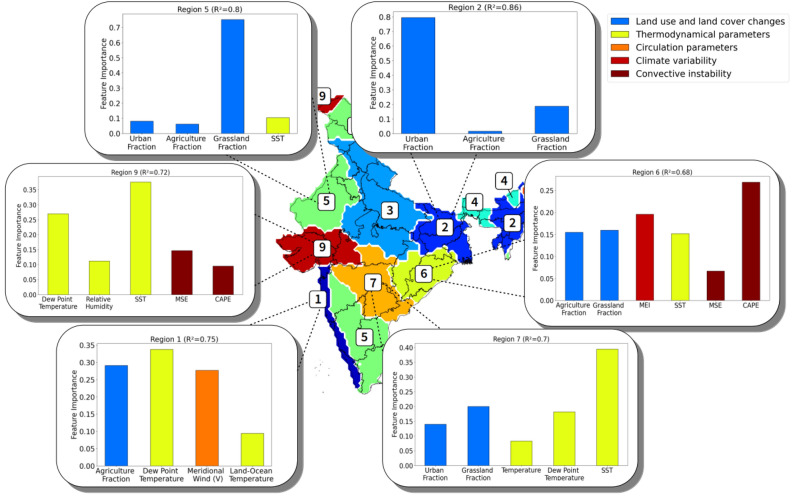
The trends of extreme precipitation events during the Indian summer monsoon measured by two different indicators have been analyzed for the period of 1901-2020, covering the entire India in 9 regions segregated by a clustering analysis based on rainfall characteristics using the Indian Meteorological Department high-resolution gridded data. In seven regions with sufficiently high confidence in the precipitation data, 12 out of the 14 calculated trends are found to be statistically significantly increasing. The important climatological parameters correlated to such increasing trends have also been identified by performing for the first time a multivariate analysis using a nonlinear machine learning regression with 17 input variables. It is found that man-made long-term shifting of land-use and land-cover patterns, and most significantly the urbanization, play a crucial role in the prediction of the long-term trends of extreme precipitation events, particularly of the intensity of extremes. While in certain regions, thermodynamical, circulation, and convective instability parameters are also found to be key predicting factors, mostly of the frequency of the precipitation extremes. The findings of these correlations to the monsoonal precipitation extremes provides a foundation for further causal relation analyses using advanced models.
利用印度气象局高分辨率网格化数据,基于降水特征的聚类分析,将印度分为 9 个区域,对 1901 年至 2020 年整个印度的两个不同指标测量的印度夏季风期间极端降水事件的趋势进行了分析。在降水数据置信度足够高的 7 个区域中,计算出的 14 个趋势中有 12 个呈显著增加趋势。首次通过使用具有 17 个输入变量的非线性机器学习回归进行多元分析,确定了与这些增加趋势相关的重要气候参数。研究发现,人为的土地利用和土地覆盖模式的长期转变,尤其是城市化,在极端降水事件的长期趋势预测中起着至关重要的作用,特别是在极端强度方面。虽然在某些地区,热力学、环流和对流不稳定性参数也被发现是关键的预测因素,主要是降水极值的频率。这些与季风降水极值的相关性研究为使用先进模型进行进一步的因果关系分析提供了基础。