Burlen Jordan, Chennubhotla Suma, Ahmed Shifat, Landes Sarah, Ramirez Allan, Stocker Abigail M, Abell Thomas L
Division of Gastroenterology, Department of Internal Medicine, The Ohio State University, Columbus, OH, USA.
Division of Gastroenterology, Department of Internal Medicine, St. Elizabeth Healthcare, Crestview Hills, KY, USA.
Gastroenterology Res. 2022 Jun;15(3):120-126. doi: 10.14740/gr1501. Epub 2022 Jun 22.
Lung transplant patients are at risk of developing chronic lung allograft dysfunction (CLAD) of which bronchitis obliterans syndrome (BOS) is the most common. These patients also are noted to develop gastrointestinal (GI) disease. Gastroesophageal reflux disease (GERD) is implicated in BOS, and diagnosis and treatment of GERD may help to decrease incidence of BOS.
A total of 131 lung transplant recipients with post-transplant evaluation between 2012 and 2019 were studied. Of 60 post-transplant evaluations with at least 6 months of post-transplant follow-up that included impedance testing, high-resolution manometry (HRM), and pH testing, procedures were performed according to recognized standards.
Of 60 patients, 56 (93%) were alive at 1-year post-transplant. The patients were found to have high rates of GI motility diseases: 37 patients (62%) had abnormal impedance testing, 50 patients (83%) had abnormal HRM results, 22 patients (37%) had abnormal pH test results. There was associated high rejection rates in patients with abnormal esophageal motility. There were 37 patients that had abnormal impedance test results and of those 25 patients (67%) developed rejection. Fifty patients had abnormal post-transplant HRM studies, 33 (66%) had an acute cellular rejection episode. Twenty-two patients had abnormal pH results, with 14 (63%) having an acute cellular rejection.
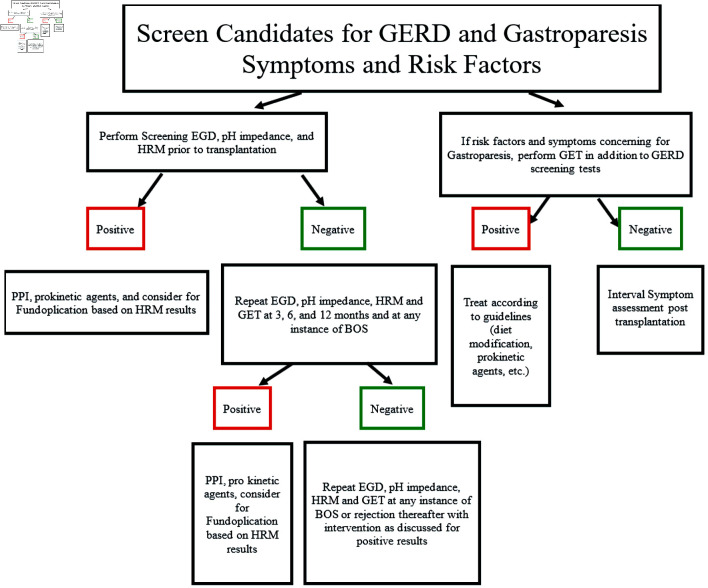
Patients undergoing lung transplantation were found to have increased incidence of abnormal GI motility studies of the esophagus. These patients were further found to have increased rejection rates and BOS which has been associated with worsened mortality. Developing a formalized pre- and post-transplant motility study process, using evolving technologies for these patients, may provide guidance of at-risk patients for CLAD and early treatment to prevent CLAD.
肺移植患者有发生慢性肺移植功能障碍(CLAD)的风险,其中闭塞性细支气管炎综合征(BOS)最为常见。这些患者还被发现会出现胃肠道(GI)疾病。胃食管反流病(GERD)与BOS有关,GERD的诊断和治疗可能有助于降低BOS的发生率。
对2012年至2019年间接受移植后评估的131例肺移植受者进行了研究。在60例进行了至少6个月移植后随访的移植后评估中,包括阻抗测试、高分辨率测压法(HRM)和pH测试,所有检查均按照公认标准进行。
60例患者中,56例(93%)在移植后1年存活。这些患者被发现患有胃肠道动力疾病的比例很高:37例患者(62%)阻抗测试异常,50例患者(83%)HRM结果异常,22例患者(37%)pH测试结果异常。食管动力异常的患者排斥反应发生率也较高。37例阻抗测试结果异常的患者中,25例(67%)发生了排斥反应。50例移植后HRM研究异常的患者中,33例(66%)发生了急性细胞排斥反应。22例pH结果异常的患者中,14例(63%)发生了急性细胞排斥反应。
接受肺移植的患者食管胃肠道动力研究异常发生率增加。进一步发现这些患者的排斥反应率和BOS增加,而BOS与死亡率恶化有关。利用不断发展的技术为这些患者制定正式的移植前和移植后动力研究流程,可能为CLAD高危患者提供指导并进行早期治疗以预防CLAD。