Department of Oncology, 3201 Hospital of Xi'an Jiaotong University Health Science Center, Hanzhong, Shaanxi 723000, China.
School of Medicine and Public Health, Priority Research Centre for Cancer Research, University of Newcastle, Callaghan, Newcastle, NSW 2308, Australia.
Theranostics. 2022 Jun 21;12(11):4935-4948. doi: 10.7150/thno.73223. eCollection 2022.
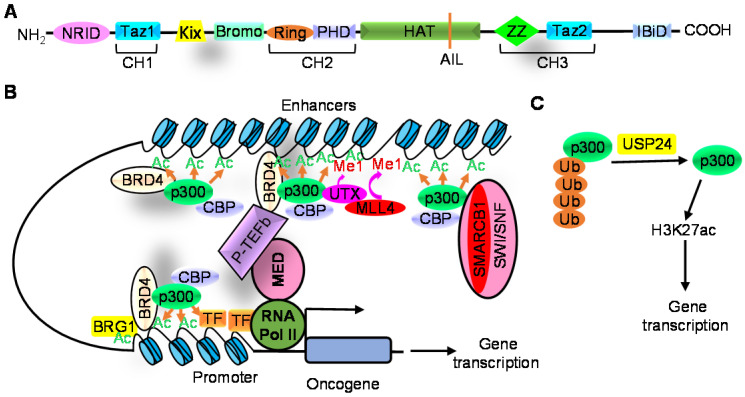
The histone acetyltransferases CBP and p300, often referred to as CBP/p300 due to their sequence homology and functional overlap and co-operation, are emerging as critical drivers of oncogenesis in the past several years. CBP/p300 induces histone H3 lysine 27 acetylation (H3K27ac) at target gene promoters, enhancers and super-enhancers, thereby activating gene transcription. While earlier studies indicate that CBP/p300 deletion/loss can promote tumorigenesis, CBP/p300 have more recently been shown to be over-expressed in cancer cells and drug-resistant cancer cells, activate oncogene transcription and induce cancer cell proliferation, survival, tumorigenesis, metastasis, immune evasion and drug-resistance. Small molecule CBP/p300 histone acetyltransferase inhibitors, bromodomain inhibitors, CBP/p300 and BET bromodomain dual inhibitors and p300 protein degraders have recently been discovered. The CBP/p300 inhibitors and degraders reduce H3K27ac, down-regulate oncogene transcription, induce cancer cell growth inhibition and cell death, activate immune response, overcome drug resistance and suppress tumor progression . In addition, CBP/p300 inhibitors enhance the anticancer efficacy of chemotherapy, radiotherapy and epigenetic anticancer agents, including BET bromodomain inhibitors; and the combination therapies exert substantial anticancer effects in mouse models of human cancers including drug-resistant cancers. Currently, two CBP/p300 inhibitors are under clinical evaluation in patients with advanced and drug-resistant solid tumors or hematological malignancies. In summary, CBP/p300 have recently been identified as critical tumorigenic drivers, and CBP/p300 inhibitors and protein degraders are emerging as promising novel anticancer agents for clinical translation.
组蛋白乙酰转移酶 CBP 和 p300,由于其序列同源性和功能重叠与合作,通常被称为 CBP/p300,近年来已成为致癌作用的关键驱动因素。CBP/p300 在靶基因启动子、增强子和超级增强子处诱导组蛋白 H3 赖氨酸 27 乙酰化(H3K27ac),从而激活基因转录。虽然早期的研究表明 CBP/p300 的缺失/丢失会促进肿瘤发生,但最近的研究表明 CBP/p300 在癌细胞和耐药癌细胞中过度表达,激活致癌基因转录并诱导癌细胞增殖、存活、肿瘤发生、转移、免疫逃逸和耐药性。最近发现了小分子 CBP/p300 组蛋白乙酰转移酶抑制剂、溴结构域抑制剂、CBP/p300 和 BET 溴结构域双重抑制剂和 p300 蛋白降解剂。CBP/p300 抑制剂和降解剂降低 H3K27ac,下调致癌基因转录,诱导癌细胞生长抑制和细胞死亡,激活免疫反应,克服耐药性并抑制肿瘤进展。此外,CBP/p300 抑制剂增强了化疗、放疗和表观遗传抗癌药物(包括 BET 溴结构域抑制剂)的抗癌疗效;联合疗法在包括耐药癌症在内的人类癌症的小鼠模型中发挥了显著的抗癌作用。目前,两种 CBP/p300 抑制剂正在晚期和耐药实体瘤或血液恶性肿瘤患者中进行临床评估。总之,CBP/p300 最近被确定为关键的致癌驱动因素,CBP/p300 抑制剂和蛋白降解剂作为有前途的新型抗癌药物正在进行临床转化。