Kunieda Mai, Sunohara Hidehiko, Inukai Yoshiaki, Reyes Vincent Pamugas, Nishiuchi Shunsaku, Doi Kazuyuki
Laboratory of Information Sciences in Agricultural Lands, Graduate School of Bioagricultural Sciences, Nagoya University, Nagoya, Japan.
Department of Botany, University of Yangon, Yangon, Myanmar.
Front Plant Sci. 2022 Jun 28;13:908000. doi: 10.3389/fpls.2022.908000. eCollection 2022.
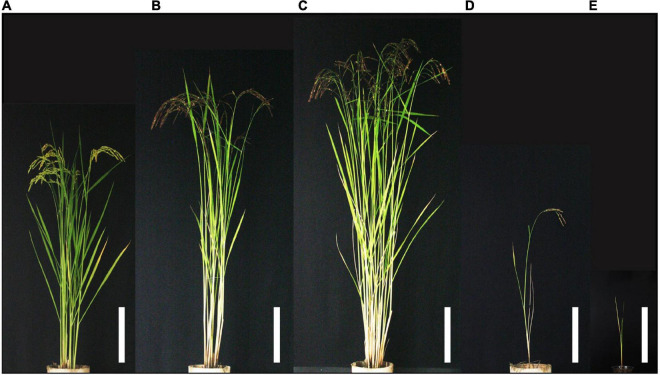
Reproductive isolation is an obstacle for plant breeding when a distant cross is demanded. It can be divided into two main types based on different growth stages: prezygotic isolation and postzygotic isolation. The hybrid weakness, which is a type of postzygotic isolation, can become a problem in crop breeding. In order to overcome reproductive isolation, it is necessary to elucidate its mechanism. In this study, genetic analysis for low temperature-dependent hybrid weakness was conducted in a rice F population derived from Taichung 65 (T65, Japonica) and Lijiangxintuanheigu (LTH, Japonica). The weak and severe weak plants in F showed shorter culm length, late heading, reduced panicle number, decreased grain numbers per panicle, and impaired root development in the field. Our result also showed that hybrid weakness was affected by temperature. It was observed that 24°C enhanced hybrid weakness, whereas 34°C showed recovery from hybrid weakness. In terms of the morphology of embryos, no difference was observed. Therefore, hybrid weakness affects postembryonic development and is independent of embryogenesis. The genotypes of 126 F plants were determined through genotyping-by-sequencing and a linkage map consisting of 862 single nucleotide polymorphism markers was obtained. Two major quantitative trait loci (QTLs) were detected on chromosomes 1 [ ()] and 11 [ ()]. Further genotyping indicated that the hybrid weakness was due to an incompatible interaction between the T65 allele of and the LTH allele of . A large F populations consisting of 5,722 plants were used for fine mapping of and . The two loci, and , were mapped in regions of 65-kb on chromosome 1 and 145-kb on chromosome 11, respectively. For , the 65-kb region contained 11 predicted genes, while in the region, 22 predicted genes were identified, two of which are disease resistance-related genes. The identified genes along these regions serve as preliminary information on the molecular networks associated with hybrid weakness in rice.
当需要进行远缘杂交时,生殖隔离是植物育种的一个障碍。根据不同的生长阶段,它可分为两种主要类型:合子前隔离和合子后隔离。杂种劣势作为合子后隔离的一种类型,可能会成为作物育种中的一个问题。为了克服生殖隔离,有必要阐明其机制。在本研究中,对来自台中65(T65,粳稻)和丽江新团黑谷(LTH,粳稻)的水稻F群体进行了低温依赖性杂种劣势的遗传分析。F群体中的弱株和严重弱株在田间表现为茎长较短、抽穗晚、穗数减少、每穗粒数减少以及根系发育受损。我们的结果还表明杂种劣势受温度影响。观察到24°C加剧了杂种劣势,而34°C时杂种劣势有所恢复。在胚胎形态方面,未观察到差异。因此,杂种劣势影响胚后发育且与胚胎发生无关。通过简化基因组测序确定了126株F植株的基因型,并获得了一个由862个单核苷酸多态性标记组成的连锁图谱。在第1染色体[()]和第11染色体[()]上检测到两个主要的数量性状位点(QTL)。进一步的基因分型表明,杂种劣势是由于和的T65等位基因与和的LTH等位基因之间的不相容相互作用所致。一个由5722株植株组成的大F群体用于对和进行精细定位。这两个位点和分别定位在第1染色体上65 kb的区域和第11染色体上145 kb的区域。对于,65 kb的区域包含11个预测基因,而在区域中,鉴定出22个预测基因,其中两个是抗病相关基因。沿这些区域鉴定出的基因可作为水稻杂种劣势相关分子网络的初步信息。