Institute for Health and Sport, Victoria University, Melbourne, Australia.
Centre for Muscle Research, Department of Anatomy and Physiology, University of Melbourne, Parkville, Australia.
J Physiol. 2022 Aug;600(16):3749-3774. doi: 10.1113/JP283017. Epub 2022 Aug 2.
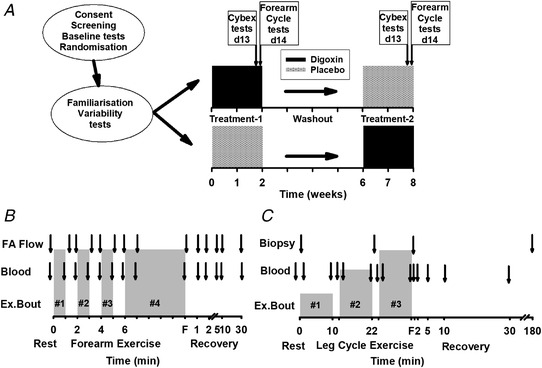
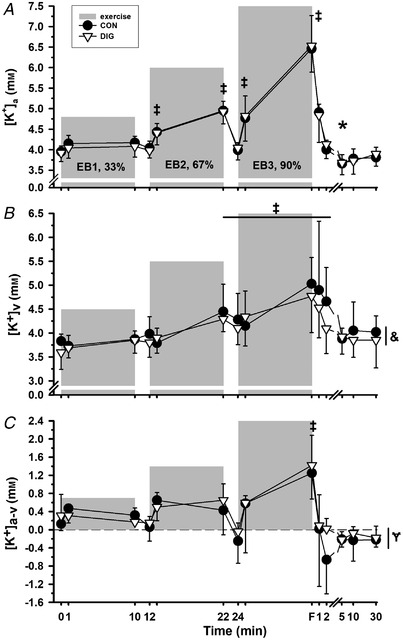
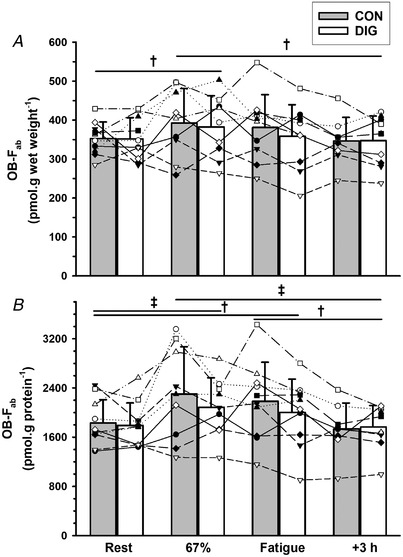
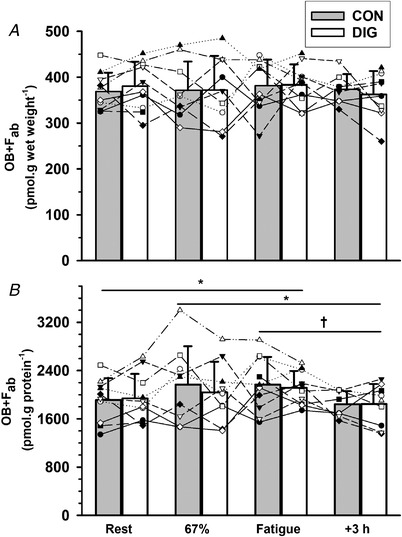
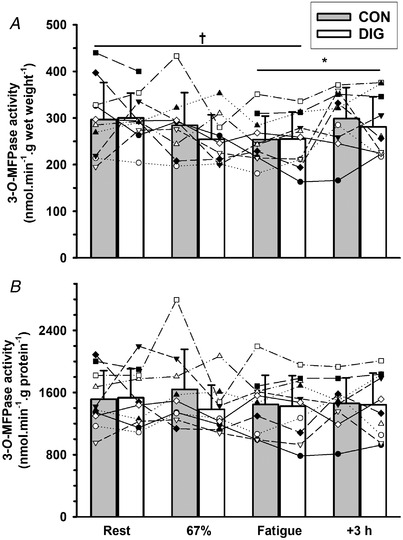
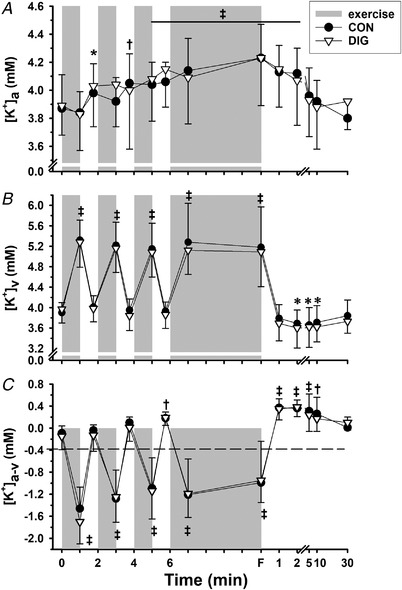
We investigated whether digoxin lowered muscle Na ,K -ATPase (NKA), impaired muscle performance and exacerbated exercise K disturbances. Ten healthy adults ingested digoxin (0.25 mg; DIG) or placebo (CON) for 14 days and performed quadriceps strength and fatiguability, finger flexion (FF, 105% , 3 × 1 min, fourth bout to fatigue) and leg cycling (LC, 10 min at 33% and 67% , 90% to fatigue) trials using a double-blind, crossover, randomised, counter-balanced design. Arterial (a) and antecubital venous (v) blood was sampled (FF, LC) and muscle biopsied (LC, rest, 67% , fatigue, 3 h after exercise). In DIG, in resting muscle, [ H]-ouabain binding site content (OB-F ) was unchanged; however, bound-digoxin removal with Digibind revealed total ouabain binding (OB+F ) increased (8.2%, P = 0.047), indicating 7.6% NKA-digoxin occupancy. Quadriceps muscle strength declined in DIG (-4.3%, P = 0.010) but fatiguability was unchanged. During LC, in DIG (main effects), time to fatigue and [K ] were unchanged, whilst [K ] was lower (P = 0.042) and [K ] greater (P = 0.004) than in CON; with exercise (main effects), muscle OB-F was increased at 67% (per wet-weight, P = 0.005; per protein P = 0.001) and at fatigue (per protein, P = 0.003), whilst [K ] , [K ] and [K ] were each increased at fatigue (P = 0.001). During FF, in DIG (main effects), time to fatigue, [K ] , [K ] and [K ] were unchanged; with exercise (main effects), plasma [K ] , [K ] , [K ] and muscle K efflux were all increased at fatigue (P = 0.001). Thus, muscle strength declined, but functional muscle NKA content was preserved during DIG, despite elevated plasma digoxin and muscle NKA-digoxin occupancy, with K disturbances and fatiguability unchanged. KEY POINTS: The Na ,K -ATPase (NKA) is vital in regulating skeletal muscle extracellular potassium concentration ([K ]), excitability and plasma [K ] and thereby also in modulating fatigue during intense contractions. NKA is inhibited by digoxin, which in cardiac patients lowers muscle functional NKA content ([ H]-ouabain binding) and exacerbates K disturbances during exercise. In healthy adults, we found that digoxin at clinical levels surprisingly did not reduce functional muscle NKA content, whilst digoxin removal by Digibind antibody revealed an ∼8% increased muscle total NKA content. Accordingly, digoxin did not exacerbate arterial plasma [K ] disturbances or worsen fatigue during intense exercise, although quadriceps muscle strength was reduced. Thus, digoxin treatment in healthy participants elevated serum digoxin, but muscle functional NKA content was preserved, whilst K disturbances and fatigue with intense exercise were unchanged. This resilience to digoxin NKA inhibition is consistent with the importance of NKA in preserving K regulation and muscle function.
我们研究了地高辛是否降低了肌肉 Na,K -ATP 酶(NKA),损害了肌肉性能,并加剧了运动 K 紊乱。10 名健康成年人服用地高辛(0.25 毫克;DIG)或安慰剂(CON)14 天,并使用双盲、交叉、随机、平衡设计进行股四头肌力量和疲劳性、手指弯曲(FF,105%,3×1 分钟,第四次疲劳)和腿部循环(LC,10 分钟在 33%和 67%,90%疲劳)试验。动脉(a)和肘前静脉(v)血液采样(FF、LC)和肌肉活检(LC、休息、67%、疲劳、运动后 3 小时)。在 DIG 中,在休息的肌肉中,[ H]-哇巴因结合位点含量(OB-F)没有变化;然而,用 Digibind 去除结合的地高辛显示总哇巴因结合(OB+F)增加(8.2%,P=0.047),表明 7.6%的 NKA-地高辛占有率。股四头肌力量在 DIG 中下降(-4.3%,P=0.010),但疲劳性不变。在 LC 中,在 DIG 中(主要效应),疲劳时间和[K ]不变,而[K ]较低(P=0.042),[K ]较高(P=0.004);运动时(主要效应),67%时肌肉 OB-F 增加(每湿重,P=0.005;每蛋白,P=0.001),疲劳时增加(每蛋白,P=0.003),而[K ]、[K ]和[K ]在疲劳时均增加(P=0.001)。在 FF 中,在 DIG 中(主要效应),疲劳时间、[K ]、[K ]和[K ]不变;运动时(主要效应),血浆[K ]、[K ]、[K ]和肌肉 K 流出在疲劳时均增加(P=0.001)。因此,尽管血浆地高辛和肌肉 NKA-地高辛占有率升高,但 DIG 期间肌肉力量下降,但功能性肌肉 NKA 含量保持不变,K 紊乱和疲劳性不变。关键点:Na,K -ATP 酶(NKA)对于调节骨骼肌细胞外钾浓度([K ])、兴奋性以及血浆[K ]和[K ]非常重要,因此也对剧烈收缩时的疲劳起到调节作用。地高辛抑制 NKA,在心脏病患者中,地高辛降低肌肉功能性 NKA 含量([ H]-哇巴因结合),并在运动时加剧 K 紊乱。在健康成年人中,我们发现,地高辛在临床水平上令人惊讶地没有降低功能性肌肉 NKA 含量,而 Digibind 抗体去除地高辛显示肌肉总 NKA 含量增加了约 8%。因此,尽管股四头肌力量下降,但地高辛并没有加剧动脉血浆[K ]紊乱或使剧烈运动时的疲劳恶化。因此,地高辛治疗在健康参与者中提高了血清地高辛水平,但保留了肌肉功能性 NKA 含量,而剧烈运动时的 K 紊乱和疲劳不变。这种对地高辛 NKA 抑制的抵抗力与 NKA 在维持 K 调节和肌肉功能方面的重要性一致。