From the Pritzker School of Medicine, University of Chicago, Chicago, IL (Feldt, Krishnan).
Department of Surgery, The University of Chicago Medicine, Chicago, IL (Keskey, Hyman, Shogan).
J Am Coll Surg. 2022 Aug 1;235(2):285-292. doi: 10.1097/XCS.0000000000000222. Epub 2022 Apr 12.
Infections after abdominal surgery remain a significant problem. Although preoperative antibiotic prophylaxis is a primary strategy used to reduce postoperative infections, it is typically prescribed based on standardized protocols, without attention to previous infection or antibiotic history. Patients with a previous infection after surgery may be at higher risk for infectious complications after subsequent operations owing to antibiotic resistance. We hypothesized that a previous postoperative infection is a significant risk factor for the development of infection after a second unrelated surgery.
We performed a retrospective study of patients who had undergone 2 unrelated abdominal operations at a tertiary care center from 2012 to 2018. Clinical variables and microbiological culture results were abstracted. Univariate and multivariable regression models were constructed.
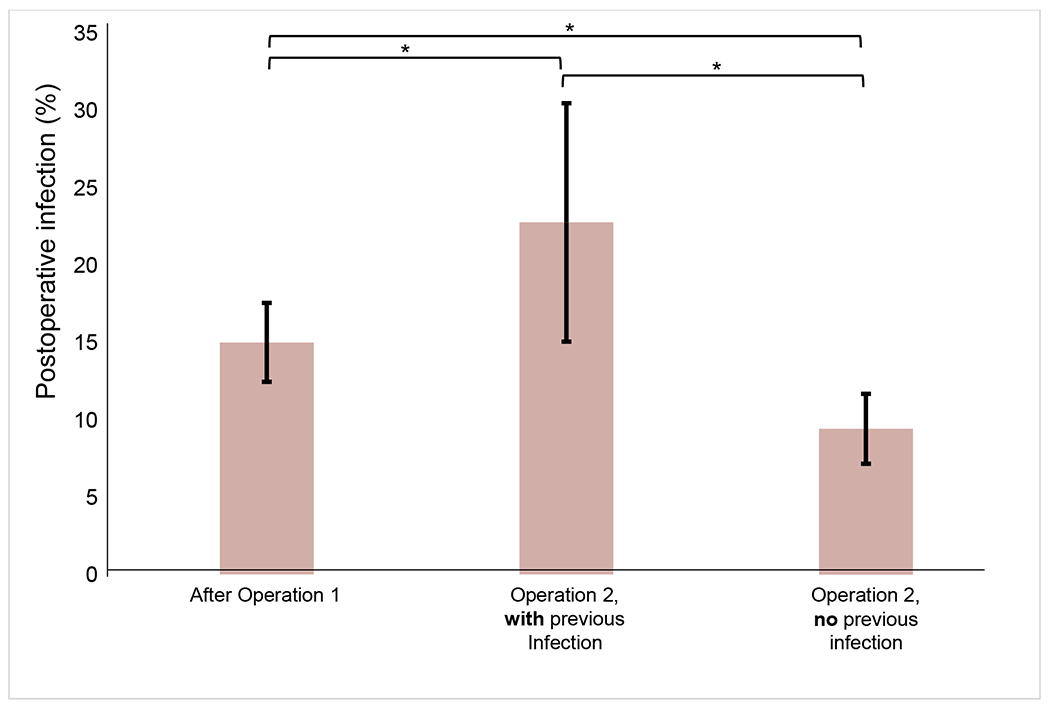
Of 758 patients, 15.0% (n = 114) developed an infection after the first operation. After the second operation, 22.8% (n = 26) of those with a previous infection developed another infection, whereas the incidence of an infection after the second operation was only 9.5% (n = 61) in patients who did not develop an infection after the first operation. Multivariable analysis demonstrated that previous infection (odds ratio 2.49, 95% CI 1.46 to 4.25) was associated with future infection risk. Microbiological analysis found that infections after the second surgery were significantly more likely to be antibiotic resistant than infections after the first surgery (82.3% vs 64.1%; p = 0.036). Strikingly, 49% of infections after the second surgery were resistant to the antibiotic prophylaxis given at the time of incision.
Previous postoperative infection is an independent risk factor for a subsequent postoperative infection and is associated with resistance to standard prophylaxis. Individualization of antibiotic prophylaxis in patients with a previous postoperative infection is warranted.
腹部手术后感染仍然是一个重大问题。尽管术前抗生素预防是降低术后感染的主要策略,但通常是根据标准化方案开处方,而不考虑先前的感染或抗生素史。手术后有先前感染的患者由于抗生素耐药性,随后手术发生感染性并发症的风险可能更高。我们假设先前手术后感染是第二次无关手术发生感染的重要危险因素。
我们对 2012 年至 2018 年在一家三级护理中心接受 2 次无关腹部手术的患者进行了回顾性研究。提取临床变量和微生物培养结果。建立单变量和多变量回归模型。
在 758 例患者中,15.0%(n=114)在第一次手术后发生感染。在第二次手术后,先前有感染的患者中有 22.8%(n=26)发生了另一次感染,而在第一次手术后未发生感染的患者中,第二次手术后感染的发生率仅为 9.5%(n=61)。多变量分析表明,先前感染(优势比 2.49,95%CI 1.46 至 4.25)与未来感染风险相关。微生物分析发现,第二次手术后的感染明显比第一次手术后的感染更可能对抗生素产生耐药性(82.3%对 64.1%;p=0.036)。引人注目的是,第二次手术后感染中 49%对抗生素预防药物耐药,而这种抗生素预防药物在切口时就已给予。
先前手术后感染是随后手术后感染的独立危险因素,并且与对标准预防措施的耐药性相关。对先前手术后感染的患者,有必要个体化使用抗生素预防。