Laboratory of Medical and Molecular Oncology, Oncology Research Center, Faculty of Medicine and Pharmacy, Vrije Universiteit Brussel, Laarbeeklaan 103, 1090, Brussels, Belgium.
Center of Medical Genetics, UZ Brussel, Brussels, Belgium.
Cell Death Dis. 2022 Jul 15;13(7):611. doi: 10.1038/s41419-022-04994-4.
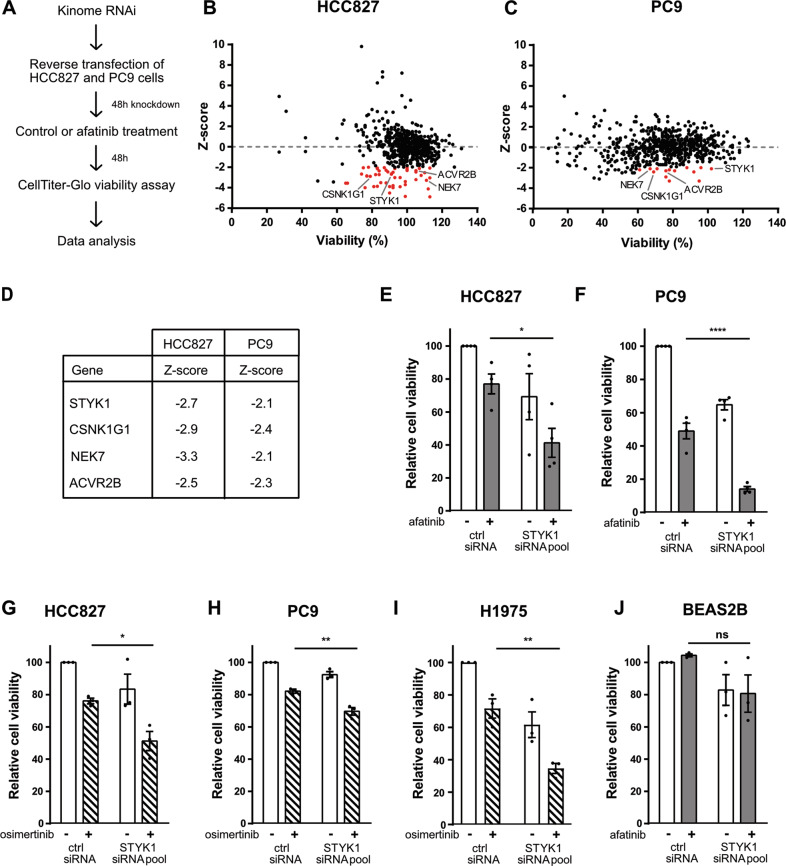
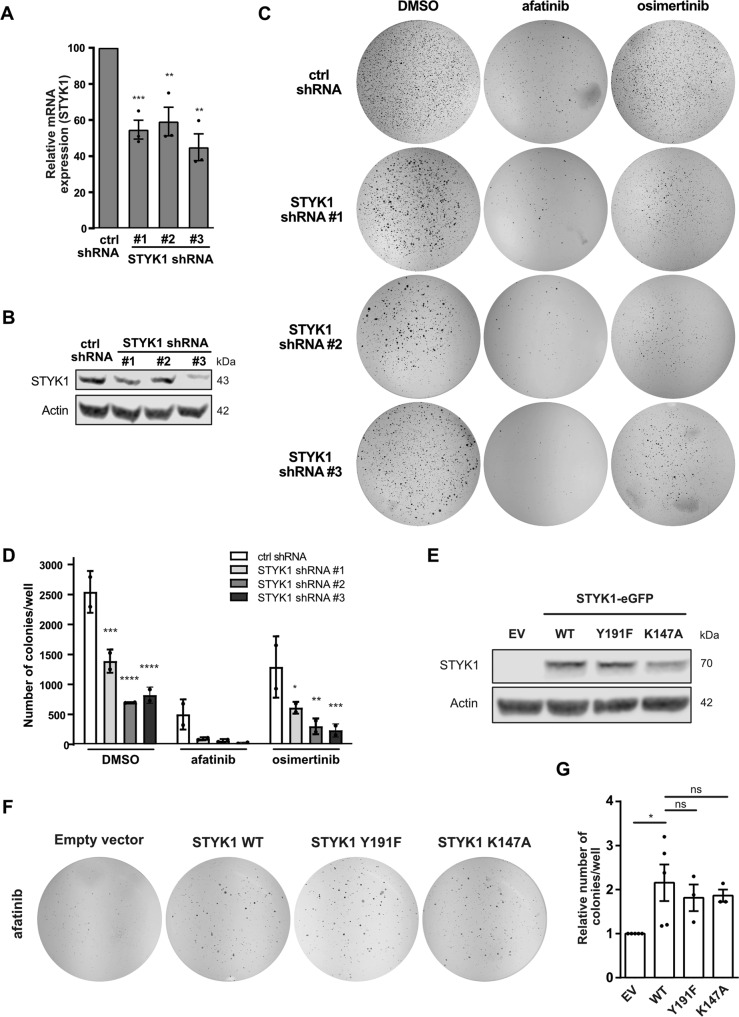
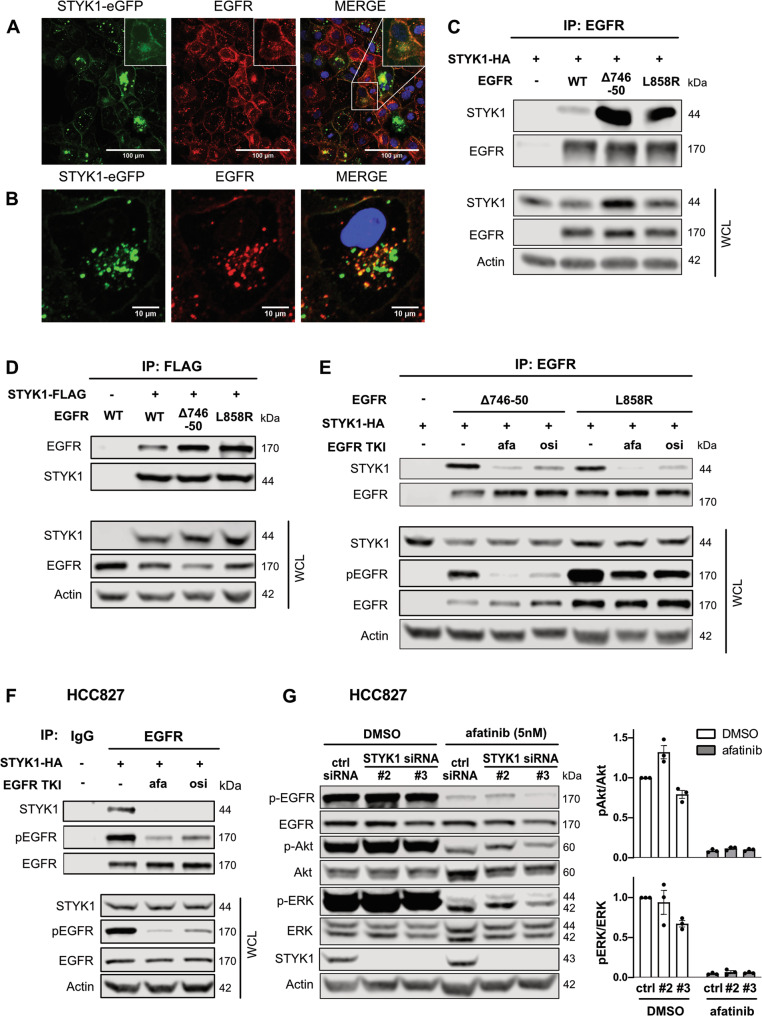
Non-small cell lung cancer (NSCLC) patients harboring activating mutations in epidermal growth factor receptor (EGFR) are sensitive to therapy with EGFR tyrosine kinase inhibitors (TKI). Despite remarkable clinical responses using EGFR TKI, surviving drug tolerant cells serve as a reservoir from which drug resistant tumors may emerge. This study addresses the need for improved efficacy of EGFR TKI by identifying targets involved in functional drug tolerance against them. To this aim, a high-throughput siRNA kinome screen was performed using two EGFR TKI-sensitive EGFR-mutant NSCLC cell lines in the presence/absence of the second-generation EGFR TKI afatinib. From the screen, Serine/Threonine/Tyrosine Kinase 1 (STYK1) was identified as a target that when downregulated potentiates the effects of EGFR inhibition in vitro. We found that chemical inhibition of EGFR combined with the siRNA-mediated knockdown of STYK1 led to a significant decrease in cancer cell viability and anchorage-independent cell growth. Further, we show that STYK1 selectively interacts with mutant EGFR and that the interaction is disrupted upon EGFR inhibition. Finally, we identified fibroblast growth factor 1 (FGF1) as a downstream effector of STYK1 in NSCLC cells. Accordingly, downregulation of STYK1 counteracted the afatinib-induced upregulation of FGF1. Altogether, we unveil STYK1 as a valuable target to repress the pool of surviving drug tolerant cells arising upon EGFR inhibition. Co-targeting of EGFR and STYK1 could lead to a better overall outcome for NSCLC patients.
非小细胞肺癌 (NSCLC) 患者携带表皮生长因子受体 (EGFR) 的激活突变对 EGFR 酪氨酸激酶抑制剂 (TKI) 的治疗敏感。尽管使用 EGFR TKI 取得了显著的临床反应,但存活的耐药细胞作为一个库,耐药肿瘤可能从中出现。本研究通过鉴定参与针对 EGFR TKI 的功能耐药的靶标来解决提高 EGFR TKI 疗效的需求。为此,在存在/不存在第二代 EGFR TKI 阿法替尼的情况下,使用两种对 EGFR TKI 敏感的 EGFR 突变型 NSCLC 细胞系进行了高通量 siRNA 激酶组筛选。在筛选中,丝氨酸/苏氨酸/酪氨酸激酶 1 (STYK1) 被鉴定为一个靶标,当下调时,可增强 EGFR 抑制在体外的作用。我们发现,EGFR 的化学抑制与 STYK1 的 siRNA 介导的敲低相结合,导致癌细胞活力和锚定非依赖性细胞生长显著下降。此外,我们表明 STYK1 选择性地与突变型 EGFR 相互作用,并且该相互作用在 EGFR 抑制时被破坏。最后,我们确定成纤维细胞生长因子 1 (FGF1) 是 NSCLC 细胞中 STYK1 的下游效应物。因此,下调 STYK1 可抵消 afatinib 诱导的 FGF1 上调。总之,我们揭示 STYK1 是一个有价值的靶标,可以抑制 EGFR 抑制时出现的存活耐药细胞库。EGFR 和 STYK1 的共同靶向可能为 NSCLC 患者带来更好的整体结果。