Endocrinology Research Centre.
Probl Endokrinol (Mosk). 2022 Apr 12;68(3):93-104. doi: 10.14341/probl12854.
Cushing's disease (CD) is a rare disorder of a persistent cortisol excess caused by ACTH-secreting pituitary tumor (corticotropinoma). Transsphenoidal surgery (TSS) is a treatment of choice for СD, which effectiveness range is from 70 to 90%. Recurrence rate after successful treatment is about 25%. If surgical treatment is unsuccessful or recurrence appear, radiation treatment is the next therapeutic option, which effectiveness range is also 90%, but the hypopituitarism rate as side effect of treatment is higher. Preoperative predictors of remission and recurrence are still unexplored what leads to further investigations.
Analysis of remission and recurrence rates of pediatric CD after successful treatment according to preoperative MRI and therapeutic option.
We conducted a retrospective analysis of 90 pediatric patients with CD who were observed between 1992 and 2020 at the Endocrinology Research Centre.
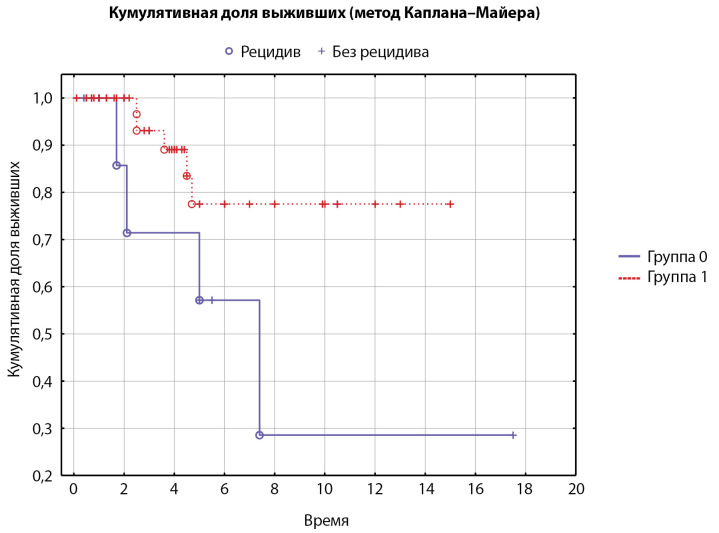
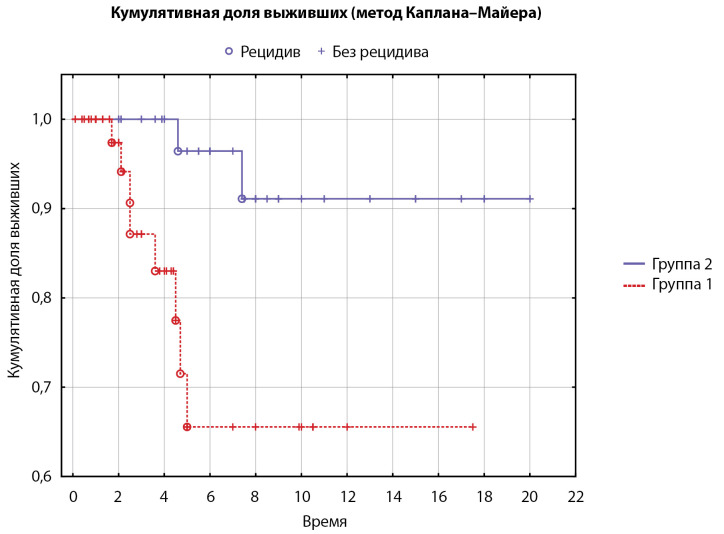
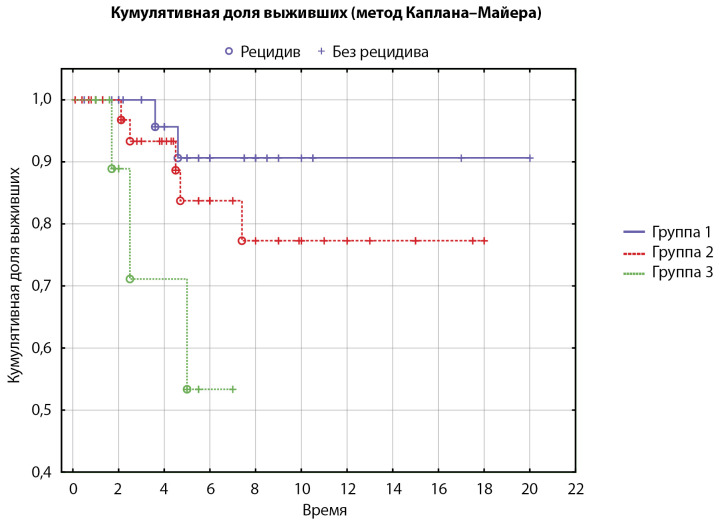
The most common clinical symptoms of CD were weight gain [94%] and growth retardation [72%]. Pituitary tumor was detected on radiological imaging in 53/90 patients [59%], there were no signs of visible adenoma in 37/90 of patients [41%]. 63 of 90 patients underwent TSS (70%), 27 patients underwent radiosurgery (30%). Remission rate after TSS was 71% [45/63], after radiosurgery - 85% [23/27]. There were no significant differences in remission rates after radical treatment according to preoperative MRI results (P=0.21 after TSS and P=0.87 after radiosurgery, х2 analysis). Recurrence after successful treatment was diagnosed in 10 patients. There were no significant differences in time to recurrence according to preoperative MRI results (P=0.055, х2 analysis). Time to recurrence was statistically different after TSS compared to radiosurgery (P=0.007, Kaplan-Meier analysis) and in the group with developed adrenal insufficiency in the early postoperative period (P=0.04, Kaplan-Meier analysis). Analysis of side effect of treatment showed that the frequency of growth hormone and gonadotrophin deficiency was statistically higher after radiosurgery (р<0.01, Kruskel-Wallis ANOVA test). Diabetes insipidus was diagnosed only after TSS.
Results of our study didn`t allow to use MRI-results as predictor of effectiveness treatment in pediatric CD. Therapeutic option has an impact on time to recurrence, not on recurrence rates. The frequency of growth hormone and gonadotrophin deficiency was statistically higher after radiosurgery compared to TSS. Further studies are needed to identify predictors of remission and recurrence in CD.>< 0.01, Kruskel-Wallis ANOVA test). Diabetes insipidus was diagnosed only after TSS.
Results of our study didn`t allow to use MRI-results as predictor of effectiveness treatment in pediatric CD. Therapeutic option has an impact on time to recurrence, not on recurrence rates. The frequency of growth hormone and gonadotrophin deficiency was statistically higher after radiosurgery compared to TSS. Further studies are needed to identify predictors of remission and recurrence in CD.
库欣病(CD)是一种罕见的持续性皮质醇过多症,由促肾上腺皮质激素分泌垂体瘤(促皮质瘤)引起。经蝶窦手术(TSS)是治疗 CD 的首选方法,其有效率为 70%至 90%。成功治疗后的复发率约为 25%。如果手术治疗不成功或复发,放射治疗是下一个治疗选择,其有效率也为 90%,但作为治疗副作用的垂体功能减退发生率较高。术前缓解和复发的预测因素仍未得到探索,这导致了进一步的研究。
分析根据术前 MRI 和治疗选择,成功治疗儿童 CD 后的缓解和复发率。
我们对 1992 年至 2020 年间在内分泌学研究中心观察的 90 名儿童 CD 患者进行了回顾性分析。
CD 的最常见临床症状是体重增加[94%]和生长迟缓[72%]。53/90 例患者[59%]的影像学检查发现垂体瘤,37/90 例患者[41%]无可见腺瘤迹象。90 例患者中 63 例行 TSS(70%),27 例行放射治疗(30%)。TSS 后的缓解率为 71%[45/63],放射治疗后为 85%[23/27]。根据术前 MRI 结果,根治性治疗后的缓解率无显著差异(TSS 后 P=0.21,放射治疗后 P=0.87,x2 分析)。10 例患者成功治疗后诊断为复发。根据术前 MRI 结果,复发时间无显著差异(P=0.055,x2 分析)。TSS 后与放射治疗后复发时间有统计学差异(P=0.007,Kaplan-Meier 分析),且术后早期发生肾上腺皮质功能不全的患者有统计学差异(P=0.04,Kaplan-Meier 分析)。治疗副作用分析显示,放射治疗后生长激素和促性腺激素缺乏的频率明显更高(p<0.01,Kruskel-Wallis ANOVA 检验)。仅在 TSS 后诊断为尿崩症。
我们的研究结果不允许将 MRI 结果用作儿科 CD 有效治疗的预测因子。治疗选择对复发时间有影响,而不是复发率。与 TSS 相比,放射治疗后生长激素和促性腺激素缺乏的频率明显更高。需要进一步研究以确定 CD 缓解和复发的预测因子。