Almeida-Antunes Natália, Vasconcelos Margarida, Crego Alberto, Rodrigues Rui, Sampaio Adriana, López-Caneda Eduardo
Psychological Neuroscience Laboratory, Psychology Research Center, University of Minho, Braga, Portugal.
Front Neurosci. 2022 Jun 29;16:914213. doi: 10.3389/fnins.2022.914213. eCollection 2022.
Binge Drinking (BD) has been associated with altered inhibitory control and augmented alcohol-cue reactivity. Memory inhibition (MI), the ability to voluntarily suppress unwanted thoughts/memories, may lead to forgetting of memories in several psychiatric conditions. However, despite its potential clinical implications, no study to date has explored the MI abilities in populations with substance misuse, such as binge drinkers (BDs).
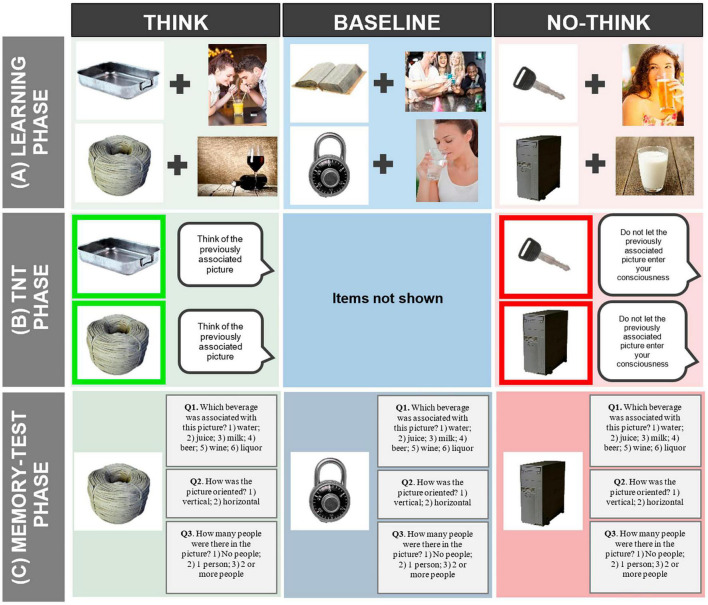
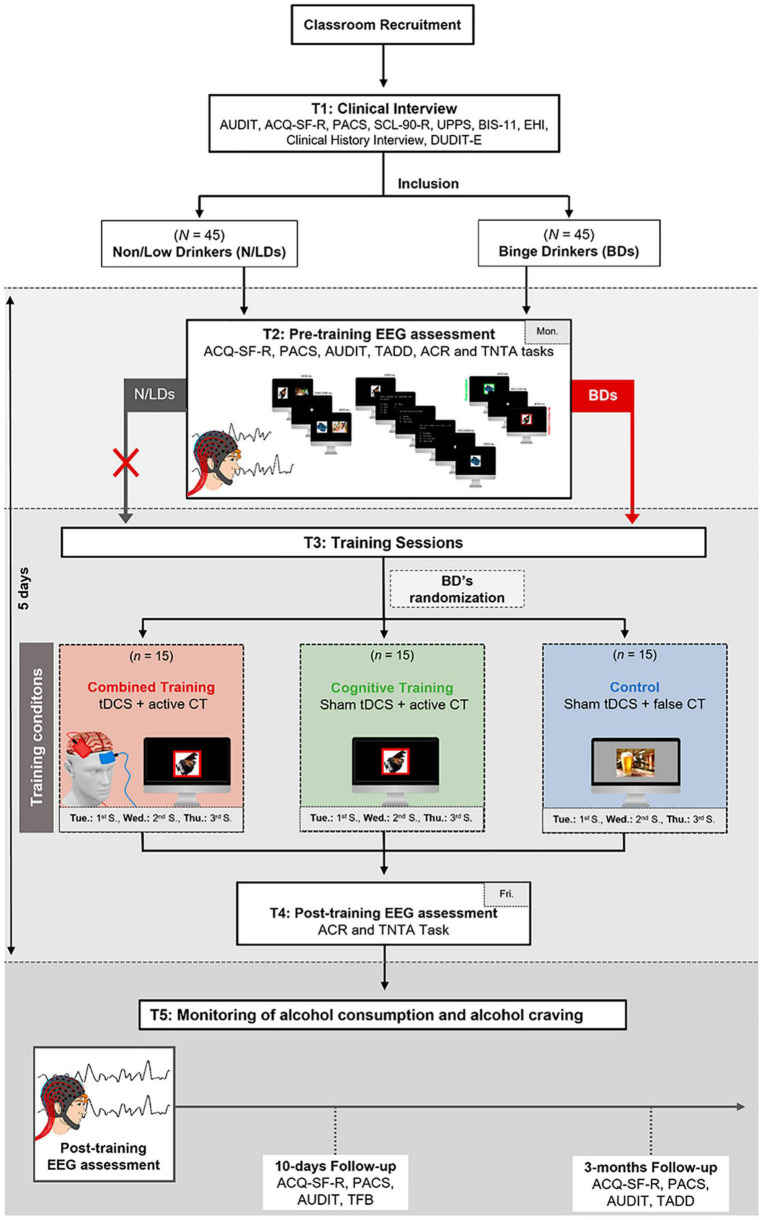
This study-registered in the NIH Clinical Trials Database (ClinicalTrials.gov identifier: NCT05237414)-aims firstly to examine the behavioral and electroencephalographic (EEG) correlates of MI among college BDs. For this purpose, 45 BDs and 45 age-matched non/low-drinkers (50% female) will be assessed by EEG while performing the Think/No-Think Alcohol task, a paradigm that evaluates alcohol-related MI. Additionally, this work aims to evaluate an alcohol-specific MI intervention protocol using cognitive training (CT) and transcranial direct current stimulation (tDCS) while its effects on behavioral and EEG outcomes are assessed. BDs will be randomly assigned to one MI training group: [CT and verum tDCS applied over the right dorsolateral prefrontal cortex (DLPFC)], (CT and sham tDCS), or (sham CT and sham tDCS). Training will occur in three consecutive days, in three sessions. MI will be re-assessed in BDs through a post-training EEG assessment. Alcohol use and craving will be measured at the first EEG assessment, and both 10-days and 3-months post-training. In addition, behavioral and EEG data will be collected during the performance of an alcohol cue reactivity (ACR) task, which evaluates attentional bias toward alcoholic stimuli, before, and after the MI training sessions.
This study protocol will provide the first behavioral and neurofunctional MI assessment in BDs. Along with poor MI abilities, BDs are expected to show alterations in event-related potentials and functional connectivity patterns associated with MI. Results should also demonstrate the effectiveness of the protocol, with BDs exhibiting an improved capacity to suppress alcohol-related memories after both and training, along with a reduction in alcohol use and craving in the short/medium-term. Collectively, these findings might have major implications for the understanding and treatment of alcohol misuse.
[www.ClinicalTrials.gov], identifier [NCT05237414].
暴饮(BD)与抑制控制改变和酒精线索反应增强有关。记忆抑制(MI),即自愿抑制 unwanted 想法/记忆的能力,可能导致在几种精神疾病中记忆的遗忘。然而,尽管其具有潜在的临床意义,但迄今为止尚无研究探讨物质滥用人群(如暴饮者(BDs))的MI能力。
本研究已在美国国立卫生研究院临床试验数据库注册(ClinicalTrials.gov标识符:NCT05237414),其首要目的是研究大学BDs中MI的行为和脑电图(EEG)相关性。为此,45名BDs和45名年龄匹配的非饮酒者/低饮酒者(50%为女性)在执行“思考/不思考酒精”任务(一种评估与酒精相关的MI的范式)时将接受EEG评估。此外,这项工作旨在评估一种特定于酒精的MI干预方案,该方案使用认知训练(CT)和经颅直流电刺激(tDCS),同时评估其对行为和EEG结果的影响。BDs将被随机分配到一个MI训练组:[在右侧背外侧前额叶皮层(DLPFC)施加CT和真tDCS]、(CT和假tDCS)或(假CT和假tDCS)。训练将连续三天进行,每天三个时段。通过训练后的EEG评估对BDs的MI进行重新评估。在第一次EEG评估时以及训练后10天和3个月测量酒精使用情况和渴望程度。此外,在MI训练时段之前和之后执行酒精线索反应(ACR)任务(该任务评估对酒精刺激的注意偏向)期间将收集行为和EEG数据。
本研究方案将首次对BDs进行行为和神经功能MI评估。除了较差的MI能力外,预计BDs在与MI相关的事件相关电位和功能连接模式方面会出现改变。结果还应证明该方案的有效性,即BDs在[具体训练方式1]和[具体训练方式2]训练后表现出抑制与酒精相关记忆的能力提高,以及在短期/中期酒精使用和渴望程度降低。总体而言,这些发现可能对酒精滥用的理解和治疗具有重要意义。