Needham Hope, Torpey Grace, Flores Carlos C, Davis Christopher J, Vanderheyden William M, Gerstner Jason R
Department of Biology, Gonzaga University, Spokane, WA, United States.
Department of Translational Medicine and Physiology, Elson S. Floyd College of Medicine, Washington State University, Spokane, WA, United States.
Front Neurosci. 2022 Jun 30;16:798994. doi: 10.3389/fnins.2022.798994. eCollection 2022.
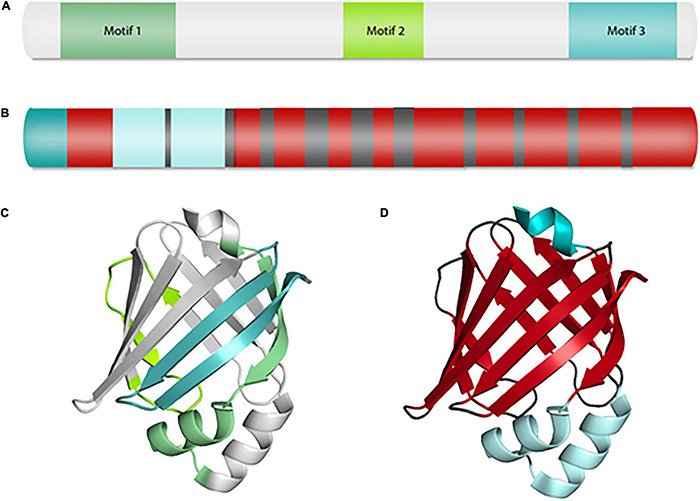
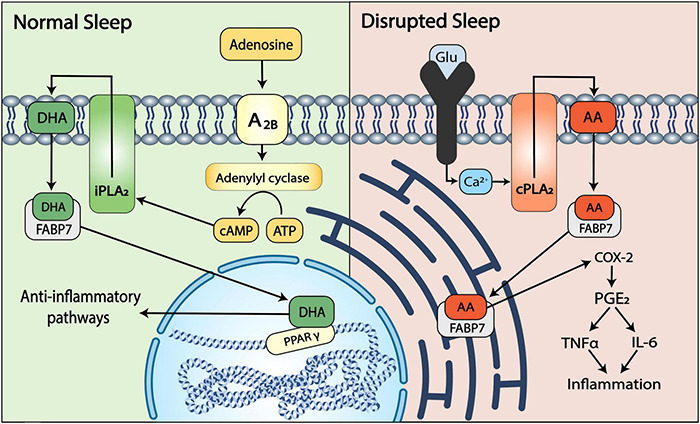
Fatty acid binding proteins (FABPs) are a family of intracellular lipid chaperone proteins known to play critical roles in the regulation of fatty acid uptake and transport as well as gene expression. Brain-type fatty acid binding protein (FABP7) is enriched in astrocytes and has been implicated in sleep/wake regulation and neurodegenerative diseases; however, the precise mechanisms underlying the role of FABP7 in these biological processes remain unclear. FABP7 binds to both arachidonic acid (AA) and docosahexaenoic acid (DHA), resulting in discrete physiological responses. Here, we propose a dichotomous role for FABP7 in which ligand type determines the subcellular translocation of fatty acids, either promoting wakefulness aligned with Alzheimer's pathogenesis or promoting sleep with concomitant activation of anti-inflammatory pathways and neuroprotection. We hypothesize that FABP7-mediated translocation of AA to the endoplasmic reticulum of astrocytes increases astrogliosis, impedes glutamatergic uptake, and enhances wakefulness and inflammatory pathways via COX-2 dependent generation of pro-inflammatory prostaglandins. Conversely, we propose that FABP7-mediated translocation of DHA to the nucleus stabilizes astrocyte-neuron lactate shuttle dynamics, preserves glutamatergic uptake, and promotes sleep by activating anti-inflammatory pathways through the peroxisome proliferator-activated receptor-γ transcriptional cascade. Importantly, this model generates several testable hypotheses applicable to other neurodegenerative diseases, including amyotrophic lateral sclerosis and Parkinson's disease.
脂肪酸结合蛋白(FABPs)是一类细胞内脂质伴侣蛋白,已知在脂肪酸摄取、转运以及基因表达的调节中发挥关键作用。脑型脂肪酸结合蛋白(FABP7)在星形胶质细胞中富集,并且与睡眠/觉醒调节及神经退行性疾病有关;然而,FABP7在这些生物学过程中作用的精确机制仍不清楚。FABP7能与花生四烯酸(AA)和二十二碳六烯酸(DHA)结合,从而产生不同的生理反应。在此,我们提出FABP7具有双重作用,即配体类型决定脂肪酸的亚细胞转运,要么促进与阿尔茨海默病发病机制相关的觉醒,要么通过激活抗炎途径和神经保护作用来促进睡眠。我们假设FABP7介导的AA转运至星形胶质细胞的内质网会增加星形胶质细胞增生,阻碍谷氨酸能摄取,并通过COX - 2依赖性生成促炎前列腺素增强觉醒和炎症途径。相反,我们提出FABP7介导的DHA转运至细胞核可稳定星形胶质细胞 - 神经元乳酸穿梭动力学,保留谷氨酸能摄取,并通过过氧化物酶体增殖物激活受体 - γ转录级联反应激活抗炎途径来促进睡眠。重要的是,该模型产生了几个适用于其他神经退行性疾病(包括肌萎缩侧索硬化症和帕金森病)的可测试假设。