Université Paris Cité, Centre de Recherche sur l'Inflammation, Institut National de la Santé Et de la Recherche Médicale (INSERM) UMR1149, Centre National de la Recherche Scientifique (CNRS). EMR8252, Faculté de Médecine site Bichat, Paris, France.
Université Paris Cité, Laboratoire d'Excellence INFLAMEX, Paris, France.
Front Immunol. 2022 Jun 29;13:900532. doi: 10.3389/fimmu.2022.900532. eCollection 2022.
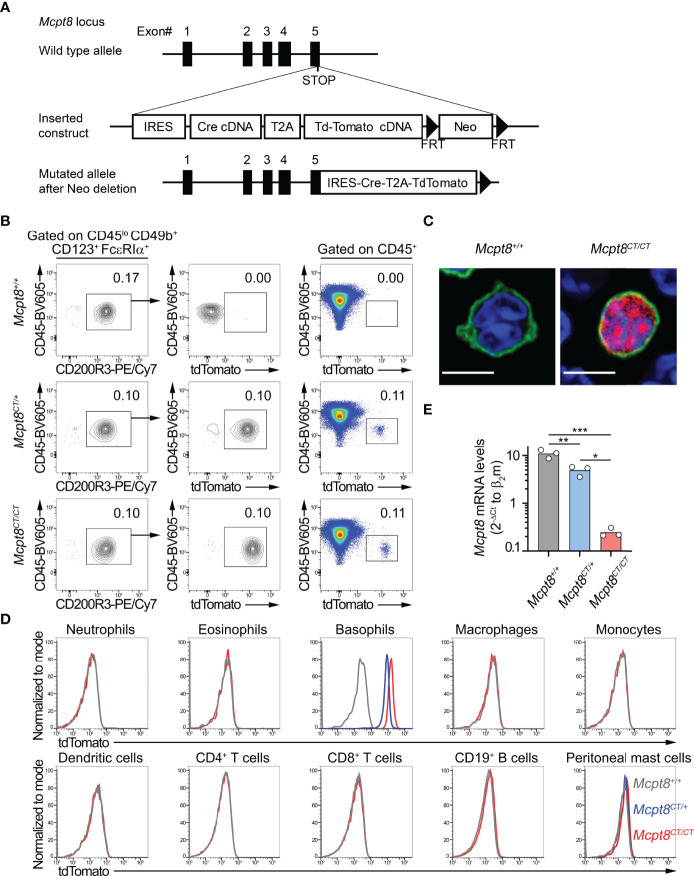
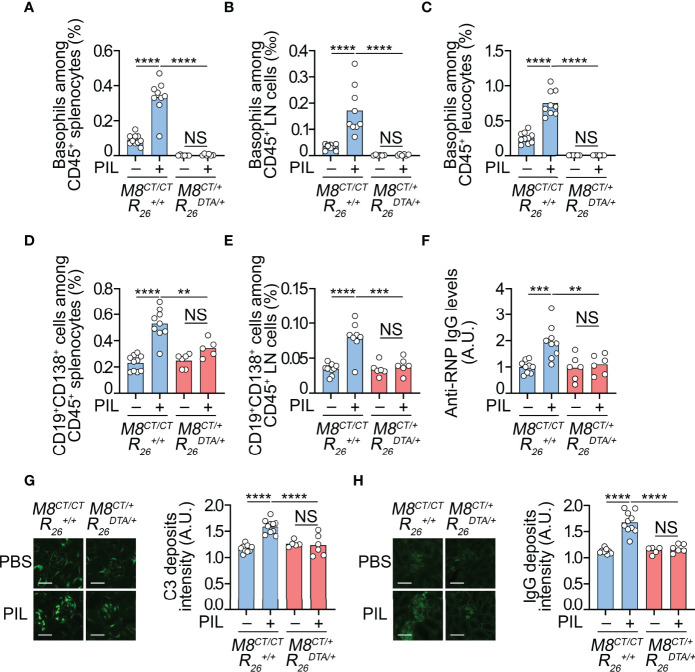
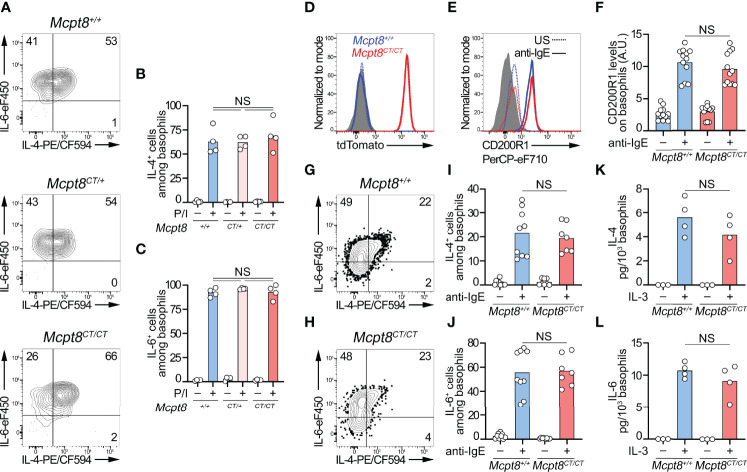
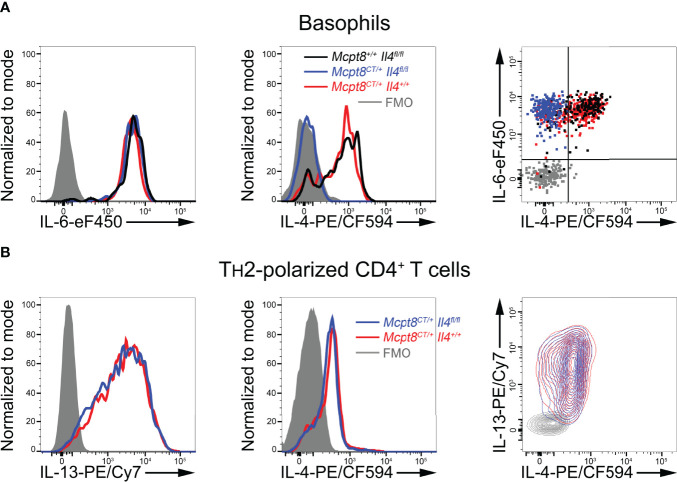
Tissue-specific mouse models are essential tools to decipher the role of each cell compartment and/or their expressed genes in the pathophysiology of diseases. Here, we describe a new knock-in mouse model allowing expression of both the fluorescent protein tdTomato and the CRE recombinase selectively in the basophil compartment under the control of the Mcpt8 gene. These "CT-M8" mice did not show any abnormalities in their peripheral distribution of major immune cell populations nor their basophil function. CT-M8 mice allowed the identification of basophils by immunofluorescence and flow cytometry and basophil-specific Cre-mediated floxed gene deletion. Breeding of our CT-M8 mice with the mice led to the generation of basophil-deficient mice with no detectable abnormalities in other cell compartments. These mice were then used to document basophil involvement in systemic lupus erythematosus (SLE) pathophysiology since we previously reported by transient depletion of these cells during the course of an ongoing disease that they support and amplify autoantibody production in two distinct lupus-like mouse models ( and pristane-induced). Here, constitutive basophil deficiency prevented pristane-induced lupus-like disease development by limiting autoantibody titers and renal damages. Therefore, basophils have a nonredundant role in pristane-induced lupus-like disease and are involved in both its induction and amplification. This CT-M8 new mouse model will allow us to finely decipher the role of basophils and their expressed genes in health and disease.
组织特异性小鼠模型是解析每个细胞区室及其表达基因在疾病病理生理学中的作用的重要工具。在这里,我们描述了一种新的基因敲入小鼠模型,该模型允许在 Mcpt8 基因的控制下,在嗜碱性粒细胞区室中选择性表达荧光蛋白 tdTomato 和 CRE 重组酶。这些“CT-M8”小鼠在外周主要免疫细胞群的分布或其嗜碱性粒细胞功能方面没有任何异常。CT-M8 小鼠允许通过免疫荧光和流式细胞术鉴定嗜碱性粒细胞,并通过 Cre 介导的 floxed 基因缺失来特异性删除嗜碱性粒细胞。我们的 CT-M8 小鼠与 小鼠杂交,产生了嗜碱性粒细胞缺失的小鼠,其他细胞区室没有可检测到的异常。然后,我们使用这些小鼠来证明嗜碱性粒细胞参与系统性红斑狼疮 (SLE) 病理生理学,因为我们之前通过在正在进行的疾病过程中短暂耗尽这些细胞,报告了它们在两种不同的狼疮样小鼠模型( 和 pristane 诱导)中支持和放大自身抗体产生。在这里,固有嗜碱性粒细胞缺乏通过限制自身抗体滴度和肾脏损伤,预防 pristane 诱导的狼疮样疾病发展。因此,嗜碱性粒细胞在 pristane 诱导的狼疮样疾病中具有非冗余作用,并参与其诱导和放大。这种 CT-M8 新的小鼠模型将使我们能够精细地解析嗜碱性粒细胞及其表达基因在健康和疾病中的作用。