Katayama Yusuke, Kanehara Atsushi, Yamashita Yuya, Kitamura Tetsuhisa, Oda Jun
Department of Traumatology and Acute Critical Medicine, Osaka University Graduate School of Medicine, Suita, Japan.
Division of Environmental Medicine and Population Sciences, Department of Social and Environmental Medicine, Osaka University Graduate School of Medicine, Suita, Japan.
Front Public Health. 2022 Jun 30;10:911675. doi: 10.3389/fpubh.2022.911675. eCollection 2022.
Ambulatory care sensitive conditions (ACSCs) are defined as clinical conditions for which the risk of emergency hospital admission can be reduced by timely and effective ambulatory care. However, the actual status of patients with ACSCs who are transported by ambulance and their outcomes have not been fully elucidated. The purpose of this study was to reveal characteristics and outcomes of patients with ACSCs who were transported by ambulance using population-based registry data in Osaka, Japan.
This descriptive epidemiological study was conducted in the 5-year period from January 2016 to December 2020, and included patients who were transported by ambulance due to sudden illness. In this study, ACSC was further classified into acute ACSCs, chronic ACSCs, and preventable ACSCs based on the ICD-10. The number of patients transported by ambulance for ACSCs per 100,000 population in each age group was calculated for each year. In addition, Poisson regression models were used to assess the trend in the number of ACSCs patients transported by ambulance.
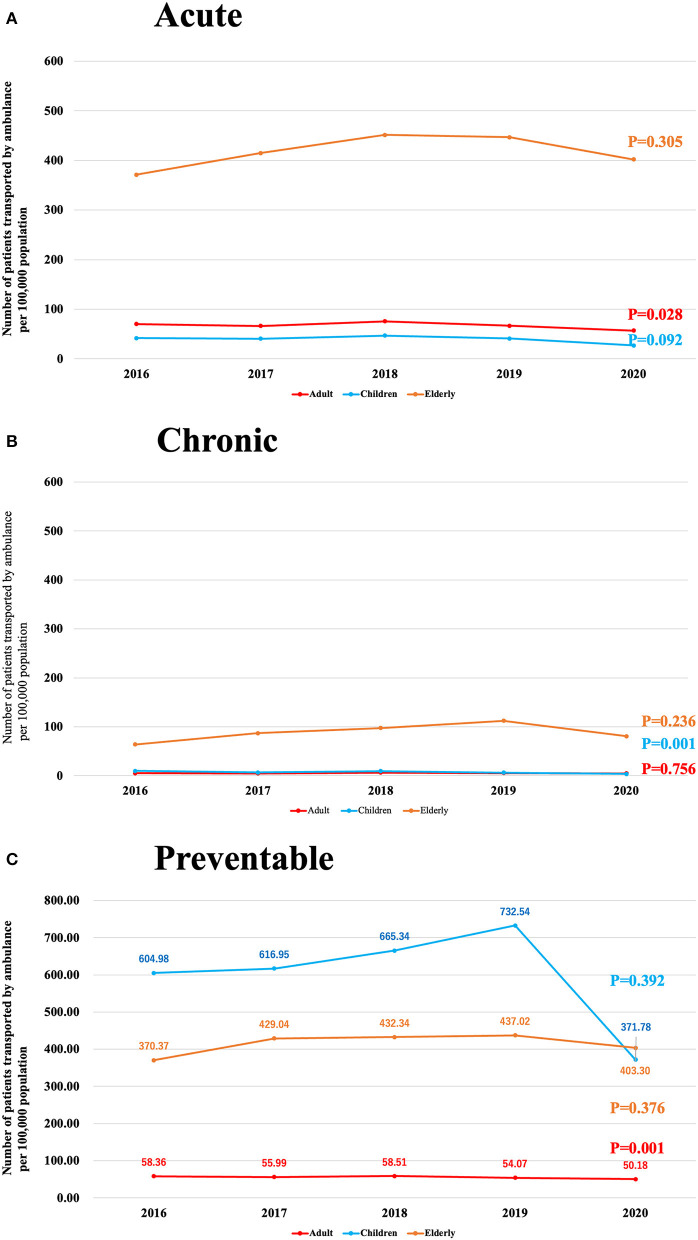
A total of 1,572,152 patients were included in this study (acute ACSCs, = 69,621; chronic ACSCs, = 12,250; preventable ACSCs, = 96,036; and non-ACSCs, = 1,394,245). The overall median age was 71 years (95% confidence interval [CI], 46-92). Patients with acute ACSCs (median age: 76 years [IQR: 60-84]) and chronic ACSCs (median age: 80 years [IQR: 72-87]) were older, while patients with preventable ACSCs were younger (median age: 66 years [95%CI: 3-81]) and included a high proportion of children (33.3%, 32,002/96,036). Regarding the outcome after treatment at the emergency department, 42.6% (670,392/1,572.152) of patients were hospitalized, while 82.3% (10,079/12,250) of patients with chronic ACSCs were hospitalized. No change was observed in adults ( = 0.001) or elderly (age ≥65 years) individuals ( = 0.376) with preventable ACSCs, however, among children, the number increased until 2019 (732.5) and then decreased in 2020 (371.8) ( = 0.392).
In this study, patients with chronic ACSCs were predominantly elderly, while patients with preventable ACSCs were polarized between children and the elderly. Among patients with preventable ACSCs, there was no change over time in adults and children, but there was a marked decrease among the elderly after 2020.
门诊护理敏感疾病(ACSCs)被定义为通过及时有效的门诊护理可降低急诊住院风险的临床疾病。然而,通过救护车转运的ACSCs患者的实际状况及其结局尚未完全阐明。本研究的目的是利用日本大阪基于人群的登记数据,揭示通过救护车转运的ACSCs患者的特征和结局。
本描述性流行病学研究在2016年1月至2020年12月的5年期间进行,纳入因突发疾病通过救护车转运的患者。在本研究中,根据国际疾病分类第十版(ICD - 10),ACSC进一步分为急性ACSCs、慢性ACSCs和可预防的ACSCs。计算每年各年龄组每10万人口中因ACSCs通过救护车转运的患者数量。此外,使用泊松回归模型评估通过救护车转运的ACSCs患者数量的趋势。
本研究共纳入1,572,152例患者(急性ACSCs,n = 69,621;慢性ACSCs,n = 12,250;可预防的ACSCs,n = 96,036;非ACSCs,n = 1,394,245)。总体中位年龄为71岁(95%置信区间[CI],46 - 92)。急性ACSCs患者(中位年龄:76岁[四分位间距:60 - 84])和慢性ACSCs患者(中位年龄:80岁[四分位间距:72 - 87])年龄较大,而可预防的ACSCs患者年龄较小(中位年龄:66岁[95%CI:3 - 81]),且儿童比例较高(33.3%,32,002/96,036)。关于在急诊科治疗后的结局,42.6%(670,392/1,572,152)的患者住院,而慢性ACSCs患者中有82.3%(10,079/12,250)住院。可预防的ACSCs在成人(P = 0.001)或老年人(年龄≥65岁)(P = 0.376)中未观察到变化,然而,在儿童中,数量在2019年之前增加(732.5),然后在2020年下降(371.8)(P = 0.392)。
在本研究中,慢性ACSCs患者以老年人为主,而可预防的ACSCs患者在儿童和老年人之间呈两极分化。在可预防的ACSCs患者中,成人和儿童随时间无变化,但在老年人中2020年后有显著下降。