Ma Wei, Wang Mao, Fu Haifeng, Tang Chaoyi, Wang Wenqing
Key Laboratory of the Coastal and Wetland Ecosystems (Xiamen University) Ministry of Education, College of the Environment and Ecology Xiamen University Xiamen China.
Ecol Evol. 2022 Jul 13;12(7):e9033. doi: 10.1002/ece3.9033. eCollection 2022 Jul.
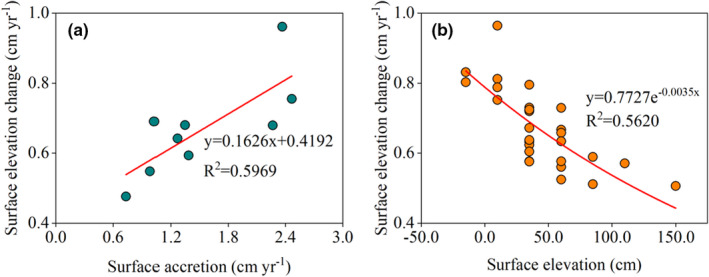
Mollusks are an important component of the mangrove ecosystem, and the vertical distributions of molluscan species in this ecosystem are primarily dictated by tidal inundation. Thus, sea level rise (SLR) may have profound effects on mangrove mollusk communities. Here, we used dynamic empirical models, based on measurements of surface elevation change, sediment accretion, and molluscan zonation patterns, to predict changes in molluscan spatial distributions in response to different sea level rise rates in the mangrove forests of Zhenzhu Bay (Guangxi, China). The change in surface elevation was 4.76-9.61 mm year during the study period (2016-2020), and the magnitude of surface-elevation change decreased exponentially as original surface elevation increased. Based on our model results, we predicted that mangrove mollusks might successfully adapt to a low rate of SLR (2.00-4.57 mm year) by 2100, with mollusks moving seaward and those in the lower intertidal zones expanding into newly available zones. However, as SLR rate increased (4.57-8.14 mm year), our models predicted that surface elevations would decrease beginning in the high intertidal zones and gradually spread to the low intertidal zones. Finally, at high rates of SLR (8.14-16.00 mm year), surface elevations were predicted to decrease across the elevation gradient, with mollusks moving landward and species in higher intertidal zones blocked by landward barriers. Tidal inundation and the consequent increases in interspecific competition and predation pressure were predicted to threaten the survival of many molluscan groups in higher intertidal zones, especially arboreal and infaunal mollusks at the landward edge of the mangroves, resulting in a substantial reduction in the abundance of original species on the landward edge. Thus, future efforts to conserve mangrove floral and faunal diversity should prioritize species restricted to landward mangrove areas and protect potential species habitats.
软体动物是红树林生态系统的重要组成部分,该生态系统中软体动物物种的垂直分布主要受潮汐淹没的影响。因此,海平面上升可能会对红树林软体动物群落产生深远影响。在此,我们基于对地表高程变化、沉积物堆积以及软体动物分区模式的测量,使用动态经验模型来预测中国广西珍珠湾红树林中软体动物空间分布随不同海平面上升速率的变化情况。研究期间(2016 - 2020年)地表高程变化为每年4.76 - 9.61毫米,且地表高程变化幅度随原始地表高程增加呈指数下降。根据我们的模型结果,预计到2100年,红树林软体动物可能成功适应低速率的海平面上升(每年2.00 - 4.57毫米),软体动物向海迁移,潮间带下部的物种扩展到新出现的区域。然而,随着海平面上升速率增加(每年4.57 - 8.14毫米),我们的模型预测地表高程将从高潮间带开始下降,并逐渐蔓延至低潮间带。最后,在高海平面上升速率(每年8.14 - 16.00毫米)下,预计地表高程会在整个高程梯度上下降,软体动物向陆地迁移,潮间带上部的物种受到陆地屏障阻挡。预计潮汐淹没以及随之而来的种间竞争和捕食压力增加将威胁到高潮间带许多软体动物群体的生存,特别是红树林陆地边缘的树栖和底内软体动物,导致陆地边缘原生物种数量大幅减少。因此,未来保护红树林动植物多样性的工作应优先考虑局限于红树林陆地区域的物种,并保护潜在的物种栖息地。