Ribrag Vincent, Chavez Julio C, Boccomini Carola, Kaplan Jason, Chandler Jason C, Santoro Armando, Corradini Paolo, Flinn Ian W, Advani Ranjana, Cassier Philippe A, Sangha Randeep, Kenkre Vaishalee P, Isufi Iris, Uttamsingh Shailaja, Hagner Patrick R, Gandhi Anita K, Shen Frank, Michelliza Sophie, Haeske Harald, Hege Kristen, Pourdehnad Michael, Kuruvilla John
Institut Gustave Roussy Villejuif France.
H. Lee Moffitt Cancer Center & Research Institute Tampa Florida USA.
EJHaem. 2022 Jan 14;3(1):139-153. doi: 10.1002/jha2.375. eCollection 2022 Feb.
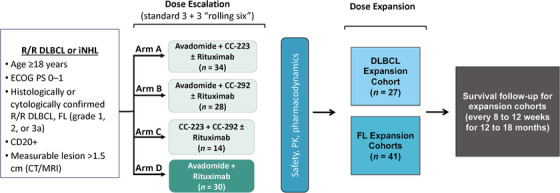
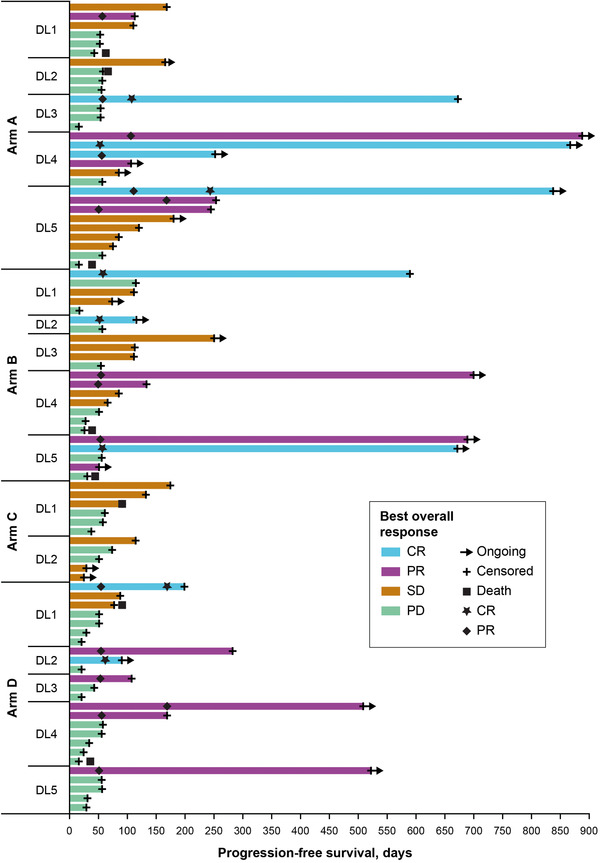
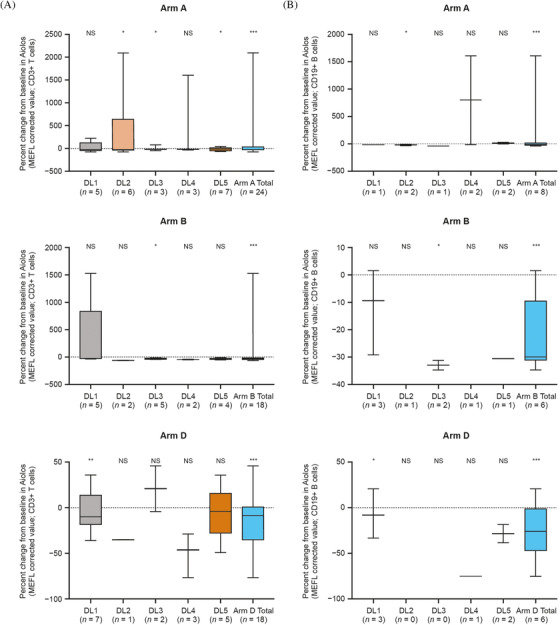
There is a need for additional treatment options for patients with relapsed or refractory diffuse large B-cell lymphoma (DLBCL) who do not benefit from available therapies. We examined combinations of the cereblon E3 ligase modulator (CELMoD) agent avadomide (CC-122), the selective, ATP-competitive mammalian target of rapamycin kinase inhibitor CC-223, and the potent, selective, covalent Bruton tyrosine kinase inhibitor CC-292 in patients with relapsed/refractory (R/R) DLBCL. In the multicenter, phase Ib CC-122-DLBCL-001 study (NCT02031419), the dose-escalation portion explored combinations of CC-122, CC-223, and CC-292 administered as doublets or triplets with rituximab in patients with chemorefractory DLBCL. Primary endpoints were safety, tolerability, and dose-limiting toxicities; additional endpoints included pharmacokinetics, pharmacodynamics, biomarkers, and preliminary efficacy. As of December 1, 2017, 106 patients were enrolled across four cohorts. The median age was 65 years (range 24-84 years), and patients had a median of 3 (range 1-10) prior to regimens. A total of 101 patients (95.3%) discontinued, most commonly due to disease progression (49.1%). The most common any-grade adverse events (AEs) across treatment arms were gastrointestinal and hematologic; the most common grade 3/4 AEs were hematologic. CC-122 was well tolerated, with no unexpected safety concerns. Preliminary efficacy was observed in three of four treatment arms. CC-122 plus rituximab was considered suitable for dose expansion, whereas CC-223 and CC-292 combinations were associated with enhanced toxicity and/or insufficient improvement in responses. CC-122 plus rituximab was well tolerated, with preliminary antitumor activity in patients with R/R DLBCL. This innovative study demonstrates the feasibility of assessing the tolerability and preliminary efficacy of novel combinations utilizing a multi-arm dose-finding design.
对于复发或难治性弥漫性大B细胞淋巴瘤(DLBCL)患者而言,现有治疗方法无法使他们受益,因此需要更多的治疗选择。我们研究了大脑E3连接酶调节剂(CELMoD)药物阿伐度胺(CC-122)、选择性的、ATP竞争性雷帕霉素哺乳动物靶点激酶抑制剂CC-223以及强效、选择性、共价布鲁顿酪氨酸激酶抑制剂CC-292联合使用,用于复发/难治性(R/R)DLBCL患者的情况。在多中心Ib期CC-122-DLBCL-001研究(NCT02031419)中,剂量递增部分探索了CC-122、CC-223和CC-292与利妥昔单抗联合使用的双药或三药组合,用于化疗难治性DLBCL患者。主要终点是安全性、耐受性和剂量限制性毒性;其他终点包括药代动力学、药效学、生物标志物和初步疗效。截至2017年12月1日,四个队列共纳入106例患者。中位年龄为65岁(范围24 - 84岁),患者在接受治疗方案前的中位治疗次数为3次(范围1 - 10次)。共有101例患者(95.3%)停药,最常见的原因是疾病进展(49.1%)。各治疗组中最常见的任何级别不良事件(AE)是胃肠道和血液学方面的;最常见的3/4级AE是血液学方面的。CC-122耐受性良好,没有意外的安全问题。在四个治疗组中的三个组观察到了初步疗效。CC-122加利妥昔单抗被认为适合进行剂量扩展,而CC-223和CC-292组合与毒性增强和/或反应改善不足相关。CC-122加利妥昔单抗耐受性良好,对R/R DLBCL患者具有初步抗肿瘤活性。这项创新性研究证明了利用多臂剂量探索设计评估新型联合用药耐受性和初步疗效的可行性。