Bermudez-Lekerika Paola, Crump Katherine B, Tseranidou Sofia, Nüesch Andrea, Kanelis Exarchos, Alminnawi Ahmad, Baumgartner Laura, Muñoz-Moya Estefano, Compte Roger, Gualdi Francesco, Alexopoulos Leonidas G, Geris Liesbet, Wuertz-Kozak Karin, Le Maitre Christine L, Noailly Jérôme, Gantenbein Benjamin
Tissue Engineering for Orthopaedics and Mechanobiology, Bone and Joint Program, Department for BioMedical Research (DBMR), Faculty of Medicine, University of Bern, Bern, Switzerland.
Department of Orthopaedic Surgery and Traumatology, Inselspital, Bern University Hospital, Medical Faculty, University of Bern, Bern, Switzerland.
Front Cell Dev Biol. 2022 Jun 29;10:924692. doi: 10.3389/fcell.2022.924692. eCollection 2022.
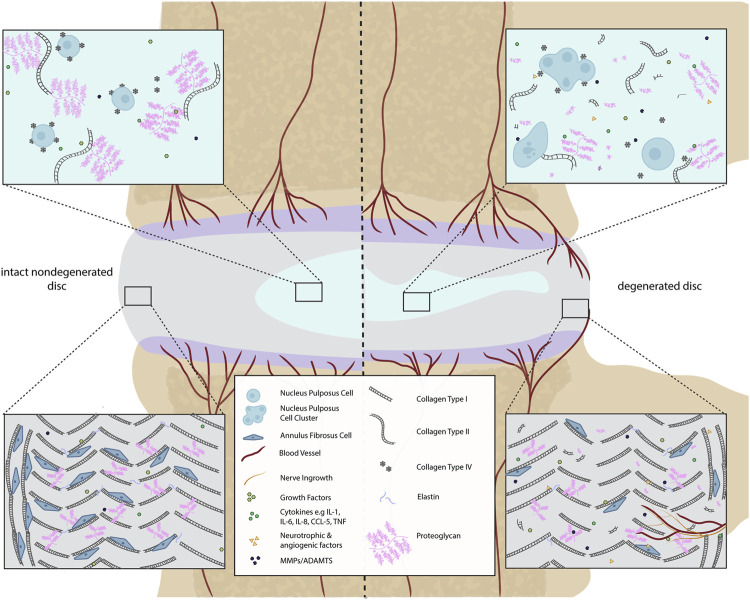
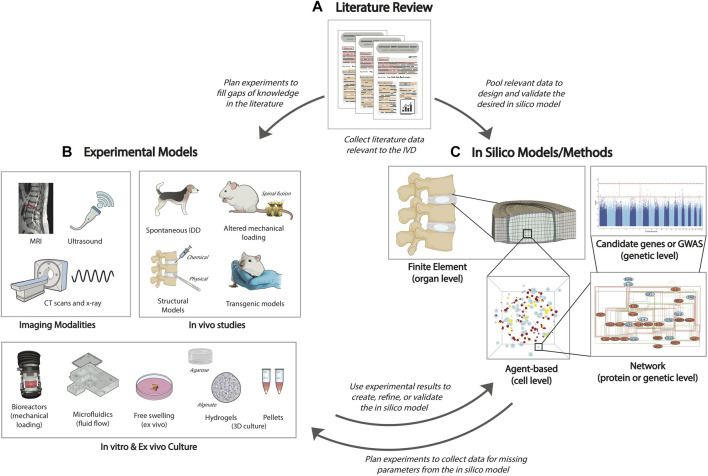
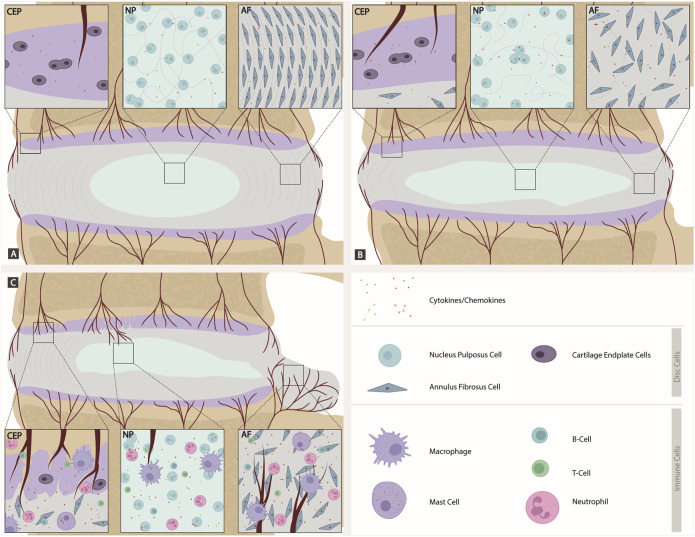
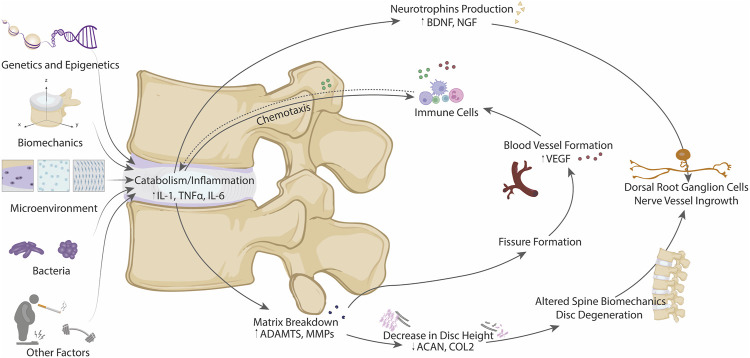
Low back pain is a highly prevalent, chronic, and costly medical condition predominantly triggered by intervertebral disc degeneration (IDD). IDD is often caused by structural and biochemical changes in intervertebral discs (IVD) that prompt a pathologic shift from an anabolic to catabolic state, affecting extracellular matrix (ECM) production, enzyme generation, cytokine and chemokine production, neurotrophic and angiogenic factor production. The IVD is an immune-privileged organ. However, during degeneration immune cells and inflammatory factors can infiltrate through defects in the cartilage endplate and annulus fibrosus fissures, further accelerating the catabolic environment. Remarkably, though, catabolic ECM disruption also occurs in the absence of immune cell infiltration, largely due to native disc cell production of catabolic enzymes and cytokines. An unbalanced metabolism could be induced by many different factors, including a harsh microenvironment, biomechanical cues, genetics, and infection. The complex, multifactorial nature of IDD brings the challenge of identifying key factors which initiate the degenerative cascade, eventually leading to back pain. These factors are often investigated through methods including animal models, 3D cell culture, bioreactors, and computational models. However, the crosstalk between the IVD, immune system, and shifted metabolism is frequently misconstrued, often with the assumption that the presence of cytokines and chemokines is synonymous to inflammation or an immune response, which is not true for the intact disc. Therefore, this review will tackle immunomodulatory and IVD cell roles in IDD, clarifying the differences between cellular involvements and implications for therapeutic development and assessing models used to explore inflammatory or catabolic IVD environments.
腰痛是一种高度普遍、慢性且代价高昂的医学病症,主要由椎间盘退变(IDD)引发。IDD通常由椎间盘(IVD)的结构和生化变化引起,这些变化促使从合成代谢状态向分解代谢状态发生病理性转变,影响细胞外基质(ECM)的产生、酶的生成、细胞因子和趋化因子的产生、神经营养因子和血管生成因子的产生。IVD是一个免疫豁免器官。然而,在退变过程中,免疫细胞和炎性因子可通过软骨终板的缺陷和纤维环裂隙浸润,进一步加速分解代谢环境。不过,值得注意的是,即使在没有免疫细胞浸润的情况下,分解代谢的ECM破坏也会发生,这主要归因于椎间盘细胞自身产生的分解代谢酶和细胞因子。许多不同因素可导致代谢失衡,包括恶劣的微环境、生物力学信号、遗传因素和感染。IDD的复杂多因素性质带来了识别引发退变级联反应的关键因素的挑战,最终导致背痛。这些因素通常通过动物模型、3D细胞培养、生物反应器和计算模型等方法进行研究。然而,IVD、免疫系统和代谢转变之间的相互作用常常被误解,通常认为细胞因子和趋化因子的存在等同于炎症或免疫反应,而对于完整的椎间盘并非如此。因此,本综述将探讨免疫调节和IVD细胞在IDD中的作用,阐明细胞参与的差异以及对治疗发展的影响,并评估用于探索炎症性或分解代谢性IVD环境的模型。