Xue Yan Xue, Dai Fei Fei, Yang Qian, Chen Jian Hua, Lin Qiao Jing, Fang Li Jun, Lin Wei Wei
College of Chemistry, Chemical Engineering and Environment, Minnan Normal University, Zhangzhou 363000, China.
Fujian Province University Key Laboratory of Modern Analytical Science and Separation Technology, Minnan Normal University, Zhangzhou 363000, China.
ACS Omega. 2022 Jun 27;7(27):23467-23478. doi: 10.1021/acsomega.2c01847. eCollection 2022 Jul 12.
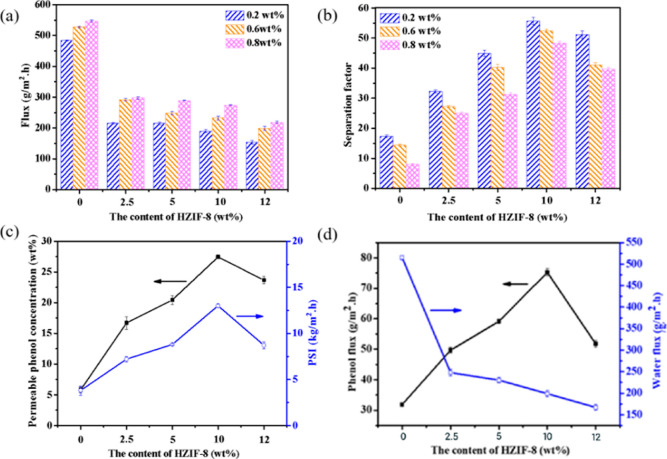
Phenol and its chemical derivatives serve as essential chemical materials are indispensable for the synthesis of many kinds of polymers. However, they are highly toxic, carcinogenic, difficult to be degraded biologically, and often found in aqueous effluents. Recovery of hazardous phenol from wastewater remains a daunting challenge. Herein, we prepared a hybrid membrane containing polyether block amide (PEBA) matrix and HZIF-8 fillers. To improve the compatibility between ZIF-8 and PEBA, ZIF-8 was modified by using polystyrene (PS) as a template to prepare porous HZIF-8. ZIF-8, composed of zinc nodes linked by the imidazole ring skeleton, is a kind of inorganic material with high hydrothermal stability, ordered pores, and hydrophobic microporous surfaces, which has a wide range of applications in membrane separation. The separation performance of the PEBA/HZIF-8 based membranes for phenol/water is improved due to the presence of PS on the surface of HZIF-8 and the imidazole ring skeleton in ZIF-8, which enhance the π-π interaction between HZIF-8 and phenol molecules. The effects of HZIF-8 content, feed phenol concentration, and feed temperature on the pervaporation performance of PEBA/HZIF-8 membranes were further investigated. The results showed that the pervaporation performance of the PEBA/HZIF-8-10 membrane was promising with a separation factor of 80.89 and permeate flux of 247.70 g/m·h under the feed phenol concentration of 0.2 wt % at 80 °C. In addition, the PEBA/HZIF-8-10 membrane presented excellent stability, which has great prospect for practical application in phenol recovery from waste water.
苯酚及其化学衍生物作为重要的化学原料,在多种聚合物的合成中不可或缺。然而,它们具有高毒性、致癌性,生物降解困难,且常存在于废水之中。从废水中回收有害苯酚仍然是一项艰巨的挑战。在此,我们制备了一种包含聚醚嵌段酰胺(PEBA)基质和HZIF - 8填料的混合膜。为了提高ZIF - 8与PEBA之间的相容性,以聚苯乙烯(PS)为模板对ZIF - 8进行改性,制备出多孔HZIF - 8。ZIF - 8由通过咪唑环骨架连接的锌节点组成,是一种具有高水热稳定性、有序孔道和疏水微孔表面的无机材料,在膜分离领域有广泛应用。由于HZIF - 8表面的PS以及ZIF - 8中的咪唑环骨架增强了HZIF - 8与苯酚分子之间的π - π相互作用,基于PEBA/HZIF - 8的膜对苯酚/水的分离性能得到了提高。进一步研究了HZIF - 8含量、进料苯酚浓度和进料温度对PEBA/HZIF - 8膜渗透汽化性能的影响。结果表明,在80℃、进料苯酚浓度为0.2 wt%的条件下,PEBA/HZIF - 8 - 10膜的渗透汽化性能良好,分离因子为80.89,渗透通量为247.70 g/m·h。此外,PEBA/HZIF - 8 - 10膜表现出优异的稳定性,在从废水中回收苯酚的实际应用中具有广阔前景。