Ghosh Amrita, Pawar Aiswarya B, Chirmade Tejas, Jathar Swaraj M, Bhambure Rahul, Sengupta Durba, Giri Ashok P, Kulkarni Mahesh J
Biochemical Sciences Division, CSIR-National Chemical Laboratory, Dr. Homi Bhabha Road, Pune 411008, India.
Academy of Scientific and Innovative Research (AcSIR), Ghaziabad 201002, India.
ACS Omega. 2022 Jun 30;7(27):23115-23126. doi: 10.1021/acsomega.2c00660. eCollection 2022 Jul 12.
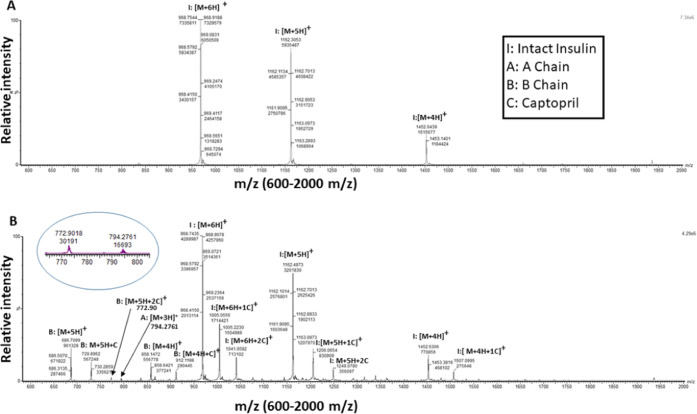
Post-translational modifications remarkably regulate proteins' biological function. Small molecules such as reactive thiols, metabolites, and drugs may covalently modify the proteins and cause structural changes. This study reports the covalent modification and noncovalent interaction of insulin and captopril, an FDA-approved antihypertensive drug, through mass spectrometric and computation-based approaches. Mass spectrometric analysis shows that captopril modifies intact insulin, reduces it into its "A" and "B" chains, and covalently modifies them by forming adducts. Since captopril has a reactive thiol group, it might reduce the insulin dimer or modify it by reacting with cysteine residues. This was proven with dithiothreitol treatment, which reduced the abundance of captopril adducts of insulin A and B chains and intact Insulin. Liquid chromatography tandem mass spectrometric analysis identified the modification of a total of four cysteine residues, two in each of the A and B chains of insulin. These modifications were identified to be Cys6 and Cys7 of the A chain and Cys7 and Cys19 of the B chain. Mass spectrometric analysis indicated that captopril may simultaneously modify the cysteine residues of intact insulin or its subunits A and B chains. Biophysical studies involving light scattering and thioflavin T assay suggested that the binding of captopril to the protein leads to the formation of aggregates. Docking and molecular dynamics studies provided insights into the noncovalent interactions and associated structural changes in insulin. This work is a maiden attempt to understand the detailed molecular interactions between captopril and insulin. These findings suggest that further investigations are required to understand the long-term effect of drugs like captopril.
翻译后修饰显著调节蛋白质的生物学功能。诸如活性硫醇、代谢物和药物等小分子可能会共价修饰蛋白质并导致结构变化。本研究通过质谱分析和基于计算的方法,报道了胰岛素与卡托普利(一种美国食品药品监督管理局批准的抗高血压药物)之间的共价修饰和非共价相互作用。质谱分析表明,卡托普利修饰完整的胰岛素,将其降解为“A”链和“B”链,并通过形成加合物对它们进行共价修饰。由于卡托普利含有一个活性硫醇基团,它可能会使胰岛素二聚体还原或与半胱氨酸残基反应对其进行修饰。二硫苏糖醇处理证明了这一点,该处理降低了胰岛素A链和B链以及完整胰岛素的卡托普利加合物的丰度。液相色谱串联质谱分析确定总共四个半胱氨酸残基发生了修饰,胰岛素的A链和B链各有两个。这些修饰被确定为A链的Cys6和Cys7以及B链的Cys7和Cys19。质谱分析表明,卡托普利可能同时修饰完整胰岛素或其亚基A链和B链的半胱氨酸残基。涉及光散射和硫黄素T分析的生物物理研究表明,卡托普利与蛋白质的结合会导致聚集体的形成。对接和分子动力学研究提供了对胰岛素中非共价相互作用和相关结构变化的见解。这项工作是了解卡托普利与胰岛素之间详细分子相互作用的首次尝试。这些发现表明,需要进一步研究以了解像卡托普利这样的药物的长期影响。