Division of Applied Mathematics, Mälardalen University, Box 883, 721 23 Västerås, Sweden.
Department of Mathematics, Kyaukse University, Kyaukse 05151, Myanmar.
Tree Physiol. 2022 Nov 8;42(11):2174-2185. doi: 10.1093/treephys/tpac065.
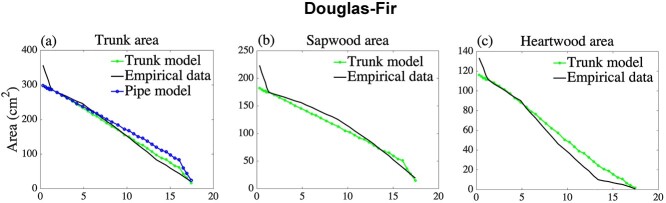
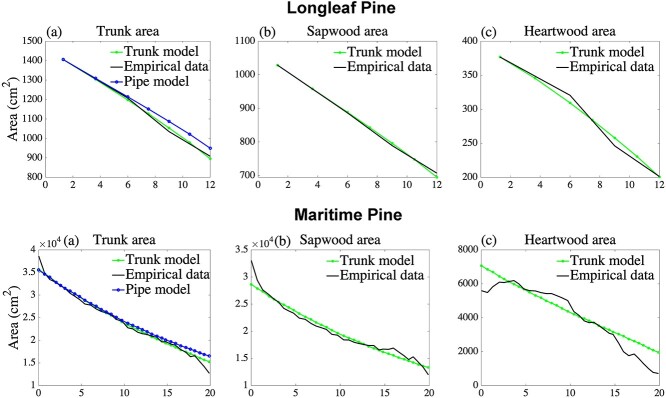
Estimates of tree heartwood and sapwood profiles are important in the pulp industry and for dynamic vegetation models, in which they determine tree biomechanical stability and hydraulic conductivity. Several phenomenological models of stem profiles have been developed for this purpose, based on assumptions on how tree crown and foliage distributions change over time. Here, we derive estimates of tree profiles by synthesizing a simple pipe model theory of plant form with a recently developed theory of branch thinning that from simple assumptions quantifies discarded branches and leaves. This allows us to develop a new trunk model of tree profiles from breast height up to the top of the tree. We postulate that leaves that are currently on the tree are connected by sapwood pipes, while pipes that previously connected discarded leaves or branches form the heartwood. By assuming that a fixed fraction of all pipes remain on the trunk after a branching event, as the trunk is traversed from the root system to the tips, this allows us to quantify trunk heartwood and sapwood profiles. We test the trunk model performance on empirical data from five tree species across three continents. We find that the trunk model accurately describes heartwood and sapwood profiles of all tested tree species (calibration; R2: 84-99%). Furthermore, once calibrated to a tree species, the trunk model predicts heartwood and sapwood profiles of conspecific trees in similar growing environments based only on the age and height of a tree (cross-validation/prediction; R2: 68-98%). The fewer and often contrasting parameters needed for the trunk model make it a potentially useful complementary tool for biologists and foresters.
树木心材和边材轮廓的估计在纸浆工业和动态植被模型中非常重要,因为它们决定了树木的生物力学稳定性和水力传导性。为此,已经基于树冠和枝叶分布随时间变化的假设,开发了几种茎干轮廓的现象学模型。在这里,我们通过将植物形态的简单管道模型理论与最近开发的分支变薄理论相结合,来估计树木轮廓,该理论从简单的假设出发,量化了丢弃的树枝和树叶。这使我们能够从胸高处到树顶开发一种新的树木轮廓主干模型。我们假设,目前在树上的叶子通过边材管道连接,而之前连接丢弃的叶子或树枝的管道形成心材。通过假设在分支事件后,树干上的所有管道中都有固定的比例保留下来,随着树干从根系到树梢的延伸,我们可以量化树干的心材和边材轮廓。我们在跨越三大洲的五个树种的实证数据上测试了主干模型的性能。我们发现,主干模型准确地描述了所有测试树种的心材和边材轮廓(校准;R2:84-99%)。此外,一旦针对一个树种进行了校准,该主干模型仅基于一棵树的年龄和高度,就可以预测类似生长环境中的同种树木的心材和边材轮廓(交叉验证/预测;R2:68-98%)。主干模型所需的参数更少且往往更具代表性,这使其成为生物学家和林务员的一种潜在有用的补充工具。