Mburu Simon W, Koskey Gilbert, Njeru Ezekiel M, Ombori Omwoyo, Maingi John, Kimiti Jacinta M
Department of Biochemistry, Microbiology and Biotechnology, Kenyatta University, P.O. Box 43844 (00100), Nairobi, Kenya.
Department of Biological Sciences, Chuka University, P.O Box 109, Chuka, -60400, Kenya.
J Genet Eng Biotechnol. 2022 Jul 18;20(1):109. doi: 10.1186/s43141-022-00386-5.
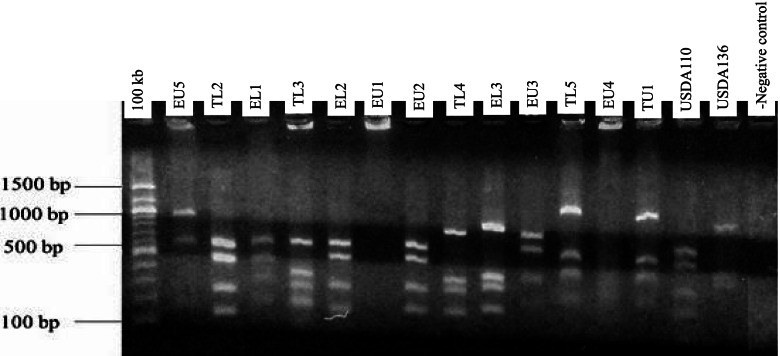
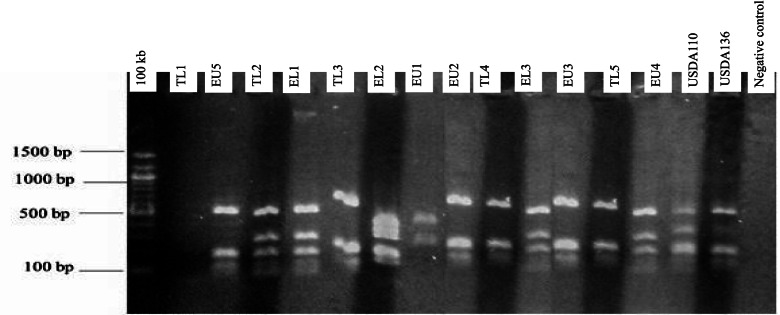
Global food supply is highly dependent on field crop production that is currently severely threatened by changing climate, poor soil quality, abiotic, and biotic stresses. For instance, one of the major challenges to sustainable crop production in most developing countries is limited nitrogen in the soil. Symbiotic nitrogen fixation of legumes such as soybean (Glycine max (L.) Merril) with rhizobia plays a crucial role in supplying nitrogen sufficient to maintain good crop productivity. Characterization of indigenous bradyrhizobia is a prerequisite in the selection and development of effective bioinoculants. In view of this, bradyrhizobia were isolated from soybean nodules in four agro-climatic zones of eastern Kenya (Embu Upper Midland Zone, Embu Lower Midland Zone, Tharaka Upper Midland Zone, and Tharaka Lower Midland Zone) using two soybean varieties (SB8 and SB126). The isolates were characterized using biochemical, morphological, and genotypic approaches. DNA fingerprinting was carried out using 16S rRNA gene and restricted by enzymes HaeIII, Msp1, and EcoRI. RESULTS: Thirty-eight (38) bradyrhizobia isolates obtained from the trapping experiments were placed into nine groups based on their morphological and biochemical characteristics. Most (77%) of the isolates had characteristics of fast-grower bradyrhizobia while 23% were slow-growers. Restriction digest revealed significant (p < 0.015) variation within populations and not among the agro-climatic zones based on analysis of molecular variance. Principal coordinate analysis demonstrated sympatric speciation of indigenous bradyrhizobia isolates. Embu Upper Midland Zone bradyrhizobia isolates had the highest polymorphic loci (80%) and highest genetic diversity estimates (H' = 0.419) compared to other agro-climatic zones.
The high diversity of bradyrhizobia isolates depicts a valuable genetic resource for selecting more effective and competitive strains to improve promiscuous soybean production at a low cost through biological nitrogen fixation.
全球粮食供应高度依赖大田作物生产,而目前这种生产正受到气候变化、土壤质量差、非生物和生物胁迫的严重威胁。例如,大多数发展中国家可持续作物生产面临的主要挑战之一是土壤中氮含量有限。大豆(Glycine max (L.) Merril)等豆科植物与根瘤菌的共生固氮在提供足以维持良好作物生产力的氮方面起着关键作用。鉴定本地慢生根瘤菌是选择和开发有效生物肥料的前提条件。有鉴于此,使用两个大豆品种(SB8和SB126),从肯尼亚东部四个农业气候区(恩布上中部地区、恩布下中部地区、塔拉卡上中部地区和塔拉卡下中部地区)的大豆根瘤中分离出慢生根瘤菌。采用生化、形态和基因型方法对分离菌株进行了鉴定。使用16S rRNA基因进行DNA指纹图谱分析,并用HaeIII、Msp1和EcoRI酶进行酶切。
根据形态和生化特征,从诱捕实验中获得的38株慢生根瘤菌分离株被分为9组。大多数(77%)分离株具有快生型慢生根瘤菌的特征,而23%为慢生型。基于分子方差分析,酶切显示群体内部存在显著(p < 0.015)差异,而不同农业气候区之间无显著差异。主坐标分析表明本地慢生根瘤菌分离株存在同域物种形成现象。与其他农业气候区相比,恩布上中部地区的慢生根瘤菌分离株具有最高的多态位点(80%)和最高的遗传多样性估计值(H' = 0.419)。
慢生根瘤菌分离株的高度多样性描绘了一种宝贵的遗传资源,可用于选择更有效和更具竞争力的菌株,通过生物固氮以低成本提高杂交大豆产量。