Center for Experimental and Molecular Medicine (CEMM), Amsterdam University Medical Centers - Location AMC, University of Amsterdam, Amsterdam, The Netherlands.
Department of Anesthesia and Intensive Care, Hôpital Lariboisière, INSERM U942S MASCOT, Université de Paris, Paris, France.
Thromb Haemost. 2022 Oct;122(10):1683-1692. doi: 10.1055/s-0042-1749438. Epub 2022 Jul 18.
Activated platelets have been implicated in the proinflammatory and prothrombotic phenotype of coronavirus disease 2019 (COVID-19). While it is increasingly recognized that lipids have important structural and signaling roles in platelets, the lipidomic landscape of platelets during infection has remained unexplored.
To investigate the platelet lipidome of patients hospitalized for COVID-19.
We performed untargeted lipidomics in platelets of 25 patients hospitalized for COVID-19 and 23 noninfectious controls with similar age and sex characteristics, and with comparable comorbidities.
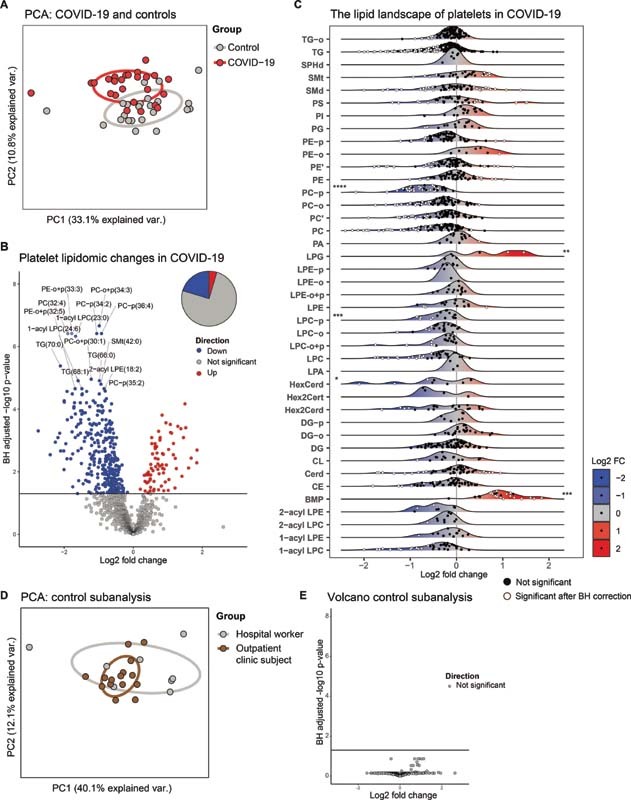
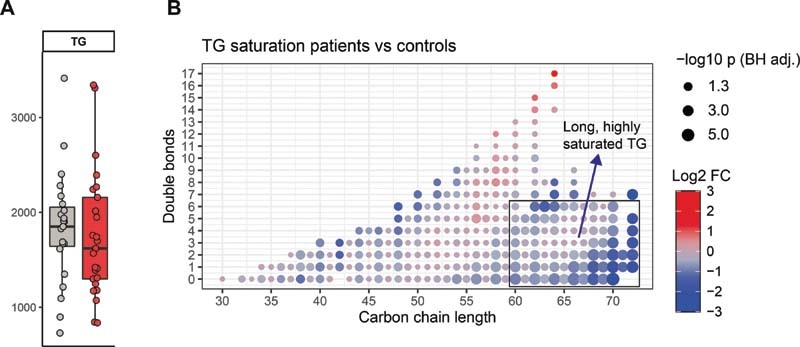
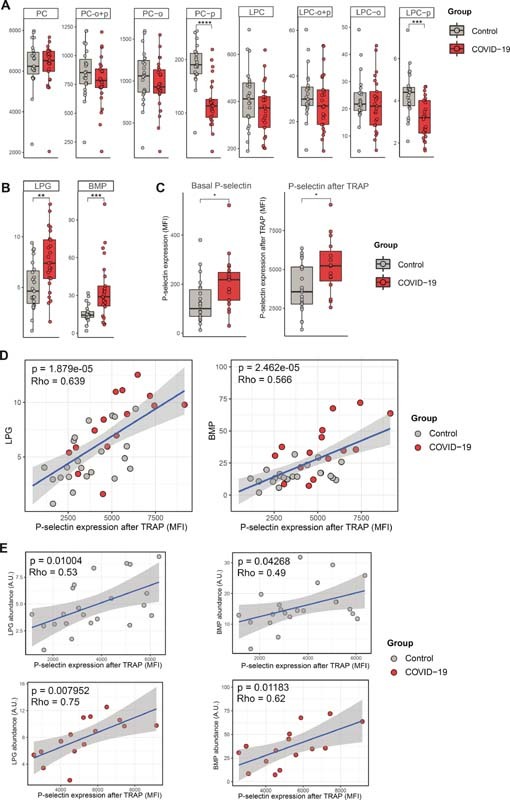
Twenty-five percent of the 1,650 annotated lipids were significantly different between the groups. The significantly altered part of the platelet lipidome mostly comprised lipids that were less abundant in patients with COVID-19 (20.4% down, 4.6% up, 75% unchanged). Platelets from COVID-19 patients showed decreased levels of membrane plasmalogens, and a distinct decrease of long-chain, unsaturated triacylglycerols. Conversely, platelets from patients with COVID-19 displayed class-wide higher abundances of bis(monoacylglycero)phosphate and its biosynthetic precursor lysophosphatidylglycerol. Levels of these classes positively correlated with ex vivo platelet reactivity-as measured by P-selectin expression after PAR1 activation-irrespective of disease state.
Taken together, this investigation provides the first exploration of the profound impact of infection on the human platelet lipidome, and reveals associations between the lipid composition of platelets and their reactivity. These results warrant further lipidomic research in other infections and disease states involving platelet pathophysiology.
已发现活化血小板参与 2019 年冠状病毒病(COVID-19)的促炎和促血栓形成表型。虽然人们越来越认识到脂质在血小板中具有重要的结构和信号作用,但感染期间血小板的脂质组学图谱仍未得到探索。
研究因 COVID-19 住院患者的血小板脂质组。
我们对 25 例因 COVID-19 住院的患者和 23 例具有相似年龄和性别特征且具有可比性的非传染性对照者的血小板进行了非靶向脂质组学分析。
在 1650 种注释脂质中,有 25%在两组之间存在显著差异。血小板脂质组中明显改变的部分主要由在 COVID-19 患者中含量较低的脂质组成(20.4%下调,4.6%上调,75%不变)。COVID-19 患者的血小板显示出膜质体减少,长链不饱和三酰甘油明显减少。相反,COVID-19 患者的血小板显示出双(单酰甘油)磷酸酯及其生物合成前体溶血磷脂酰甘油的类广泛更高丰度。这些类别的水平与体外血小板反应性呈正相关-通过 PAR1 激活后 P-选择素表达来衡量-与疾病状态无关。
总之,这项研究首次探索了感染对人血小板脂质组的深远影响,并揭示了血小板脂质组成与其反应性之间的关联。这些结果证明在涉及血小板病理生理学的其他感染和疾病状态中需要进一步进行脂质组学研究。