Departments of Urology and Obstetrics and Gynecology, Atrium Health Wake Forest Baptist, and Biostatistics and Data Science and Gerontology and Geriatric Medicine, Wake Forest School of Medicine, Winston-Salem, North Carolina; the School of Rehabilitation, University of Montréal, Montréal, Québec, Canada; and the UConn Center on Aging, University of Connecticut School of Medicine, Farmington, Connecticut.
Obstet Gynecol. 2022 Aug 1;140(2):243-251. doi: 10.1097/AOG.0000000000004852. Epub 2022 Jul 6.
To examine the role of physical function impairments on the change in urinary incontinence (UI) symptoms after pelvic floor muscle training in older women.
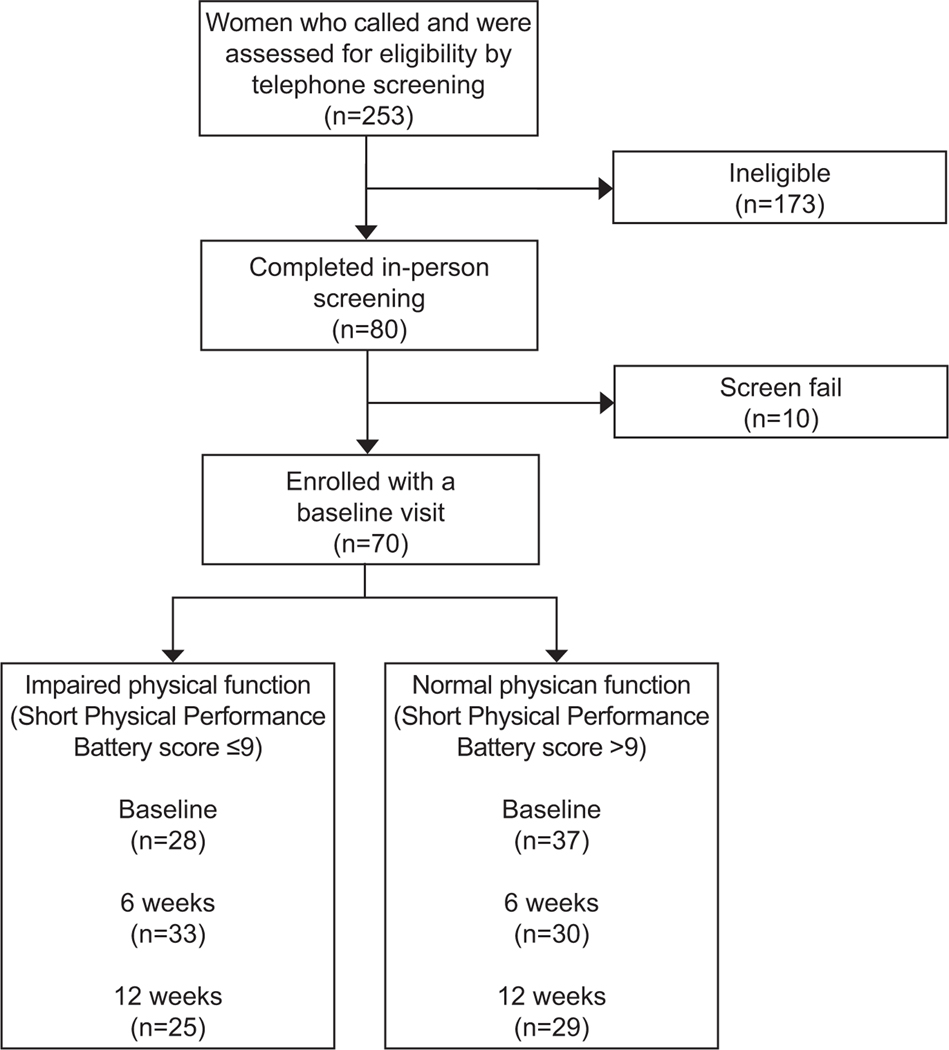
This is a prospective cohort study of 70 community-dwelling participants, older than age 70 years, with at least moderate incontinence symptoms. A comprehensive pelvic floor and physical function assessment was done at baseline. Individualized pelvic floor muscle training prescriptions with behavioral management strategies to reduce incontinence episodes were provided for 12 weeks. Baseline physical function was determined using the SPPB (Short Physical Performance Battery). A total score of 9 or lower out of 12 indicated impaired physical function, and scores higher than 9 indicated normal physical function. A 3-day bladder diary established daily incontinence episodes. The between-group difference in the change in number of UI episodes, from baseline to 6 weeks, was our primary outcome. Descriptive analyses compared important demographic and clinical characteristics. Longitudinal mixed model linear regression analyses determined the change in incontinence episodes and estimates of improvement based on the presence of impaired physical function and adjusted for age, race, and body mass index (BMI).
Participants' mean±SD age was 76.9±5.4 years, and 15.7% identified as African American, with no significant differences in age or race between groups. Participants with impaired physical function had higher mean±SD BMI (33.6±14.5 vs 27.4±5.8; P=.03) and more baseline incontinence episodes (4.5±2.9 vs 2.7±2.1 episodes per day; P=.005) than in women without functional impairment. After 6 weeks of pelvic floor exercises, the change in number of incontinence episodes per day was not different between participants with physical functional impairment compared with women with normal physical function (mean [95% CI] -1.2 [-2.0 to -0.5] vs -0.4 [-1.1 to 0.3], P=.31). Overall, after 12 weeks of pelvic floor muscle training, complete satisfaction with incontinence symptom improvement was low for both groups (41.8% with physical function impairments vs 44.8% with normal physical function; P=.90).
Behavioral therapy including pelvic floor muscle training may not significantly decrease UI symptoms to a degree that is satisfactory in women who are older than 70 years and are seeking treatment for UI, regardless of the presence of physical function impairments.
ClinicalTrials.gov, NCT03057834.
探讨老年女性盆底肌训练后尿失禁(UI)症状变化与躯体功能障碍的关系。
这是一项针对 70 名年龄在 70 岁以上、至少有中度失禁症状的社区居民的前瞻性队列研究。在基线时进行全面的盆底和躯体功能评估。针对每位参与者制定个体化的盆底肌训练方案,并辅以行为管理策略以减少失禁次数。12 周的训练结束后,采用简短躯体表现测试(SPPB)评估基线躯体功能。总分 9 分或以下表示躯体功能障碍,总分 9 分以上表示躯体功能正常。通过 3 天的膀胱日记记录每日失禁次数。主要结局为 6 周时 UI 发作次数较基线的变化。描述性分析比较了重要的人口统计学和临床特征。采用纵向混合模型线性回归分析,根据躯体功能障碍的存在情况,调整年龄、种族和体重指数(BMI)后,评估失禁次数的变化和改善程度。
参与者的平均年龄为 76.9±5.4 岁,15.7%为非裔美国人,两组之间的年龄和种族无显著差异。躯体功能障碍组的平均 BMI 较高(33.6±14.5 比 27.4±5.8;P=.03),基线失禁次数较多(4.5±2.9 比 2.7±2.1 次/天;P=.005)。与躯体功能正常的女性相比,盆底肌锻炼 6 周后,躯体功能障碍组失禁次数的变化无差异(平均[95%CI]-1.2[-2.0 至-0.5]比-0.4[-1.1 至 0.3],P=.31)。总的来说,12 周的盆底肌训练后,两组对失禁症状改善的完全满意度均较低(躯体功能障碍组为 41.8%,躯体功能正常组为 44.8%;P=.90)。
对于 70 岁以上且正在接受 UI 治疗的女性,无论是否存在躯体功能障碍,行为治疗(包括盆底肌训练)可能都无法显著降低 UI 症状至满意程度。
ClinicalTrials.gov,NCT03057834。