Department of Emergency Medicine, The Second Xiangya Hospital, Central South University, Changsha, China.
Trauma Center of Hunan Province, Changsha, China.
Sci Rep. 2022 Jul 19;12(1):12289. doi: 10.1038/s41598-022-16704-3.
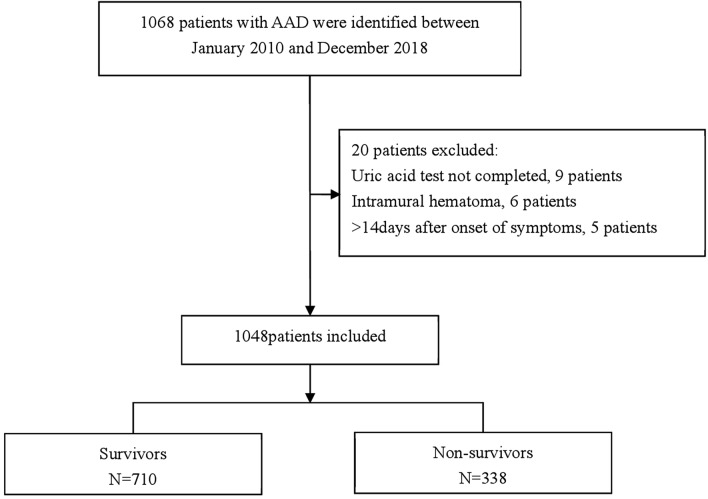
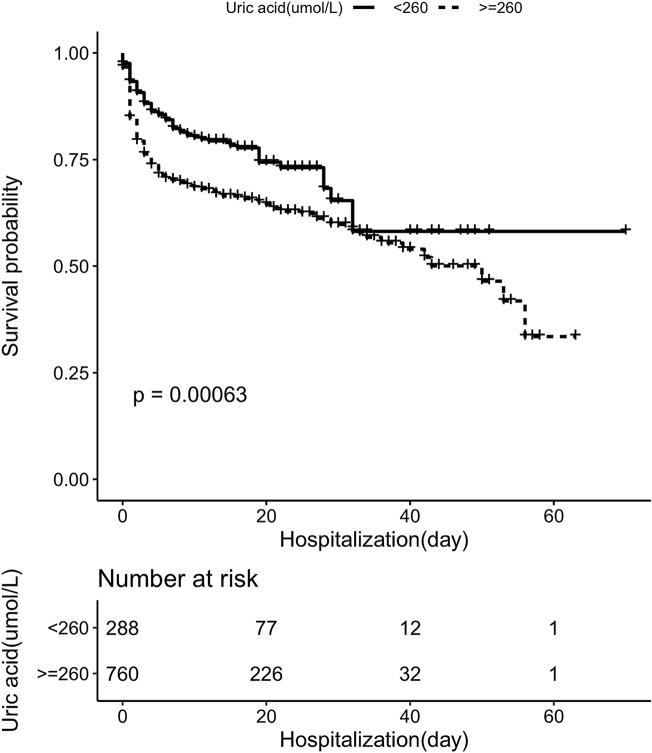
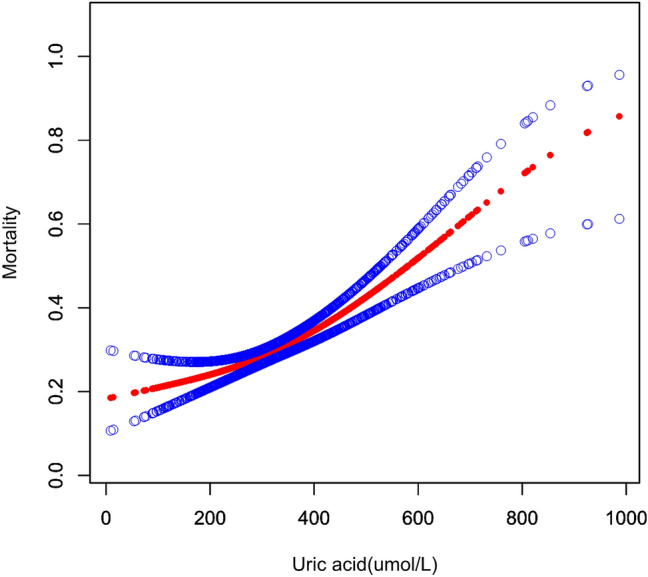
There is currently insufficient evidence of correlation between on-admission serum uric acid and in-hospital mortality of patients with acute type A aortic dissection. Thus, this study analysed the relation between serum uric acid and in-hospital deaths in patients with acute type A aortic dissection. A total of 1048 patients with acute type A aortic dissection participated in this study between January 2010 and December 2018. The independent variable was on-admission serum uric acid, whilst the dependent variable was in-hospital deaths. The covariates of the study included patient age, gender, body mass index, smoking status, hypertension, diabetes, Marfan syndrome, bicuspid aortic valve, chronic renal insufficiency, stroke, atherosclerosis, time to presentation, systolic blood pressure, diastolic blood pressure, aortic diameter, aortic regurgitation, abdominal vessel involvement, arch vessel involvement, ejection fraction value, laboratory parameters, symptom, coronary malperfusion, mesenteric malperfusion, cerebral malperfusion, hypotension/shock, cardiac tamponade and operation status. The mean age of the sample was 50.17 ± 11.47 years, with approximately 24.24% of the participants being female. After analysis, it was found that the admission serum uric acid of patients with acute type A aortic dissection was positively correlated with in-hospital death (OR = 1.04, 95% CI 1.02-1.06). Subsequently, a non-linear relationship was determined between admission serum uric acid (point 260 µmol/L) and in-hospital mortality for patients with acute type A aortic dissection. The effect sizes and confidence intervals of the right (serum uric acid > 260 µmol/L) and left (serum uric acid ≤ 260 µmol/L) aspects of the inflection point were 1.04 (1.02-1.05) and 1.00 (0.99-1.02), respectively. Furthermore, subgroup analysis indicated a stable relationship between serum uric acid and in-hospital mortality, whilst an insignificant difference was found for the interactions between different subgroups. Overall, a non-linear correlation was determined between admission serum uric acid and in-hospital mortality of patients with acute type A aortic dissection. When serum uric acid > 260 µmol/L, it showed a positive correlation with in-hospital mortality.
目前,入院时血清尿酸与急性 A 型主动脉夹层患者院内死亡率之间的相关性证据不足。因此,本研究分析了急性 A 型主动脉夹层患者血清尿酸与院内死亡的关系。2010 年 1 月至 2018 年 12 月期间,共有 1048 例急性 A 型主动脉夹层患者参与了本研究。本研究的自变量为入院时血清尿酸,因变量为院内死亡。研究的协变量包括患者年龄、性别、体重指数、吸烟状况、高血压、糖尿病、马凡综合征、二叶式主动脉瓣、慢性肾功能不全、中风、动脉粥样硬化、就诊时间、收缩压、舒张压、主动脉直径、主动脉瓣反流、腹主动脉受累、主动脉弓受累、射血分数值、实验室参数、症状、冠状动脉灌注不良、肠系膜灌注不良、脑灌注不良、低血压/休克、心脏压塞和手术状态。样本的平均年龄为 50.17±11.47 岁,约 24.24%的参与者为女性。分析后发现,急性 A 型主动脉夹层患者入院时的血清尿酸与院内死亡呈正相关(OR=1.04,95%CI 1.02-1.06)。随后,确定了急性 A 型主动脉夹层患者入院时血清尿酸(260µmol/L 点)与院内死亡率之间存在非线性关系。拐点右侧(血清尿酸>260µmol/L)和左侧(血清尿酸≤260µmol/L)的效应大小和置信区间分别为 1.04(1.02-1.05)和 1.00(0.99-1.02)。此外,亚组分析表明,血清尿酸与院内死亡率之间存在稳定的关系,而不同亚组之间的交互作用差异无统计学意义。总体而言,急性 A 型主动脉夹层患者入院时血清尿酸与院内死亡率之间存在非线性关系。当血清尿酸>260µmol/L 时,与院内死亡率呈正相关。