Blaquier Juan Bautista, Recondo Gonzalo
Thoracic Oncology Unit, Medical Oncology, Center for Medical Education and Clinical Research (CEMIC), Buenos Aires, Argentina.
Drugs Context. 2022 Jun 29;11. doi: 10.7573/dic.2022-2-2. eCollection 2022.
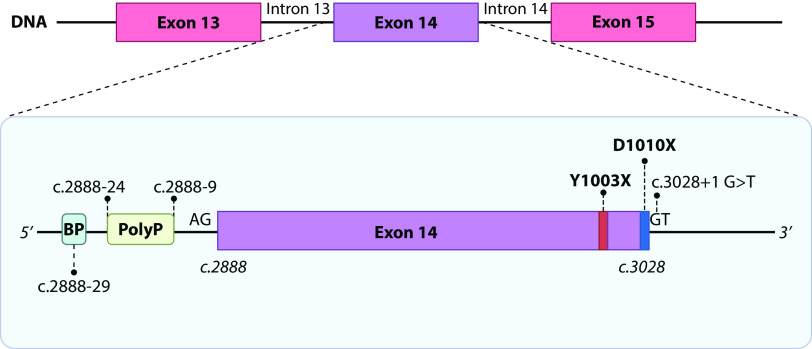
Several oncogenic mechanisms have been identified for , including amplification, fusions, mutations in the tyrosine kinase domain and exon 14 skipping alterations. exon 14 mutations are found in about 3-5% of non-small-cell lung cancers. Dysregulation of the MET receptor leads to cell proliferation and survival by activation of the PI3K-AKT-TOR and RAS-RAF-MET-ERK canonical pathways. Targeting the MET tyrosine kinase domain in the setting of exon 14 mutations using effective MET tyrosine kinase inhibitors is a current targeted therapy option for patients with metastatic lung cancer. In this Review, we focus on the management of patients with exon 14 skipping alterations by addressing the biology of the MET receptor and exon 14 skipping mutations, current treatment strategies, and sequential treatment options based on resistance mechanisms to MET inhibitors in patients with non-small-cell lung cancer.
已经确定了几种针对[相关基因]的致癌机制,包括[基因]扩增、融合、酪氨酸激酶结构域突变和外显子14跳跃改变。约3%-5%的非小细胞肺癌中存在外显子14突变。MET受体的失调通过激活PI3K-AKT-TOR和RAS-RAF-MET-ERK经典途径导致细胞增殖和存活。在存在外显子14突变的情况下,使用有效的MET酪氨酸激酶抑制剂靶向MET酪氨酸激酶结构域是转移性肺癌患者当前的靶向治疗选择。在本综述中,我们通过阐述MET受体生物学和外显子14跳跃突变、当前治疗策略以及基于非小细胞肺癌患者对MET抑制剂耐药机制的序贯治疗选择,重点关注外显子14跳跃改变患者的管理。