Department of General Internal Medicine, Shonan Kamakura General Hospital, Kamakura, Kanagawa, Japan.
Department of Emergency Medicine, Shonan Kamakura General Hospital, Kamakura, Kanagawa, Japan.
Am J Case Rep. 2022 Jul 20;23:e936275. doi: 10.12659/AJCR.936275.
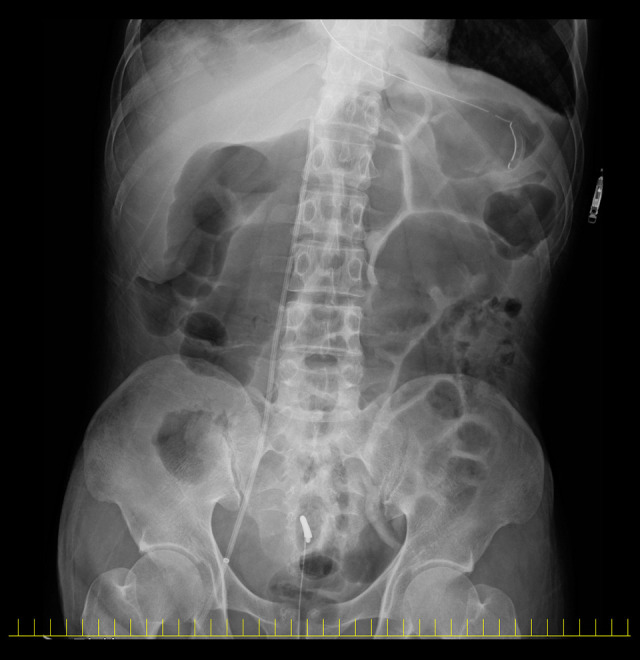
BACKGROUND Severe hypothermia has a high mortality rate and necessitates aggressive warming to save lives. One of the most effective treatments for severe hypothermia is intravascular rewarming. Intravascular recuperative warming can be delivered by inserting a catheter through the cervical or femoral veins. Catheter insertion through the femoral vein is a commonly performed procedure with fewer complications than catheter insertion through the internal jugular vein. This procedure is commonly conducted by inserting a central venous catheter through the femoral vein. When a catheter is inserted through the femoral vein, a frontal abdominal radiograph is often used to confirm the position of the catheter tip. CASE REPORT We present the case of a 58-year-old Japanese man who had severe hypothermia. Under ultrasound guidance, a catheter was inserted through the femoral vein into the inferior vena cava for active rewarming. A frontal abdominal radiograph showed that a catheter tip appeared to be in the inferior vena cava. However, a subsequent computed tomography scan revealed that the catheter tip had been misplaced into the right ascending lumbar vein. CONCLUSIONS Catheters may stray into the right ascending lumbar vein if they are placed through the right femoral vein. Frontal abdominal radiographs may be insufficient to confirm catheter placement.
严重低体温的死亡率很高,需要积极升温以挽救生命。治疗严重低体温最有效的方法之一是血管内复温。血管内复温可以通过经颈静脉或股静脉插入导管来实现。经股静脉插入导管是一种常见的操作,并发症比经颈内静脉插入导管少。该操作通常通过经股静脉插入中心静脉导管来进行。当通过股静脉插入导管时,通常使用正位腹部 X 光片来确认导管尖端的位置。
我们报告了一例 58 岁的日本男性严重低体温的病例。在超声引导下,经股静脉将导管插入下腔静脉进行主动复温。正位腹部 X 光片显示导管尖端似乎在下腔静脉内。然而,随后的 CT 扫描显示导管尖端已错位至右升腰静脉。
如果导管通过右股静脉放置,可能会误入右升腰静脉。正位腹部 X 光片可能不足以确认导管位置。