Hung Man, Lipsky Martin S, Phuatrakoon Teerarat N, Nguyen Mindy, Licari Frank W, Unni Elizabeth J
College of Dental Medicine, Roseman University of Health Sciences, South Jordan, UT, United States.
College of Dental Medicine, Roseman University of Health Sciences, Henderson, NV, United States.
Interact J Med Res. 2022 Jul 21;11(2):e39955. doi: 10.2196/39955.
COVID-19 spreads via aerosol droplets. The dental profession is at high risk of contracting the virus since their work includes treatment procedures that produce aerosols. Teledentistry offers an opportunity to mitigate the risk to dental personnel by allowing dentists to provide care without direct patient contact.
The purpose of this scoping review was to examine the implementation, challenges, strategies, and innovations related to teledentistry during the COVID-19 pandemic lockdown.
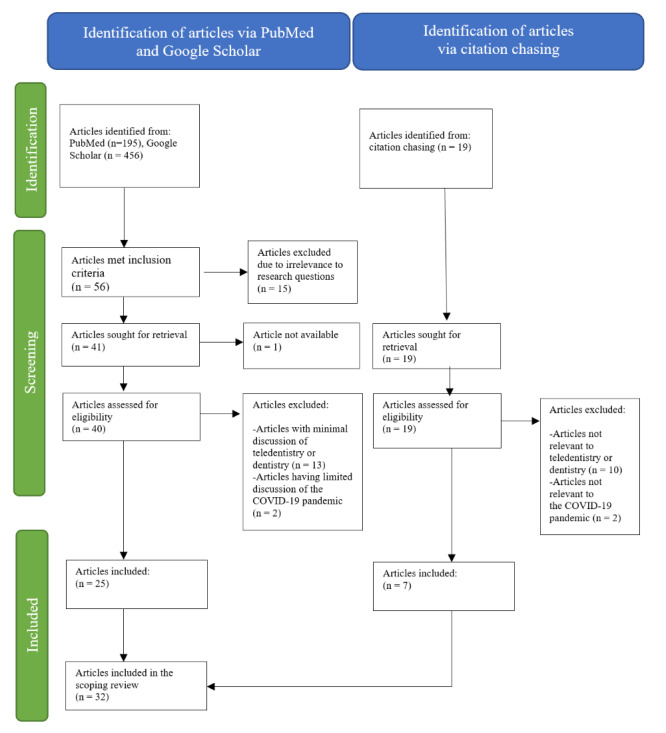
This scoping review evaluated teledentistry use during the pandemic by searching for articles in PubMed and Google Scholar using the search terms teledentistry, tele-dentistry, covid-19, coronavirus, telehealth, telemedicine, and dentistry. Inclusion criteria consisted of articles published in English from March 1, 2020, to April 1, 2022, that were relevant to dentistry and its specialties, and that included some discussion of teledentistry and COVID-19. Specifically, the review sought to explore teledentistry implementation, challenges, strategies to overcome challenges, and innovative ideas that emerged during the pandemic. It followed the 2020 Preferred Reporting Items for Systematic reviews and Meta-Analyses for Scoping Reviews (PRISMA-ScR). This approach is organized into 5 distinct steps: formulating a defined question, using the question to develop inclusion criteria to identify relevant studies, an approach to appraise the studies, summarizing the evidence using an explicit methodology, and interpreting the findings of the review.
A total of 32 articles was included in this scoping review and summarized by article type, methodology and population, and key points about the aims; 9 articles were narrative review articles, 10 were opinion pieces, 4 were descriptive studies, 3 were surveys, 2 were integrative literature reviews, and there was 1 each of the following: observational study, systematic review, case report, and practice brief. Teledentistry was used both synchronously and asynchronously for virtual consultations, often employing commercial applications such as WhatsApp, Skype, and Zoom. Dental professionals most commonly used teledentistry for triage, to reduce in-person visits, and for scheduling and providing consultations remotely. Identified challenges included patient and clinician acceptance of teledentistry, having adequate infrastructure, reimbursement, and security concerns. Strategies to address these concerns included clinician and patient training and utilizing Health Insurance Portability and Accountability Act-compliant applications. Benefits from teledentistry included providing care for patients during the pandemic and extending care to areas lacking access to dental care.
Pandemic lockdowns led to new teledentistry implementations, most commonly for triage but also for follow-up and nonprocedural care. Teledentistry reduced in-person visits and improved access to remote areas. Challenges such as technology infrastructure, provider skill level, billing issues, and privacy concerns remain.
新型冠状病毒肺炎(COVID-19)通过气溶胶飞沫传播。牙科行业感染该病毒的风险很高,因为他们的工作包括会产生气溶胶的治疗程序。远程牙科提供了一个机会,通过允许牙医在不直接接触患者的情况下提供护理,来降低牙科人员面临的风险。
本范围综述的目的是研究在COVID-19大流行封锁期间与远程牙科相关的实施情况、挑战、策略和创新。
本范围综述通过在PubMed和谷歌学术上使用搜索词“远程牙科”“远程口腔医学”“COVID-19”“冠状病毒”“远程医疗”“远程医学”和“牙科”来搜索文章,评估大流行期间远程牙科的使用情况。纳入标准包括2020年3月1日至2022年4月1日以英文发表的与牙科及其专业相关的文章,并且包括一些关于远程牙科和COVID-19的讨论。具体而言,该综述旨在探讨远程牙科的实施情况、挑战、克服挑战的策略以及在大流行期间出现的创新想法。它遵循2020年系统评价和Meta分析的范围综述优先报告项目(PRISMA-ScR)。这种方法分为5个不同步骤:提出明确的问题,使用该问题制定纳入标准以识别相关研究,评估研究的方法,使用明确的方法总结证据,以及解释综述的结果。
本范围综述共纳入32篇文章,并按文章类型、方法和人群以及关于目的的要点进行了总结;9篇为叙述性综述文章,10篇为观点文章,4篇为描述性研究,3篇为调查,2篇为综合文献综述,以下各有1篇:观察性研究、系统评价、病例报告和实践简报。远程牙科被同步和异步用于虚拟咨询,通常使用WhatsApp、Skype和Zoom等商业应用程序。牙科专业人员最常将远程牙科用于分诊,以减少面对面就诊,并用于远程安排和提供咨询。确定的挑战包括患者和临床医生对远程牙科的接受度、拥有足够的基础设施、报销和安全问题。解决这些问题的策略包括临床医生和患者培训以及使用符合《健康保险流通与责任法案》的应用程序。远程牙科的好处包括在大流行期间为患者提供护理,并将护理扩展到缺乏牙科护理服务的地区。
大流行封锁导致了新的远程牙科实施,最常见的是用于分诊,但也用于随访和非程序性护理。远程牙科减少了面对面就诊,并改善了偏远地区的医疗服务可及性。技术基础设施、提供者技能水平、计费问题和隐私问题等挑战仍然存在。