MMWR Morb Mortal Wkly Rep. 2022 Jul 22;71(29):940-947. doi: 10.15585/mmwr.mm7129e2.
Drug overdose deaths increased approximately 30% from 2019 to 2020 in the United States. Examining rates by demographic and social determinants of health characteristics can identify disproportionately affected populations and inform strategies to reduce drug overdose deaths.
Data from the State Unintentional Drug Overdose Reporting System (SUDORS) were used to analyze overdose death rates from 2019 to 2020 in 25 states and the District of Columbia. Rates were examined by race and ethnicity and county-level social determinants of health (e.g., income inequality and treatment provider availability).
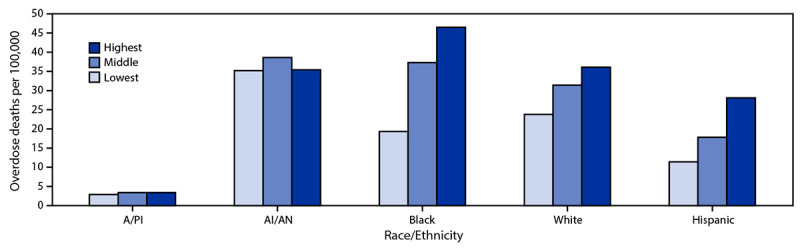
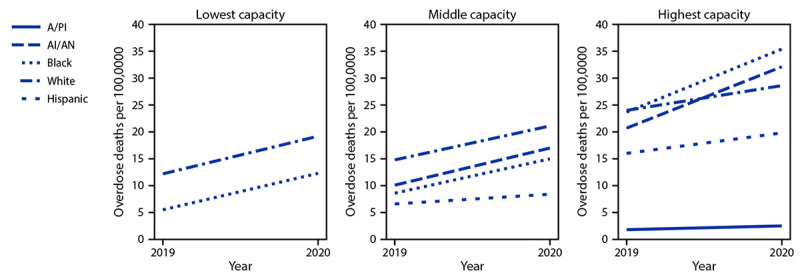
From 2019 to 2020, drug overdose death rates increased by 44% and 39% among non-Hispanic Black (Black) and non-Hispanic American Indian or Alaska Native (AI/AN) persons, respectively. Significant disparities were found across sex, age, and racial and ethnic subgroups. In particular, the rate in 2020 among Black males aged ≥65 years (52.6 per 100,000) was nearly seven times that of non-Hispanic White males aged ≥65 years (7.7). A history of substance use was frequently reported. Evidence of previous substance use treatment was lowest for Black persons (8.3%). Disparities in overdose deaths, particularly among Black persons, were larger in counties with greater income inequality. Opioid overdose rates in 2020 were higher in areas with more opioid treatment program availability compared with areas with lower opioid treatment availability, particularly among Black (34.3 versus 16.6) and AI/AN (33.4 versus 16.2) persons.
Health disparities in overdose rates continue to worsen, particularly among Black and AI/AN persons; social determinants of health, such as income inequality, exacerbate these inequities. Implementation of available, evidence-based, culturally responsive overdose prevention and response efforts that address health disparities impacting disproportionately affected populations are urgently needed.
美国 2019 年至 2020 年期间,药物过量死亡人数增加了约 30%。通过检查人口统计学和健康社会决定因素的比率,可以确定受影响程度不同的人群,并为减少药物过量死亡提供策略。
使用来自 25 个州和哥伦比亚特区的州非故意药物过量报告系统 (SUDORS) 的数据,分析了 2019 年至 2020 年期间的药物过量死亡率。通过种族和族裔以及县一级的健康社会决定因素(例如收入不平等和治疗提供者的可及性)来检查比率。
从 2019 年到 2020 年,非西班牙裔黑人(黑人)和非西班牙裔美洲印第安人或阿拉斯加原住民(AI/AN)的药物过量死亡率分别增加了 44%和 39%。在性别、年龄和种族和族裔亚群中存在显著差异。特别是,2020 年,年龄≥65 岁的黑人男性(52.6 每 10 万)的死亡率接近年龄≥65 岁的非西班牙裔白人男性(7.7)的七倍。有药物使用史的情况经常报告。黑人的先前药物使用治疗证据最低(8.3%)。在收入不平等较大的县,药物过量死亡的差异,特别是黑人,更大。与药物治疗可用性较低的地区相比,2020 年阿片类药物过量率在阿片类药物治疗方案可用性较高的地区更高,尤其是黑人(34.3 比 16.6)和 AI/AN(33.4 比 16.2)。
药物过量率的健康差异继续恶化,特别是在黑人及 AI/AN 人群中;社会决定因素,如收入不平等,加剧了这些不平等。迫切需要实施现有的、基于证据的、具有文化响应性的药物过量预防和应对措施,以解决对受影响程度不同的人群产生影响的健康差异。