Beijing Key Laboratory for Tumor Invasion and Metastasis, Department of Biochemistry and Molecular Biology, Capital Medical University, No.10 Xitoutiao, You An Men, Beijing, 100069, People's Republic of China.
Department of Oncology, Beijing Hospital of Traditional Chinese Medicine, Capital Medical University, Beijing, People's Republic of China.
Mol Cancer. 2022 Jul 22;21(1):151. doi: 10.1186/s12943-022-01622-9.
Recurrence and chemoresistance constitute the leading cause of death in colorectal cancer (CRC). Thus, it is of great significance to clarify the underlying mechanisms and identify predictors for tailoring adjuvant chemotherapy to improve the outcome of CRC.
By screening differentially expressed genes (DEGs), constructing random forest classification and ranking the importance of DEGs, we identified membrane associated guanylate kinase, WW and PDZ domain containing 3 (MAGI3) as an important gene in CRC recurrence. Immunohistochemical and western blot assays were employed to further detect MAGI3 expression in CRC tissues and cell lines. Cell counting kit-8, plate colony formation, flow cytometry, sub-cutaneous injection and azoxymethane plus dextran sulfate sodium induced mice CRC assays were employed to explore the effects of MAGI3 on proliferation, growth, cell cycle, apoptosis, xenograft formation and chemotherapy resistance of CRC. The underlying molecular mechanisms were further investigated through gene set enrichment analysis, quantitative real-time PCR, western blot, co-immunoprecipitation, ubiquitination, GST fusion protein pull-down and immunohistochemical staining assays.
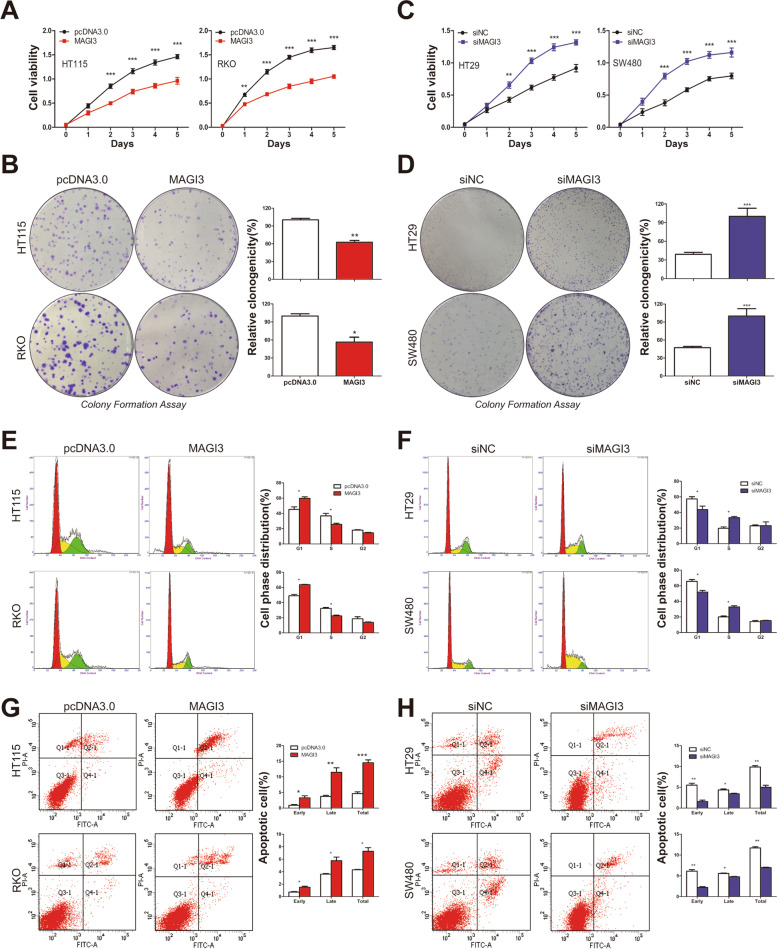
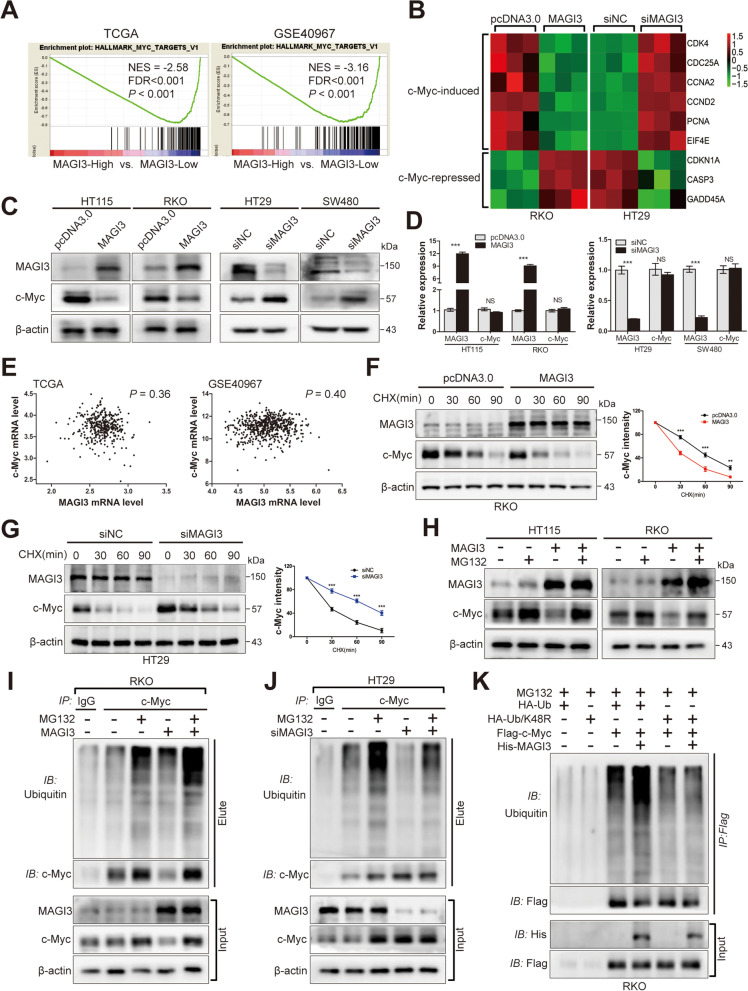
Our results showed that dysregulated low level of MAGI3 was correlated with recurrence and poor prognosis of CRC. MAGI3 was identified as a novel substrate-binding subunit of SKP1-Cullin E3 ligase to recognize c-Myc, and process c-Myc ubiquitination and degradation. Expression of MAGI3 in CRC cells inhibited cell growth, promoted apoptosis and chemosensitivity to fluoropyrimidine-based chemotherapy by suppressing activation of c-Myc in vitro and in vivo. In clinic, the stage II/III CRC patients with MAGI3-high had a significantly good recurrence-free survival (~ 80%, 5-year), and were not necessary for further adjuvant chemotherapy. The patients with MAGI3-medium had a robustly good response rate or recurrence-free survival with fluoropyrimidine-based chemotherapy, and were recommended to undergo fluoropyrimidine-based adjuvant chemotherapy.
MAGI3 is a novel E3 ubiquitin ligase by degradation of c-Myc to regulate CRC development and may act as a potential predictor of adjuvant chemotherapy for CRC patients.
复发和化疗耐药是结直肠癌(CRC)患者死亡的主要原因。因此,阐明潜在的机制并确定预测因素以调整辅助化疗以改善 CRC 患者的预后具有重要意义。
通过筛选差异表达基因(DEGs),构建随机森林分类并对 DEGs 的重要性进行排序,我们确定膜相关鸟苷酸激酶,WW 和 PDZ 结构域包含 3(MAGI3)为 CRC 复发的重要基因。免疫组织化学和 Western blot 检测用于进一步检测 CRC 组织和细胞系中 MAGI3 的表达。细胞计数试剂盒-8、平板集落形成、流式细胞术、皮下注射和氧化偶氮甲烷加葡聚糖硫酸钠诱导的小鼠 CRC 测定用于研究 MAGI3 对 CRC 增殖、生长、细胞周期、凋亡、异种移植形成和化疗耐药的影响。通过基因集富集分析、定量实时 PCR、Western blot、共免疫沉淀、泛素化、GST 融合蛋白下拉和免疫组织化学染色测定进一步研究了潜在的分子机制。
我们的结果表明,MAGI3 的失调低水平与 CRC 的复发和不良预后相关。MAGI3 被鉴定为 SKP1-Cullin E3 连接酶的新型底物结合亚基,以识别 c-Myc,并对其进行泛素化和降解。MAGI3 在 CRC 细胞中的表达通过体外和体内抑制 c-Myc 的激活,抑制细胞生长,促进凋亡并提高对氟嘧啶类化疗的敏感性。在临床上,MAGI3 高表达的 II/III 期 CRC 患者无复发生存率(~80%,5 年)显著良好,无需进一步辅助化疗。MAGI3 中表达的患者对氟嘧啶类化疗有较强的反应率或无复发生存率,建议接受氟嘧啶类辅助化疗。
MAGI3 是一种新型的 E3 泛素连接酶,通过降解 c-Myc 调节 CRC 的发生,可能是 CRC 患者辅助化疗的潜在预测因子。